Atelier – the Ultimate Dinner – Ignoring the price of course!


There’s a 2 Michelin Star Restaurant in Munich – the Dallmayr. It’s extremely small – extremely famous – and naturally – it’s very hard to get reservations. For some reason we’d thought we could sneak in at the last minute. Nope. But the very sweet Matre d’ asked if he could find another option for us – and suggested the Atelier. He even called and got us reservations.

So that’s how we ended up there – personal reference!

You’d never find it on Tripadvisor – 2 year ago someone reviewed it – in German, and gave it a 98 out of 100 – but blew it on the overall rating. Instead of a 5 – he gave it 2 – thinking Michelin stars. So the restaurant is ranked about 50th in Munich – instead of the first or second place it deserves. How do I know – after I ate there I emailed him to ask why the 2 stars!

Anyway – The restaurant is located in a tiny space (10 tables max – although all were large – at least double sized normal tables, with generous aisles and plenty of room for the serving staff). The tiny space is located in one of Munich’s don’t ask the price – you can’t afford it – upscale hotels. There were 2 other restaurants (at least) in the same hotel – the Garden which shared chefs and maitre d’ with the Atelier, although not the menu or wait staff, and rather surprisingly – a Trader Vic’s on a lower level. I haven’t seen a Trader Vic’s in at least 30 years. I didn’t get to see inside this one either!

But the layout was such that once in the Atelier – you didn’t hear or see or know anything about the other restaurants – it was a private space, set up to impress, comfort, and clearly feed you.

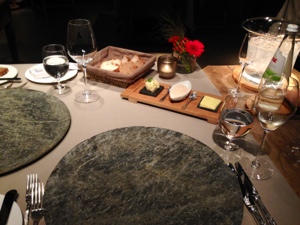
Huge round stone platters marked each place, and the salt and butter service was pink sea salt, unsalted local butter, and a house made spread.
20131014-214428.jpg

I felt very under-dressed in my blue jeans and bright blue ski sweater, but the extremely well-trained staff didn’t bat an eyelid. If I came recommended by the maitre d’ at Dallmayr – I was ok!

There are only 2 main options – a tasting menu of 5 courses, or a tasting menu of 7 courses. But our talented, knowledgeable, and very pretty head waitress assured us that the kitchen was extremely flexible – we could pick and choose as we wished.

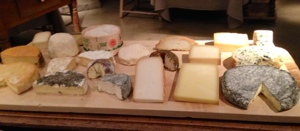
So my husband ordered the 7 course menu with wine pairings, I opted for the 5 course meal. In my opinion – I was the clear winner on this deal. My menu included unlimited selections from the cheese cart featuring raw milk cheeses from Maitre Affineur Waltmann.

Restaurants of this caliber offer additional surprise courses – delivered to the table and described as ‘gifts’ from the kitchen. At the Atelier – there were at least 4 or 5 such gifts – and the first one had 2 separate bites – both served on the same plate, I loved the mixture of crunch and soft in both the fish puree and mini ravioli. That distinctive combination of soft and crunch was a theme that niftily was repeated in most of the other offerings.

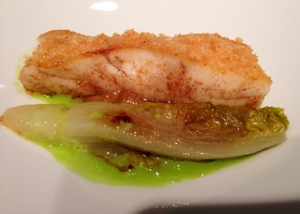
My 5 courses went from a lovely Duck breast dish with a side dim-sum of duck confit to a delightful fish slice delicately placed in a chinese lettuce and false flax oil puree. (Don’t ask me what that means – I’m just quoting from the copy of the menu they gave us when we left). What made the fish special was that they had quick fried the skin (crunchy) and properly cooked the fish (still soft and flaky – and delightfully seasoned. Yum.
20131014-214822.jpg

I didn’t much care for one of my courses – but Victor was glad to help me out. My lemon and we think lime and/or mint sorbet cleanser was delightful too.

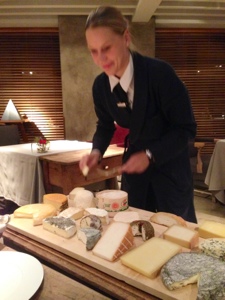
The cheese course was as perfect as it could be.
20131014-214848.jpg

The offerings ranged from cow to sheep to goat, from mild to strong to stronger. I opted for 6 different cheeses, and they were properly sliced and placed in order of complexity of flavor on a plate.
20131014-214903.jpg

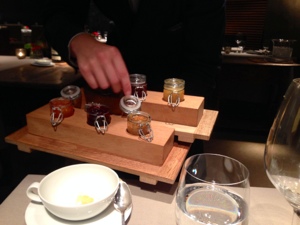
In addition there were 6 homemade jams – I asked to try all 6. And they had very lightly toasted and still soft nut bread.
20131014-214919.jpg

One of the cheese I’d picked was called Trappe Echourgnac – according to the staff – it made with a walnut liquor that we thought was exceptional. When we asked for the name – they not only provided that – they gave us a second, larger, piece to enjoy. Such an elegant way of dealing with a guest.

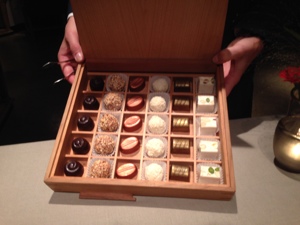
Desert – ah desert. Not just one, or two, but 3 deserts were presented. The first was a pre-desert, my main desert was a carmel butterscotch wonder with again that signature contrast of crunch and soft. In this case – the soft was home-made ice cream. After that they served a mini-desert of home-made truffle and marshmallow – followed by a box of truffles and nougat – pick however many as you want – when they presented the bill.
20131014-214932.jpg

Sigh

Meanwhile – Vic was enjoying his 7 courses – again each better than the last. His cheese course was particularly special – a goat cheese that had been bruleed on top. I didn’t taste it – but he loved it. They called it Clacbitou – and described it simply as cheese with eggplant and sesame. It was anything but simple.

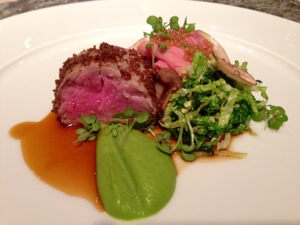
His favorite main course was the Fillet of veal and calf’s tongue with brown mushroom and Savoy cabbage. Again much more flavor and style than the description or picture could possibly could convey.
20131014-214833.jpg

Bottom line – at the Atelier you definitely get what you pay for – and if you can afford it – then it’s definitely worth the money and time! It took almost 4 hours to eat dinner – and yet we never waited for a course. There are just so many courses to enjoy, discuss, and share.

One note – Victor ordered the wine pairing – and for each course they OPENED a bottle for him, and left it available for him to enjoy as much or as little as he wanted. The same happened at the other tables – no sharing of wine. What do they do with the half-finished bottles we wondered, but didn’t ask. My guess – they become wine by the glass for the Garden restaurant next door. But if other restaurants of this type have done that in the past – I didn’t notice it. Sure made me feel special! Wine was good too.
Close up and Personal – Life in a village in Bavaria


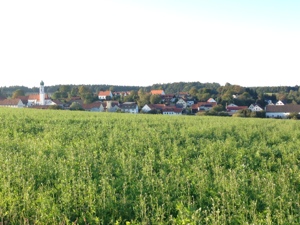
Living the nice life in Bavaria – ever wonder what it would be like to live in a village of 450 souls? Well – that’s where my German friends live – and like most dreams – the reality is always a bit unexpected.

20131015-061118.jpg

Their village is about an hour outside of Munich – but almost directly off the auto-bahn – so it’s a fairly easy drive into the city. There’s no public bus system to speak of in that area – but BMW, being the good employer that it is, provides bus service for their employees on demand. Nice, eh? So getting to and from work is not as challenging as one might imagine.

What is challenging is the lack of shopping. There are no shops of any kind in the village – if you want even a container of milk, you must drive to the next village to get it. It’s only about 5 minutes driving – but for those of us who live in the city – that’s a long way. Apparently there was a shop – but it closed. Just not enough business to be viable.

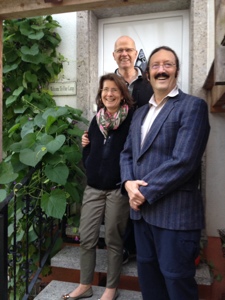
Another challenge – and this is one of those good/bad things – they know everyone. Really well. And they have a strong group of really good friends within walking distance. That’s nice – I don’t know my neighbors – so the idea of having friends so close is incredibly appealing.

20131015-061128.jpg

And they party hardy! Birthdays are a cause for huge celebrations – so large that one of the farmers actually built a room for everyone to use when they have a get-together. And they gather months prior to the party to plan the entertainment. They’ve done Can-Can numbers, written songs based on popular music – We totally cracked up on their version of ‘In the Navy’ – which had much to do with potatoes… Since it was in German, I’m sure we missed most of the jokes – but the recurring theme of potatoes was very obvious. And seriously funny.

Of course – you don’t get along with everyone – and in a village of 450 – it’s hard to avoid seeing someone who perhaps you are not that fond of. I guess avoidance is a skill you learn when you live in each others faces – all the time!

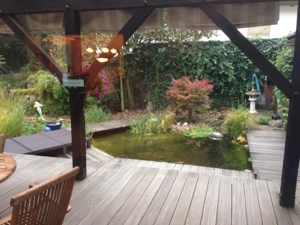
Because they live far from the city – they have a back yard. It’s small by North American standards – but fairly large by European Standards. There’s a vegetable garden, a flower garden – and a wonderful pond. Helmut has built the pond himself. It’s complete with a 4 foot high water bubbler/fall, countless frogs in season, and 20 fish. There are several sections to the pond – the 10 or so smaller fish tend to live in one part, the very large fish in the deeper portion. The pond freezes over in the winter – but Helmut assured us that the fish have no problem surviving, the water is deep enough for them to keep it from freezing completely.

20131015-061237.jpg

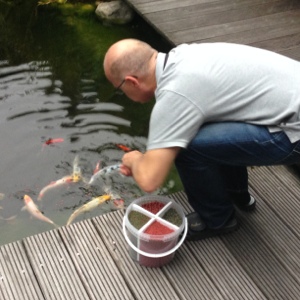
Like any pet – the fish respond to Helmut – and come when he calls – probably because he’s got the food!

20131015-061228.jpg

Their home is lovely – and we were lucky to be invited to stay with them. The home is new by European standards – built around 1970. It has 3 floors – a full basement, the main floor with a tiny kitchen, huge living and dining area, and the top floor with 3 bedrooms and another bathroom. What makes it distinctly different from what we’d expect in North America are the windows – that open at the top or at the sides depending on how you turn the handle. Another surprise – the size of the kitchen – they don’t even have a full-sized fridge – just a 1/2 size one. The full size fridge is in the basement. Because shopping requires planning – they also have a freezer in the basement. I would guess that farm houses would be larger – but this is more of city home, just located in the country.

About the food – being Eiser’s – we travel from meal to meal. And breakfast at Andrea and Helmut’s was great. And based on what we’ve been having at hotels since then – completely normal for this part of Germany. Eggs are offered, there’s at least 2 kinds of breads (it’s Octoberfest – at least one is a pretzel), jam, butter, meat slices and cheese. I visited a market and picked up fruit to add to the meals – fresh Strawberries, Figs, and pears. For dinner – if we’ve eaten in – we had wurst. Different kinds of wurst – but awesomely good. And one night we just had bread and cheese – naturally at least 4 different cheeses of course. And Beer. Lots of Beer. And Liquor. Can’t complain about the food.

Andrea is a great decorator – and unlike me – for her less is more. So each room reflects their love of Adventure travel – that is how we met them of course – with simple yet beautiful displays of all the wonderful things they have collected on their trips here and there. My favorites were the memories of Africa – an adventure we shared with them.

Because it’s a village – walking around is expected – but sidewalks are not provided. No need – there are hardly any cars. In fact, the only moving vehicle we saw in our hour or so tour was a tractor!

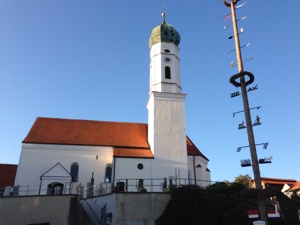
Their village has a church, a May pole, a lovely cemetery, and a huge farm – owned by one of Helmut’s very good friends. We were able to get a great tour of a working farm – by the farmer. Cool.

20131015-061157.jpg

It turns out that our friends live in the Hops growing area of Bavaria. I didn’t know this prior to our visit – but 70% or more of the hops grown to make beer in Germany is grown right near their home. We arrived just after the hops harvest had been completed. So we didn’t get to see the hops on the vines – they had been harvested, separated from the stems, and packed for shipping. But we did get to see the equipment they use today to harvest the hops – and we toured a Hops Museum.

Germany controls the stuff that goes into their beer – in a big way. A law passed in 1516 restricted what can go into German beer – just water, barley and hops! The newest research in the ‘Hops’ field is on how to naturally get the hops to have different flavors. No joke – apparently the hot new thing is raspberry Hops.

http://en.wikipedia.org/wiki/Reinheitsgebot

As you can easily imagine – having a law this strict – and given the amount of beer brewed and consumed in Germany alone – makes Hops growing a very big deal! Hops farmers do very well financially – despite the intense effort involved. And apparently the quality of the hops is key to the flavor of the beer. There is a lot of competition among the growers as to whose hops is the best. It’s a bit like growing grapes for wine – but without the cachet!

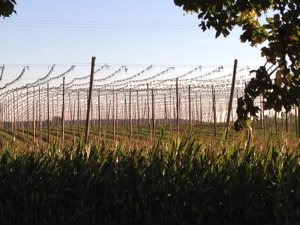
Hops are vines that grow vertically – up to about 30 feet high. So hops farms look a bit like telephone pole farms – there are poles stuck in the ground about every 10 feet – and between the poles are strung wires.

20131015-061146.jpg

In the fall, the farmers tie down wires about a foot apart – these wires are then tied to the hops plants. As the hops plants grow in the spring, the farmers manually train the plants to run up these wires. In the fall – machines cut down the wires, shake the hops seeds off the stems, grind up the stems and wires – and spit out the hop seeds into huge bags. These bags then go to the breweries to be further processed on their way to becoming beer.

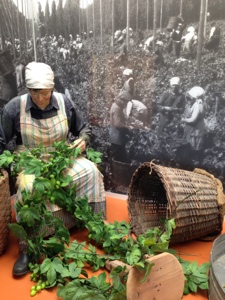
This picture – taken at the Hops Museum – shows the old-fashioned way of getting the seeds off vine. Today of course they use a huge machine.

20131015-061218.jpg

Our friends told us that most hops farms are still family owned and operated, and providing good incomes. The major concern – hops from China of course.

What made our stay with Helmut and Andrea so special – in addition to the great conversations and wonderful tours they took us on – was the chance to see how other people really live. Too often our visits to other countries are restricted to museums, hotels, and restaurants. We were lucky to spend 4 days and 4 very alcohol fueled nights enjoying a life style very different from our own. Truly a wonderful part of our trip to Germany.

A special personal thanks to Helmut and Andrea – who as you can tell – went way, way, way out of their ways to make our stay with them – and in Germany so very special. Leslie and Victor

3 Museums – One Day – Don’t do it!


Only the foolish would try for 3 world class museums in one day – well color me foolish!

One of the big reasons I stopped doing group tours was the rush rush wait kind of thing. The tour leader would have a huge long list of things that we must see that day – and his job was to carol the rest of us into going along – regardless of what we’d miss along the way.

So I wasn’t too keen to discover that we were going to attempt the same crazy stunt – but without a tour leader! In Munich – there are 4 major museums – all art museums – within about 1 minute walk of each other. Alte Pinakothek, Neue Pinakothek, the Museum of Modern Art and the Brandhorst. We’d picked the 2 Pinakotheks and the Museum of Modern art as our targets of the day – and got a good start, arriving at the front of door of the Alte Pinakothek at about 9:30. Unfortunately – it doesn’t open till 10:00. Sigh.

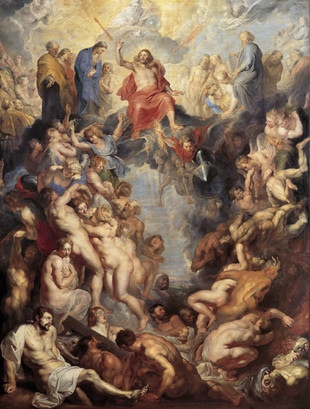
I’m not keen on sitting or standing around in the cold and wet – under any circumstances – so naturally we opted to stroll the neighborhood. Which put us back at the Alte Pinakothek at about 10:15. So much for that early start. Bathroom, ticket purchase, ear phone instructions – and we’re off. The Alte Pinakothek was built by Ludwig I around 1800 for one purpose and one purpose only – to house the most amazing painting by Rubens you’ve every seen. It’s huge – its stunning – and its in a room filled with other examples of his (Peter Paul Rubens) work. I loved that part of the museum the absolute best. There were seats, the explanations were interesting, and the art incredible. There is something so emotional about the works – you can feel the tensions of the damned and glee of the demons without even understanding the story.

20131014-000220.jpg

Also on display are a group of Rembrandt’s. The best to my mind is his rendition of the story of Jacob and Issac on the mountain. Jacob has bent back the neck of his favorite son in preparation for the sacrifice – and is literally saved by the bell. Stunningly beautiful.

There were lots of other paintings to gauk at of course – but the work of those 2 artists is reason enough to go to Munich!

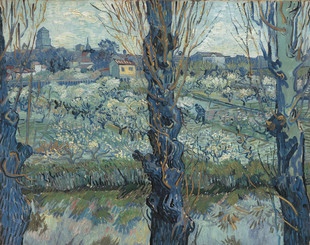
Next up – a smuggled in lunch and the Neue Pinoteck. This museum was set up by Ludwig II – and takes up where the other leaves off – starting around 1810 or so. The highlight here are the two Vincent Van Gogh paintings. The sunflower series is known world-wide, it’s iconic – and here is one of them – close enough to touch if the museum guards turn their backs. There is also one of his from the late Arles period – gay to look at quickly, emotionally depressed and isolated you feel as you identify the details – the water separating the viewer from safety and warmth, the lone peasant hunched against a cold wind only he can see. Glorious.

20131014-000457.jpg

Third – there’s the Modern Art Museum. We scored free tickets – not sure how that happened – got our ear phone sets and started to Explore. This gigantic space (are all Modern Art Museums huge?) is sub-divided into 5 sections – A special exhibit with art collected by one gentleman – Theo Wormland – consisting of mostly Max Ernst and Rene Magritte paintings, there’s the collection of the museum, there was another special exhibit of prints by Andy Warhol, there is the ‘Architecture’ Space, and final there is the Museum of Design. Each could stand on its own – as a group they are overwhelming and exhausting. Wouldn’t miss seeing it – but boy was I tried afterwards.

My clear favorites – some of the drawings – simple lines, yet so much emotion. I loved the collection called Dream Scapes. While Max Ernst’s work leaves you feeling depressed and unhappy – I have always loved the work of Magritte and Dali. What leaves you stunned is the thought that this one man would have the foresight to invest in this art when all the rest of the world thought these artists were completely crazy.

At closing time we drag ourselves out – we have dinner reservations at 7:00 (check out my review of the Atelier – it was dynamite) – but before that we must pay homage to the tomb of Josephine’s son from her first marriage and Napoleon’s Step-son – Eugene de Beauharnais. He’s buried in the Church of St. Michael – and we arrive just as services begin. Organ playing, lights on – beautiful. After the service ends, we check out the tomb. Victor is quite disappointed – they’ve dressed Eugene in a toga. Whatever for – he was in charge of the Chasseurs à Cheval of the Imperial Guard – surely a Chasseur uniform would have been better? But if it’s your tomb – you can do what you want.

We walk quietly back towards the restaurant – I’m thinking about my cold wet feet – Vic is still mad that Eugene is wearing a toga for all eternity.

12 Surprising Things about Munich


1: Escalators can go both ways – and they stop when no one is using them. This is so cool. You walk up to an escalator that isn’t working (reminds me of Concordia – for those in the know) – and when your foot hits the bottom pad – it starts. Like Magic. And it can be a foot race – winner hits the pad first! If it’s the person going down – then either you take the stairs – or wait till the escalator stops!

2. Outdoor cafes provide blankets on their chairs. Is that not the smartest thing? You can use the blanket as a seat – or drap it over your shoulders. Upscale cafes go for the fux fur look – exactly what you’d expect of course!

3. The city controls where Cafe’s can put their chairs – in a very subtle way. On the sidewalk outside of every food supply house are carefully painted, very subtle white circles. These paint splotches mark the limit of chairs and tables. You don’t have to put out any chairs – but if you do – don’t put them past that invisible line.

4. There are a lot types of BMW’s and Audi’s then we see in North America. I’m not just talking about the smaller cars – I mean options are different. The most suprising difference, and one I can’t figure out for the life of me – BMW owners can choose to not put the version of the car on the car. IE: you can’t tell a 350 from a 750 by the label. Odd, eh?

5. Bread can be beautiful. There are zillions of bakeries in Munich, so the competition must be fierce beyond belief. The solution – make yourself unique – and it helps if your bread looks pretty. Bow’s on pretzels, Gnomes in shop windows, Wedding cakes made from loaves of bread. If the imagination can think of it – the shop keepers will try it!

6. Grocery stores aren’t all the same. In Montreal, and most other cities in North America that I’ve visited, if you go into a Metro, a Piggy Wiggly, a Grand Union, a Price Chopper, or an IGA – the layout will look different – but the contents will be mostly the same. The same brands, the same sizes, the same selection – and sometimes even the same layouts. Some of the more unique Grocery Stores – Trader Joe’s say – make their mark by being unique and different – but those are few and far between. In Munich – all the grocery stores I walked into, even if the ‘brand’ was the same – had different layouts, different selections, different products. Amazing.

7. There are easily at least 15 different sizes/shapes/brands of Advent calendars. Not all stores have their Christmas goods on display – but in the ones that have gone Noel – the selection of Advent calendars simply blew me away. I don’t think I’m making out of Germany with out at least one.

8. The sidewalks are a lot cleaner than I remember. The last time I was in Germany there was dog poo all over the sidewalks – you literally couldn’t walk with your head up – it was head down and feet dodging all the time. That has totally changed. The sidewalks are completely clean. How neat is that.

9. Beware the Munich bike riders. Unlike Montreal, where bike lanes are carved out of streets – resulting in less room for cars – In Munich, the huge sidewalks have been subdivided clearly by lanes for bikes. And there are lots of bikes. And they go fast. And if you walk on the sidewalk and stray into their space – it’s not pretty. I’ve dodged the bullet several times – and Vic is getting very good at pulling me out-of-the-way of speeding bikes. The nice thing – the bike riders don’t yell at you – they might run you down – but they would be smiling while they did it!

10. The cheapest food is around the HautBanHof – that’s the main train station. Well, it might not be totally the cheapest – but the turn over is so fast – it’s clearly the freshest. Yum.

11: You have to pay to go to the bathroom. In one place – they actually had turnstiles set-up. Put in a Euro – or no pee-pee for you! At least they gave you a coupon good for .5 Euro off your next cup of coffee. Sort of feeding the system don’t you think. Even if they havent gone ‘mechanical’ – toilets almost always have a lady with her omnipresent tip plate. Often they use a coin to knock on the plate to remind you that it’s not there for food. In one toilet, there was even a conductor – she told you which stall to use, and walked in before you to wipe the seat – and hold her hand out for money.

12: Even king size beds have separate duvets – This has to be the oddest thing. You walk into a hotel room – there’s a king size bed. But on top are 2 duvets – one for him, one for her. It’s like having 2 sleeping bags on a king size air mattress. You only think you are sleeping together. But they are warm and cozy – and it’s so cold – I’ll settle for warm on cozy. In one hotel – I actually used 2 duvets!

Deutsches Museum in Munich – less than the sum of it’s parts


Don’t get me wrong – the biggest ‘Technology’ and ‘Science’ Museum in Germany is well worth visiting – it’s just that the parts are so large – it’s hard to focus.

The Deutsches Museum is all about ‘size matters’. Unlike most museums that are content with models, or electronic aids – this Museum wants the real thing. So there’s a life-size section of a Lufthansa Passenger jet showing the typical 2 – 4 – 2 seating- with the luggage containers below. There’s a real U-boat – the last of its kind, saved from destruction in 1919 by the founder of the museum, and sliced open so visitors can see the insides – from stem to stern. There are full-sized water wheels, running of course – even a full-sized sail boat used for fishing off the North Atlantic sea. At one point, you walk into the staterooms and then onto the deck of a cross Atlantic steamer – circa 1950.

It would be impossible to list all the stuff crammed into the museum – let alone see it all. But I did have one favorite part – and it’s wasn’t even on the must see sections!

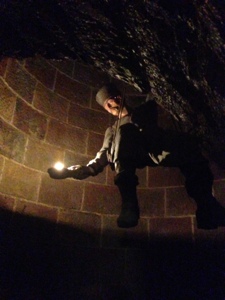
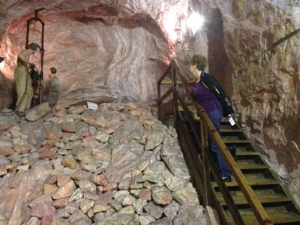
To me the highlight of the museum was the Mining section. Why – because they devoted basically 1/2 the basement to full-sized, walk thru, mines. Dark, dripping with water, dirt or wooden floored as appropriate – these ‘mines’ felt like the real thing. And since I’ve been in the real thing several times – I feel justified in saying that.

20131008-231348.jpg

To trace the changes in mining technology over the past 200 years – they have created mines worked by hand, complete with miners using lamps to claw coal from the earth. Exit that mine – and you are in a salt mine – with life-sized miners using pick-axes to cut salt ‘cubes’ from the walls. Walk a bit further, and you are in more mechanized times – horse-drawn sleds, tracks running beneath your feet, electric lights. Just a bit further – and you are face to face with gigantic mining machines with bits larger than a human. This is a truly impressive bit of display work – it would be hard to leave without a feeling of pity for anyone who would have to earn their living under the earth!

20131008-231400.jpg

Another truly fascinating section dealt with nano-technologies. This section used the very latest in museum technologies – you passed your hand over an object – and in German and English the object was explained in quite significant detail. Neat technology – but not the best at conveying information. Because you had to pick what to learn about – it was easy to by-pass important things, and get intrigued by something less critical. Basically a confusing exhibit – but very cool technology.

Another exhibit that couldn’t help but admire – but have to admit that the designers went so far – and then dropped the ball – was in the Pharmaceutical section. There you see a picture of a naked woman (this is Europe – no clothing, no problems), are forced to focus on her eye, from there to a piece of skin above her eye, and from there to a skin cell. You then turn right – and actually enter the cell – blown up 10000 times to make room for probably 30 visitors at once. So far – so cool – but then the designers ran out of ideas. Once in the cell – it’s back to basic explanation – mostly in German. Oh well. I did like that one section of floor looked like cell wall – I think the entire floor should have been made like that – it would have been far more impressive.

There’s also a model train layout – huge of course – HO scale – that is ‘animated’ 3 times a day. When animated, the cameras on the front of the trains are turned on – and you see the scene from the perspective of the engineer. A very neat effect.

Under the – scare the wits out of people heading – they have a huge exhibit on static electricity – which ends with a house bursting into flames from a lightning strike. Very noisy – but not something I haven’t seen before.

The very highly reviewed Physics section has every mechanical advantage demonstration tool I’ve ever seen – very hands on – very fun – but limited explanations. I was left thinking that kids probably press the buttons – pull the levers – and roll the balls – and then walk out – none the wiser.

Bottom line – Do go. It’s way cool to see the full-sized planes, boats, power tools, printing presses, telephone exchanges, even an old IBM 360 – the computer I learned to program on in 1966. Be sure to visit the Mining section – you’ll have to hike down stairs quite a bit – and then gradually work your way up thru the various exhibits – but it’s truly amazing. Don’t be surprised at the lack of English – some sections are well labeled, others have nary a word of English. And Don’t expect an audio guide. You will be disappointed. But I’d rate the Mining section alone a must see in Munich. I’ve never seen anything better anywhere – and that includes really coal and silver mines!

All the Beer you can drink – and delicious food – I love Munich!


I’ve been short on talking about restaurants – partly because we spent the first 4 days with friends – mostly eating at their house. Our meals with them were at the Octoberfest (delicious – with tons of beer), or quick snacks here and there.

Now that we’re on our own in Munich, we’ve been able to pick and choose our own places to eat – and tonight was our first out on the town.

We started with dessert. There’s an amazing food shop located right behind the DOM in Munich – called Dallmayr, and we wandered in yesterday. The options are completely stunning – magnificent looking hor d’ourves, chocolate truffles, a massive cheese counter with literally hundreds of options, a cold-cut section that was even larger, plus 3 ‘eating’ establishments. The first is a 2-Star Restaurant – open only for dinner – and unavailable for reservations on the 2 nights we were in Munich, a Bistro/Cafe where we enjoyed wonderful coffee and an Apple Strudel to write home about, and a seafood bar featuring fresh oysters. Dessert was wonderful – probably the best Strudel I’ve ever had. And I had to share it. Oh well.

We were in the Cafe because we were hoping to score a meal at the restaurant – but no such luck. Booked solid, so sorry. However the kind Matre d’ offered to find us somewhere else to eat – and got us reservations at one of his favorite restaurants for tomorrow night. We’ll see how that goes.

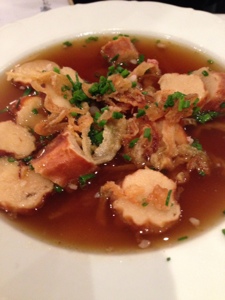
Left to our own devices, we went back to a place we’d past early in the day – Paulaner Im Tal. That means Paulander (it’s a brand of beer here in Munich) on Tal (one of the major streets leading to the Dom. Your basic Bavarian meal was on offer – schnitzels – both pork and veal, a pretzel soup (beef soup broth, sliced pretzel pieces), and a variety of other ‘low calorie’ options.

20131008-230327.jpg

I opted for the Weiner Wurst (German hot dogs) served on a fabulous hot potato salad made with super thin cucumber slices. It was yum. Victor had a Jager Schnitzel – not a deep-fried thing at all – it was a thin slice of pork topped with cheese and mushrooms and then baked under a broiler. Surprisingly good actually. We both had beer (when in Munich – do like the locals) – and it was naturally good.

Definitely a place I’d recommend to my friends – very typical, not very touristy, but able to deal with English-speaking strangers. And a lot bigger than it looks from the door. On my way to the bathroom – I must have gone thru 4 large rooms, and filled with Germans enjoying a meal before heading home.

Life Styles of the Rich and Famous – the Princess of Thurn and Taxis for example


Regensburg, Germany is a relatively small – but historically important walled city in Germany. The old town dates back to the stone age – and for quite some time – it served as the capital of Bavaria. The ecclesiastical part of Charlemagne’s General Assembly was held here in 792. So this town is no sleeper!

We visited for 2 main reasons – one to visit the ‘Schloss’ or Palace of the Prince of Thurn and Taxis, and 2nd to see the stone bridge that part of Napoleon’s army (the 3me ligne) fought hard and long to win in 1809.

Seeing the bridge was easy. It’s just there. But seeing the Palace – naturally that required some planning ahead. Regine (one of our German friends who lives in Switzerland) made reservations for us weeks ago – and it was a good thing too – getting English tours is consistently challenging here in Germany.

Why did Regensburg rate having the Prince of Thurn and Taxis build a Palace? It turns out that from 1663 until 1806 – Regensburg was the permanent seat of the Imperial Diet of the Holy Roman Empire, which of course made it very important. That wasn’t enough – what got the Palace built was the relocation of the Reichpost to Regensburg in 1748 – and as the head of the Post – the Prince of Thurn and Taxis needed a new home. However – they didn’t take possession of this Palace until 1812, when secularization laws forced the Benedictine Order to give up possession of the Cloisters of St. Emmeram, and the property came into the ownership of the family of Thurn and Taxis.

According to our tour guide – the family of Thurn and Taxis rated the inherited title of Postmaster General because the idea of postal stations was their invention. The pony express concept – horses and riders waiting at stations along the route – so the mail never starts – was invented by this family between 1200 and 1400.

Don’t believe me – check it out at Wikipedia:
http://en.wikipedia.org/wiki/Thurn_und_Taxis

With all the visitors coming and going – having a nice place to entertain was important. And so the Palace was built using part of the Monastery of St. Emmeram. It’s been maintained because the family still lives on the upper floors and is reported to be one of the wealthiest in Germany!

Their story doesn’t end badly – despite eventually losing all the lucrative postal business to the government starting in 1806 as Germany was increasingly centralized. They recovered part of the business for a while by creating a company (Thurn and Taxis Post) – but eventually the entire thing became a government monopoly.

http://en.wikipedia.org/wiki/Thurn-und-Taxis_Post

Because the Palace and the Monastery are in fact co-joined – a visit to the Palace includes a tour of the remaining portion of the Cloister – primarily the hall and the church. Outside of the Palace compound, but also part of the same complex is the Church of St. Emmeran – also worth visiting. It’s wooden painted ceiling is hundreds of years old. When we were there – they were setting up for a wedding – a combination of old and new – with music ranging from ‘You light up my Life’ to ‘Somewhere beyond the Sea’. Blue and White balloons contributed to the festive air!

If the Palace were just a museum – it would be interesting. But what make the Palace special, as I mentioned before, is that current Princess of Thurn and Taxis (Gloria) still lives in the Palace, along with her son and 2 daughters. She has her own line of jams, jellies, and wines – and has written (with maybe some help) several books on what it is like to be a member of royalty. She was quite young when she married the former prince – so it’s not a huge surprise that today she’s the regent for her son. If you check out her history – she had quite a wild youth (from a being a waitress in St. Moritz to becoming the wife of a hugely wealthy, much much older man has to have been a challenge), but when hit with inheritance taxes (by some reports – over $2 billion), she quickly settled down into a remarkable business woman. Check her out in detail at:

http://en.wikipedia.org/wiki/Gloria,_Princess_of_Thurn_and_Taxis

Until 1998 the family owned a brewery, and despite selling the ‘firm’ to the Paulaner Group, they still have their own brand – Thurn and Taxis of course.

They even have their own board game.

On the walls were several outstanding pieces of modern art – nestled along side century old tapestries, glorious inlaid tables, and magnificent ceiling paintings. My favorite painting is of one of Therese, wife of Karl Alexander, 5th Prince of Thurn and Taxis – painted in 1811 – and showing her sporting the new style of ‘undress’ or Regency Style clothing made famous by Josephine, wife of Napoleon!

20131007-223340.jpg

http://en.wikipedia.org/wiki/Duchess_Therese_of_Mecklenburg-Strelitz

My favorite part of the house? The ballroom of course. Decorated extensively in high fashion Rocco gold and gilt – and fitted with electric lights (the family still lives here – remember) – you can easily envision elegantly clad men and women dancing the evening away.

Sigh

Beer and my long lost tea pot – Color me Happy!


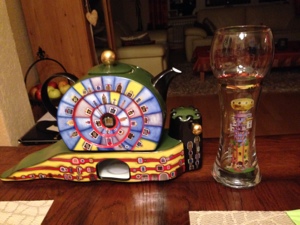
Sometimes a little imagination can go a really long way – and that’s pretty much sums up the art of Friedensreich Hundertwasser – or Fred Hundred Waters. I first saw his work in Montreal – the Museum of Fine Arts mounted an exposition – and I was totally blown away. Known for his outstanding use of colors and design – and lack of anything resembling straight lines – I promptly invested in one of his posters.

Several years later – in around 2005, I saw his tea cups – well, not really his tea cups – but tea/coffee cups that one of the high-end German porcelain producers made featuring his art. It was love at first sight. But I could only afford 6 mugs and saucers – the tea-pot that matched just seemed an impossible purchase. Naturally – I’ve mourned that decision for years – and have carefully been keeping my eyes out for it. Never saw it again.

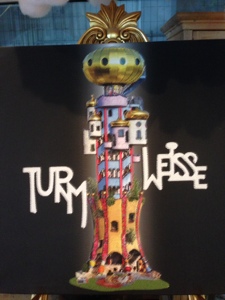
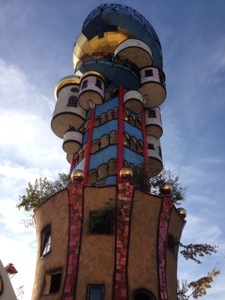
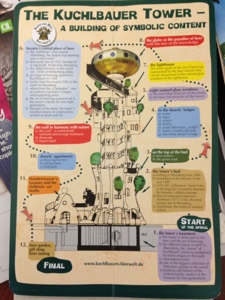
Fast forward to October 2013 – Our wonderful German hosts suggested that we visit one of the best and oldest breweries in Bavaria – Kuchlbauer. Being rather keen beer drinkers – and always fond of the lighter ‘Wheat’ beers – we promptly agreed. Now imagine our surprise when we found out that not only are they known for their beer, their copy of the last supper (full size and painted in a grotto), and their singing dwarfs (I kid you not) – they have an amazing Hundertwasser designed tower. Beer and probably my favorite artist – it’s a plan!

20131007-124107.jpg

So we drive to the brewery. Next to the parking lot is the newest work being built life-sized from his plans – I think it’s a church – but you can judge for yourself.

20131007-130652.jpg

After taking a long hard look at this newest example of art on the loose, we enter and sign up for the tour. It’s a bit pricy as these things go – but the gal selling tickets promises us it will be worth it. Things don’t start off that well – because it’s German Unification Day – there are no workers to observe – so while we can admire the equipment – it’s not really functional.

20131007-124127.jpg

Things go from ok to weird when we enter a grotto and are serenaded by dwarfs that represent the steps to beer making. Or at least I think that’s what they were singing about – it was all in German.

From there it was out into the daylight – and finally our look at the tower. It’s pretty cool.

20131007-124205.jpg

Inside the brewery there were demo versions, at least one built by Hundertwasser himself, the rest built by local artists following his designs. But for the real thing – you must go outside. Wow. What a tower. We climb the 150 steps to the top – admire the view of the totally solar-powered brewery below us – and then climb down.

20131007-125153.jpg

Now it’s time for beer tasting – and in German a taste is at least a 1/2 litre! They give us 4 bottles of beer and 4 wonderful tasting pretzels, my favorite part. We enjoy the beer, scarf down the pretzels, and then decide to buy 4 of the very unique beer glasses they are using. Victor sends me into the shop on my own – and what do I see? My tea-pot! Finally – I found it. Or perhaps better said – it found me.

20131007-130243.jpg

We have an emotional reunion, and I leave the proud owner of the most amazing tea-pot – and 4 beer glasses – gift from the owner of the brewery who was delighted to finally sell the tea-pot!

Great tour, Good beer, and my tea-pot – I’m happy!

20131008-104535.jpg

BMW Welt (World) – It’s all about the Cars!


Our friend Helmut works for BMW – so a visit to their house was definitely going to include a plant visit. What I didn’t expect to find was an organized touring schedule – replete with packaged video’s, museum quality audio projection system for the tour guide, and naturally – a up close and personal visit with your friendly robots! But BMW sees plant tours as a marketing tour – and packages them accordingly. Unlike Porsche, which wanted over $700 to do a plant tour – the BMW tours are reasonable, which explains why they were complete booked the day we went. Thank goodness for reservations.

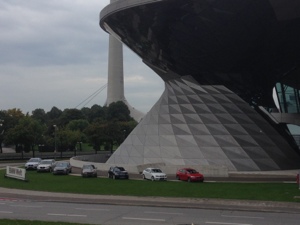
Anyway – the tour. You begin at the BMW welt – a specially designed massive building part of which is shaped like 2 stacked cones.

20131007-132333.jpg

Inside the glass doors are several huge areas devoted to various BMW product lines – there’s a section for the mini, there’s a ‘junior’ world exhibit to keep kids entertained (and informed), and on the 2nd floor – the personal car pick-up zone. If you come to Munich to take possession of your new car – you can expect only the best! A private dining room, your car presented on its own rotating platform, and then a personal ‘road’ out of the Welt and onto the streets of Munich. Nice.

For the average Soup Lady and friends – there’s a cafe offering drinks and light meals, a BMW life-style shop, a motorcycle demo which had the helmeted rider going up and down huge staircases, and the plant tour. The tour starts with a nicely produced video of the history of BMW, including an apology for using forced labor during WWII. Then a quick safety lecture (no walking outside the yellow lines, no pictures, no cell phones, no leaving the group), and we’re off.

The sprawling plant was originally built far from the city center, but the city of Munich has grown around it. There’s now a metro station right at the entrance – and across the street are the left-over buildings of the 1972 Olympics. Surrounded on all sides by housing, shops, and streets, the BMW plant blends into its surroundings, hidden in plain view.

Our tour takes us into the starting point of every BMW vehicle – the press room. Huge automated presses take flat steel and create the frames of the cars. These frames are then transported to huge rooms filled with Robots that pick up each piece, identify the type of car to be built, and then glue or bolt or spot weld the frames together.

The Munich plant only makes 3 types of BMW cars – the 3 series coupe and wagon, and the 4 series coupe. That means only 2 basic body types – but lots of options for paint color, engine, and interior. And every car is pre-sold! So each car – starting at the press room – is already pre-defined for its final look. The task is to make this happen without stopping between the steps.

Once the humanoid acting robots do the spot welding, the frames go to the body shop for their paint jobs. Robot ‘artists’ open the doors, spray on the multiple coats of paint, all while the cars are slowly moving continuously thru the plant. Attached to each frame is a transponder telling the robots what type of car, what color, what finishing needs to be done. The robots just follow the directions.

After painting, the cars spend several hours drying before the electronics, the seats, the dashboards, the chrome is carefully attached. As each car is pulled from the drying room – it joins an endless parade of cars – each being assembled. In the electronics section, there is a human ballet happening. Co-workers are assigned multi-function positions, and they rotate around the cars, standing on the conveyor belt so that they are standing still relative to the moving cars. The gas tanks are added, the padding inserted, the electronics attached. After each group of steps, a photograph is taken, and compared by both human and computer to the ‘model’. Any variation from the model is flagged – and the car removed from the assembly line for ‘repair’. Our guide explains that the system is so good that days can go by without a single car flagged for a ‘fix’.

We couldn’t tour the engine assembly room (the tour section is under renovation), but we did get to watch seats being assembled and put into moving baskets that would join up with the car assembly line just as the car for which they were intended made its appearance. Cool, eh?

It takes approximately 40 hours from rolled steel to finished car – as long as there is no problem on the line. When the cars roll off the line they are either loaded onto a train, or onto a truck for ‘local’ delivery. ‘Local’ includes the personal pick-up – but a truck is required because the cars must cross a road – and there would be too many individual cars.

We end up back where we started – having walked about 3 km around the plant.

Awesome tour – great robots – and naturally – now I really want to buy a BMW. Guess the marketing worked!

Octoberfest to the Max – Beer, Beer, and More Beer!


I don’t know about you – but my image of Octoberfest was mostly ladies in Dirndls, horse-drawn carriages, and beer barrels. Having now done a day at the Munich Octoberfest with some german friends (Helmut and Andrea), I can tell you that there is a lot more to Octoberfest than those cute pictures.

20131005-225721.jpg

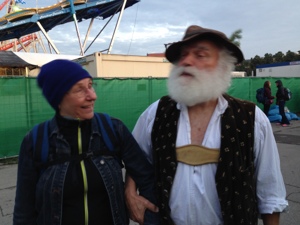
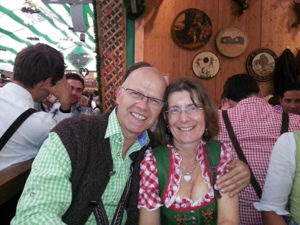
My friend above is a local who lives just minutes from the Octoberfest site – and after gleefully posing for this picture, showed us a picture of him as Santa Claus!

Like most ‘locals’, we arrived by metro. And the Munich metro, while dating from the 72 Olympics, is very nice. Comfy seats, nice and quiet both inside and on the tracks waiting for the train to arrive, and pleasantly frequent. My only negative – unlike the Metro in Seoul, you don’t know how long to the next train. Is that so very hard to do Munich? But it is still so much better than trying to find a parking place!

We could have saved big had we realized that the ‘partner’ day ticket was good for up to 5 adults. But we paid for and used a 10 ticket strip before reading the signs posted inside the metro station. Next time I travel with a group in Munich – I shall be much smarter.

But on to Octoberfest.

20131005-225924.jpg

We were visiting on a Friday – and arrived around 2:00 in the afternoon – planning on eating lunch before wandering the site. Surprise – all the 14 Giant Beer tents were already packed – with waiting lines even. Left to our own devices, Vic and I would have just patiently stood in line, but Helmut had a better idea. There’s a section of the Octoberfest area called “Oide Wisen” – which my friends translated to mean – traditional area. You had to pay 3 Euro’s each to enter – but once in side, the Traditional Beergarden there had room – and no waiting lines. Plus the rides were much much cheaper – 1 Euro each rather than the 4 to 6 Euro’s demanded by the rides in the main part of the site.

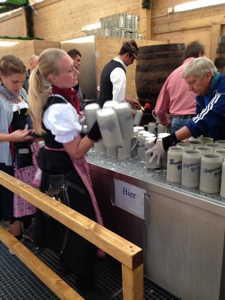
So we entered, found our selves seats outside and were quickly greeted by our dirdal clad waitress. Hint 1 – don’t try to order 1/2 a litre of beer. They laugh at you. The one and only size is a litre – and in this Beergarten, the beer was Augustiner. In our professional tasting experience, it’s the best. Light, tasty, and even better – served in a stoneware mug! My confidential source (Helmut) says that most of the Beergartens use glass – but this is the Traditional Hall. They use traditional ceramic/pottery/stoneware mugs! Heavy – but who cares.

20131005-225750.jpg

Our meal choices were meat and potato heavy – Ox Goulash, Schnitzel stuffed with wild mushrooms, BBQ Chicken – and the best course – BBQ Duck. Sides were also traditional – red coleslaw, cold potato salad (yummy), and potato noodles (large round balls that looked a lot like Matzo Balls – but were clearly Potato in origin.

While it’s hard to complain about any food served with effectively unlimited beer – I have to say my Duck was clearly outstanding. A huge portion – I think it might have been a whole duck – delightfully seasoned and cooked to perfection. Oh it was yummy.

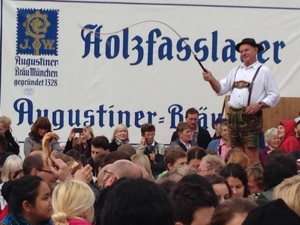
We sat, ate, drank, and chatted – and then the band arrived. At least 10 members strong – what followed can best be described as the quintessential Octoberfest production – complete with dancing couples, feet and pant slapping by the guys – and finally a whip cracking exercises that was performed on the tables. The band then invited everyone to dance – and dance we did. A modified Polka like dance – with much laughter!

20131005-225819.jpg

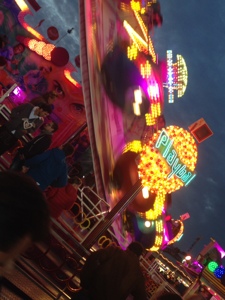
After lunch, we wandered back to the main area to admire the idiots that ride on the rides. After a lunch fueled by at least 2 litres of beer – would you want a ride that flung you upside done and then shook the money out of your pants? I think not.

>20131007-121610.jpg

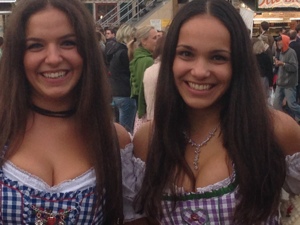
The ‘midway’ area had its share of crazy options: haunted houses, rollercoasters that looked like runaway mine trains complete with 40 foot high waterfalls, loop-the-loop coasters that resembled Olympic rings – and plenty of opportunities to try your luck at busting balloons, firing cross-bows, or hammer tossing. There were also plenty of strikingly beautiful girls.

20131007-121723.jpg

But there were things I had never seen. My top favorite – and we must have watched the action on this one for at least 20 minutes – was a wonderfully simple contraption.

The entrance was up a few steps – putting the start of the ride about 10 feet above the crowd. There was a ‘magic’ carpet that ran in an endless loop – at extremely high-speed – up a relatively steep incline. I’m guessing around 35 degrees. At the end of the ‘carpet’ was a circular staircase that led up to the top of a circular slide that you rode back down. Not much to it, right. Wrong! Riding that carpet was a challenge. There were 3 guys whose job it was to keep people from hurting themselves, and making sure that everyone made it up the ‘carpet’. For women and kids – that meant holding their hands and leading towards the top of the ride, while the rider leaned backwards. Not hard – the ladies managed to get up with little problem.

But for the guys – no help was forthcoming. Instead the guys were encouraged to leap onto the ‘carpet’ – which about 1 in 5 could do. For the remaining 4 guys – the ride up the carpet was done with legs flailing, arms whirling, and the crowd convulsed with laughter. More often than not, the guy would end up on back – feet uphill! The helpers would grab their necks, shirts, hair to make sure their heads didn’t touch the carpet – and up they went.

In a less drastic turn of events – the helpers would get on soon enough to just haul the guys up using their shirts and pants for leverage! It was a complete hoot! And from the crowds waiting to try their luck – a hopelessly addictive activity.

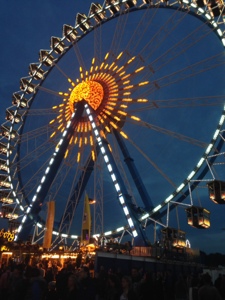
More our style was the giant slow-moving ferris wheel that offered a stunning view of the crowds, not to mention a stunning view over Munich.

20131007-121829.jpg

I was fascinated by some of the very traditional ‘rides’ in the ‘Oile Wisen’ area – including a boat like swing that was human-powered. Food shops sold all the expected traditional beer drinking snack foods – candied nuts, bratwurst, 1/2 meter long thin dogs that I never heard the name of, a spicy thick sausage made with Bison, puffed up fried dough, chocolate covered fruits – ranging from strawberries to Kiwi’s and Bananas. Given the cold, I think the ice cream vendors suffered from a lack of customers, but the vendors of heavy sweaters, rain jackets, and hats did a land office business.

I bought a peacock and ostrich feather for my hair, but besides that – our money went for food and beer – lots and lots of beer.

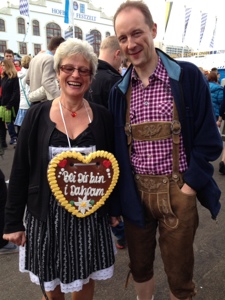
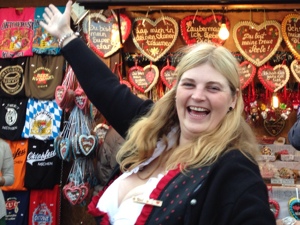
One thing I didn’t buy – but admit I was intrigued by – were the giant ginger bread cookies. Iced and decorated – and each having a unique slogan (the ones in English were things like – I love you, you are my potato pancake), these are intended to be purchased as gifts from a guy to his girl – and then proudly worn. Well, not something I’d expected to see at Octoberfest.

20131005-225909.jpg

After wandering the site, we headed back to the Traditional Hall for more music, more beer, and more pretzels. Freshly baked, huge pretzels, the only resemblance these goodies bare to the pretzels we get at home are the shape. These are soft on the side, well salted on the outside – and probably certifiable addictive. I stopped counting at 3. Given that each one is twice the size of my head – I didn’t stop too soon!

So food, fun, rides, beer, shopping, laughing people, and Cookies. Octoberfest is a local celebration that has taken on international importance, but remains resolutely local. Don’t be surprised if you are the only international face you see – this is a local party to which you are lucky to be invited.

20131005-225837.jpg

20131007-121430.jpg

20131007-121449.jpg
<br /