English in Korea – It happens!


Koreans love English words. They use them everywhere – not always correctly of course – but with delight and enthusiasm. I love it – but it does throw one off occasionally (ok – often actually).

Example 1: English on a brochure cover means nothing! – Here in Kim’s Guest House there is one labeled ‘Spring Tourist Guide’ on the outside – without a word in English on the inside! It’s completely in Korean. So why put English on the cover? Your guess is as good as mine.

Example 2: The signs – There is so much English on signs here in Korea – I sometimes forget that people may not actually speak the language. It’s quite a funny feeling. You pass a store – the slogan is in English – like Paris Baguette with its ‘Fresh and Ready’ – and no one inside speaks English at all! It happens a lot – and it is always a bit of a shock. Street signs are often translated, stores advertise ‘Sale’, you see ‘Bank’, ‘Steak and Pasta’, and ‘Korean traditional Restaurant’. But while it makes it clear what service they are offering, don’t expect more than a ‘hello’ in English – you might be pleasantly surprised – and then again – you might be reverting to sign language pretty quickly!

Check out this picture – it’s advertising a water park – English on the sign includes ‘California Water Park’ and ‘Open’ – but I’m willing to bet that no one who works there speaks English – why should they? Clearly this is for Koreans to enjoy – despite the clearly California look of the bathing beauties.

20130512-170334.jpg

Example 3: Marketing Slogans – or What exactly did you mean by that? Consider this one for the city of Gyenogju – “Meeting place – The Scent of Culture – Time to Surpass”. What do you think they were trying to say? I get meeting place – but Scent of Culture? What ever does that mean? Do you think they were hinting that the place smelled? Can’t be, right?

Or here’s another one that amuses me – In Gyenogju, they make a special Barley cake (they sometimes refer to it as ‘bread’, but it is really 2 pancakes with red bean paste spread to hold the pancakes together). What is remarkable about it in my opinion is not the cake (it’s pretty bland) – it’s the number of ‘bakeries’ – often 2 or 3 on the same block. They all have the special ovens, and use the special boxes to make these cakes. How can there possibly be enough sales to keep them all in business? We got to try (for free) cakes from 2 different bakeries – and I must admit they tasted different. Can’t say I cared for either – but they definitely didn’t taste the same. But its the marketing in English that cracks me up. On one store – the Sign cheerfully proclaimed “The Barley Way to Health”, on another it announced that here you’d find the “Rich Chewy Texture of Sticky Barley”. Yummy sounding, eh? On a third I saw “100% domestic glutinous barley” – well, that’s definitely reassuring. Do some people import the Barley? Or perhaps not all Barley is Glutinous.

But my favorite language mis-adventure happened yesterday in the Gyenogju National Museum. This is a wonderful museum that attempts to explain – in a variety of languages, just a bit of the very complex history of this remarkable city. The artifacts on display are well presented – and the audio tour quite complete, if a bit robotic sounding. But it was the free English tour in one section that was over the top. There was an older gentleman responsible for giving the tour – and he proudly explained that he was a retired English teacher. Problem? His English was literally incomprehensible. At one point we thought he was talking about growing rice, and he really meant that they had a lice problem in 800 AD – which he explained by scratching himself.

But I really shouldn’t complain. The ability of Koreans to at least attempt to communicate in ‘my’ language puts us in North America to shame. We ran into trouble at the Metro – and despite our lack of Korean – and our helper’s lack of English – we muddled through. He didn’t give up – even when it was clear that we couldn’t communicate at all. Even if it meant carrying our bags up a staircase – forcing us to sit and wait while he got help – throwing in the towel just wasn’t option – Thank goodness.

And this willingness is official – Museums here have signs in 4 languages – and not just the name of the object – the entire description is translated. Even the subway maps and signs on the metro cars use both Korean and English names. I’ve been on Metros and Buses that announced the next station in Korean and English, can’t be to help the locals. I’ve even heard cross-walk signs speak English. Bank machines and Metro card vending machines always offer an ‘English’ language button, and Audio tours in even more languages are the norm – and not just in Seoul. It’s all pretty impressive – and very tourist friendly.

So as a prospective tourist to this intriguing country – you can rest easy. You might not quite understand everything – but I can guarantee you that the Koreans will make sure you have a wonderful time. It just comes naturally to them. What a country!

20130512-170424.jpg

Fried Chicken, Fried Fish, and Ramen Noodles – Yum!


We’re in Gyeongju, along with Seoul and Jeju Island, the most visited places in South Korea. And it’s easy to see why. For a thousand years – from 71 BC to 935 AD this was the hot spot of culture, wealth, and power in Korea. The Silla Kings ruled this land – built amazing places, participated in riotous drinking parties – and converted all of South Korea to Buddhism. The resulting flowering of art, music, culture, and design was considered to be outstanding. Unfortunately – only bits and pieces survive to this day.

We cheated and joined a ‘City Bus’ tour of the highlights – primarily the Tumuli Mound Tombs, the Bulguk-sa Buddhist Temple, and to me the absolute highlight – the Seokguram temple in a grotto. Along with at least a thousand school children – all of whom want to say hello to us – we climbed steps, admired the exquisite landscapes, and felt the power of the Buddha in the grotto.

We lucked out at the Paris Baguette – and snagged a bag of 1/2 price day old goodies for lunch, but the highlight of our stay here has been the dinners.

First up was a Ramen Noodle restaurant. Now don’t go all – instant noodle on me – these were fresh noodles in a wonderful broth served with rice, Kimchi (of course), pickles (of course), and a slice of pork belly. In the soup in addition to the noodles was a soft-boiled egg, vegetables, and soy beans. It was awesome. To go with it – we had an order of potato fritters – man do these guys know fritters. These were made with mashed potatoes inside, then dredged in egg and a batter mixture and deep-fried. Oh were they good.

2nd night – we ate at student hangout – cheap prices (Just $6), and absolutely no English. Our meal consisted of two ‘Schnitzel’ Korean Style. Flattened pieces of chicken that were combined with mashed potatoes, then dredged in a yummy batter before again being deep-fried. Unlimited – help yourself – quantities of Kimchi, pickles, rice, and sauce were provided. We watched Korean Baseball – I think the good guys lost, cheered with the crowd – and headed home full.

Tonight we tried a Japanese restaurant – and ordered the best Fish and Chips (but no chips) I’ve ever ever had. We also had a pork Schnitzel – also good – but not quite as amazing as the fish. Again – more kimchi, more pickles, more rice – and lots of sauce.

I have to admit – I’m going to have trouble finding restaurants this consistently excellent at this price range in Montreal.

Signing off (and too full to move)

The Soup Lady and the Intrepid Traveller

On the Road to Gyeongju – South Korea


My favorite seat on a bus is in front – I love the 180 degree view you get – and I must admit to watching the bus driver. So imagine my surprise when our bus driver here in South Korea – while driving – washed his hands, the steering wheel, the gear shift, the side window – then put on white gloves in order to eat lunch. That’s new and different.

He also removed the fancy leather shoes he was wearing when he put our luggage on the bus, and is now wearing comfy clean white sneakers. And he has his own set of ear phones. Wonder what channel he listens to while he drives?

I’d been told that buses here are the way to travel – and I have to admit – it’s nice. There’s satelite TV (in Korean – but that is the language here), very comfy seats that recline, clean windows (Montreal – smarten up – it is possible to have clean windows on buses), and curtains.

Leaving Seoul and heading south – we started on an 8 lane highway, driving past a surprisingly beautiful city scape of skyscraper and towering sound barriers interspersed with old-fashioned residential neighborhoods followed by huge apartment complexes. I’m guessing zoning in non-existent.

Eventually the 8 lanes became 4 lanes about an hour out of Seoul – as we steadily head south toward Gyeongjue – our next destination. The highways cuts through hills, and the signs of civilization are everywhere – this is not Vermont, people.

We are passing traditional looking (but new construction) buildings, and modern factories mixed between rice paddies and farms. If you can farm it – you farm it. I even saw vegetables planted between the highway and the fences that mark private property. Everywhere peach trees are in bloom – their flowers a brilliant offset to the freshly churned but not yet planted rice paddies. There are also Ginseng farms – recognizable by the sun shades. I’m definitely going to have to try some Ginseng.

Another observation – the use of sound barriers when the highway goes past residential areas is astonishing. And they are huge – I’d guess 40 to 50 feet above the highway. Some have glass tops, many have become supports for green vines. And there is no graffiti anywhere. This was true in Seoul as well. A surprising change for us North Americans.

Arriving in Gyeongju – we check into our next guest house – a traditional style house off an alley between two motorcycles repair shops. Like most traditional homes – the front gate is plain and unassuming – but when you round the corner into the yard – you discover that there is wooden building with 4 traditional rooms – which means you sleep on the floor.

To enter the room, your shoes come off – you climb up onto a wide wooden porch, unlock your double wide doors, and then slide back rice paper screens to reveal a 10′ by 14′ room. Korean’s heat their floors – so the floor is raised off the ground. But to get to the attached bathroom or kitchen – you must step back down to ground level – about 18″. And there are ‘kitchen’ shoes and ‘bathroom’ shoes to wear in those areas. Traditionally – the floor would be wood – but this is a modern constructions – so the floor is linoleum that looks like wood. Regardless – it’s still shoes off to enter!

Our bedding is simple comforters that we unfold to sleep on – and re-fold in the morning. There is a 27″ flat screen TV – and electric lighting – two welcome modern touches.

The biggest surprise – the pillows are barley stuffed. The intrepid traveller takes both – I’m sticking with my travelling temperpedic’s thank you!

The only other piece of furniture is a small low table with folding legs. Handy for putting stuff on.

And that’s it.

We grab dinner (read about that in another post) and make ourselves comfy. It’s very quiet – and while the floor is hardly soft – I’m so tired that I think I could sleep on anything.

Signing off –

The Soup Lady and her side kick – the Intrepid Traveller.

More cool stuff about Seoul


We’ve been here almost a week – and I’m still amazed at the stuff I see/hear/do here in Seoul. This is one incredible city. In fact – I’m beginning to think that it rates right up there with Laos for coolest place to visit. There are great museums, wonderful parks, excellent shopping, and friendly people. What’s not to love?

And it’s easy on the tourist. The food is great, the place is clean – there are lots of toilets – and no you don’t have to stay in hostels – there are lots of very fancy hotels if that is what makes you happy. And the shopping is so good – we’ve run into tons of Japanese who come here just for that.

Anyway – enough of the Seoul travel agent – here’s a list of some more cool stuff about Seoul.

1. There’s music on the metro. They use different tunes at each station to announce an incoming train. It’s rather neat.

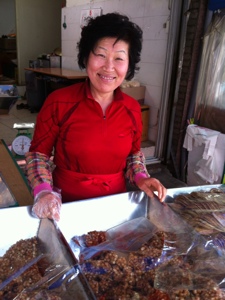
2. Shop keepers will sometimes give you free tastes – this lady was determined we try 2 each of her cookies – and even gave a bag full to take with. They were great for lunch – and we’ll drop back tomorrow to get some for the ‘road’.

3. I’ve mentioned before and I’ll mention again. It’s amazingly clean. We were even here on garbage day – so yes – there were piles of garbage on the street when we went to bed – but it was neatly stored in bags – and gone by morning. But it’s not the lack of garbage – it’s the lack of trash in general. People don’t drop stuff on the floor – I saw a lady on the metro turn around and dust off her seat when she got up! She was leaving and cleaning up. It’s a bit hard to find garbage cans – but it might be that I don’t recognize the pattern yet. Oh – and they are big on recycling – even in the hostels.

4. There are no sidewalks on lots of streets. The major streets have huge sidewalks that are beautifully paved (and they get snow here – pay attention Montreal) – but off the main drags – the streets are extremely narrow (one parked car, one moving car – max) – and there are no sidewalks.

5. Water filters are everywhere – hot and cold. It’s neat.

6. It’s not super common – but you will see severely bent over elder men and women. Jill thinks it’s the lack of dairy in the diet – and I have to say – I don’t see milk, yoghurt, or even cheese really. Plenty of protein, lots of fruit and veggies for sale – but diary is not that common. That said – the younger Koreans don’t seem to suffer from the problem – so it could also be from the restrictions during the Japanese occupation. Hard to tell, and of course – impossible to ask.

7. Cross walks are not at the corners on the major streets. Instead they are up a bit – about 5 car lengths. This gives cars room to get right up to the intersection – and I think makes it a lot safer for pedestrians. I’m impressed – Good idea there, Korea.

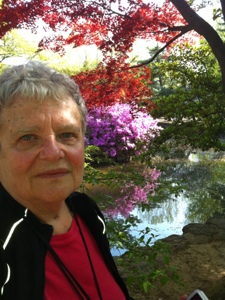
8. I knew that Cherry Blossom time would be done when we got here – but no one warned me about the Azalea Season. The flowers are simply outstanding. I’ve attached on of my favorite shots – Jill in front of a Japanese maple (red leaves) and a flowering Azalea. It doesn’t get close to capturing the size of the azalea bushes – they can be easily house size – but it does capture the wealth of color.

9. Last but not least – no one ever mentioned Rush Hour. The term ‘Moving against the Tide’ so richly describes the impact of attempting to get to a metro car just as the car has arrived at the station. The flood of humanity that leaves the cars has to be seen to be believed. There is literally nothing you can do but put your back to a wall and wait. Once the flood passes – you can continue moving forward. I’ve been in Japan and seen rush hour there – and I’m telling you. This is impressive.

So that’s it for now – after we visit the DMZ tomorrow – we head out of Seoul for the country side. I’m sure there are more surprises in store.

Signing off – The Soup Lady and her side-kick – the Intrepid Traveller.

20130506-061600.jpg

20130506-061612.jpg

20130506-061628.jpg

20130506-061643.jpg

DMZ – Scarier than you’d think…


As a tourist in South Korea – you can’t miss going to the DMZ – and apparently that’s true for Korean school kids as well! We were told that there are 800,000 visitors a year to the DMZ – about 70,000 of whom also visit the JSA (Joint Security Area). Naturally – I opted to do both, and the Intrepid traveller didn’t put up a fuss. She’s a history person – so seeing the DMZ was high on her list too.
20130508-193941.jpg

Some surprising facts – 1 out of 100 of South Korea’s population of 50 million serves in the army – and 21 months of service is mandatory for all men. Generally, men do their service between their sophomore and junior years of college – and as our informant told us – leave as kids and come back as adults. In North Korea (as explained by Grace, our lovely English South Korean Guide), the numbers are very different. 1 in 25 of North Koreans are in the military (1 million out of a population of 25 million), and men must serve for 10 years. Women serve for only 7. But they are serving between the ages of 17 and 27 – prime child rearing age – which in my book goes a long way towards explaining the smaller population in North Korea.

Back to the DMZ.

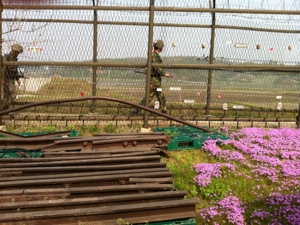
Our trip started in Seoul. After a passport check (you have your passport – good), and a clothing check (no pseudo military looks allowed – and no nose rings), we headed up Highway 1 along the Han River – the 2nd longest river in Korea. The river is considered a favorite infiltration point for North Korean Spies – and is completely fortified. Every 50 yards there is a guard station, manned and armed of course, and there are frequent patrols. There is even a system of flag turning that is used by one patrol to another to clearly keep track of who has passed most recently. Given that the river is extremely wide and that there are rice paddies between the observation posts and the river itself, survaliance must be a challenge. But they take it seriously none-the-less.

I think it’s pretty important to mention here that there are have been very few incidents since the war ended in 1953 – that’s 60 years ago! During the cold war – the North Koreans built at least 4 infiltration tunnels – we’re going to visit tunnel #3 today – and there was a debate that turned bloody over a popular tree in the 1970’s.

And this entire complex was built in the days of tank warefare. Today consider the uselessness of the idea of a DMZ – A single missle launched from any where in North Korea could take out Seoul. What’s the point of 4 km of space between 2 countries at war?

Some more facts – From 2000 to 2008 – the time of warmest relationships – the South Korean’s – hoping for reconciliation like that of East and West Germany, built a railroad station just south of the DMZ – and in North Korea built 132 factories. Employees were selected by the North Korean government, and given princely wages of over $200 a month. Primo salaries by North Korean standards. These factories were employing 50,000 North Korean workers until just 30 days ago – when they were shut down due to rising tensions.

Speaking of rising tensions – you wouldn’t even know there was a DMZ – let alone rising tension in Seoul. Even our guides – when directly asked – said it’s just hot air and posturing. Apparently despite the desperate press in our country – the South Korean’s think this is all just a lot of bad-smelling wind. (you know what word I’d be typing – right?)

Anyway – back to the fortifications. Once you get close to the DMZ – you can see some of the steps that have been taken in case North Korea does decide to attack. There are dynamited tank traps, mine fields, double rows of barbed wire, manned observation posts, and the like. On the DMZ tour – we visited 4 areas – First up was Imjingak park (part amusement park with kiddie rides, part memorial to lost Korean lives, part moving plea to Re-Unification) near the freedom bridge – where the exchanges of prisoners have happened in the past. From there we boarded different buses that were authorized (and I’m guessing – inspected) to enter the Civilian Control Zone – which is 2 km beyond the DMZ, which is 2 km from the line dividing the 2 countries. This distinction is important – only the JSA tour actually crosses into the DMZ – the more popular, and cheaper by far, DMZ tours do not cross into the DMZ – they just go pass the Civilian Control Points. I didn’t actually know this prior to making our arrangements – and it’s not clear in the marketing materials – so buyer beware.

2nd stop was the Dorasan Station – the railway station renovated in 2000-2002 and dedicated by George W. Bush. The South Koreans hope that someday this station will be the start of the trans-Siberian Railroad. If they can convince North Korea to build the missing track. Until a month ago – it was the staging area for materials coming from the factories built by South Korea in North Korea, unfortunately now both the factories and staging areas are empty. Oh well.

3rd stop was the Dora Observatory. I particularly liked the 3D map of the area with the locations shown under a huge glass window that looked out over the DMZ and into North Korea. You could clearly see the ‘fake’ village on the Northern side with its giant 170 meter (that’s 510 feet) tall flag pole, and the counter point of the populated village on the South side with its 100 meter (that 300 feet) tall flagpole. There were binoculars like you see on tall building all along the wall – and through these you could see people working in the fields in the North. You could see the buildings of the Industrial area – but of course there were no people there. According to our guide – the military can see 27 km into North Korea from this location.

Curiously – we were not allowed to take pictures. There was a yellow line about 20 feet from the edge – and if you lifted a camera beyond that line – they confiscated your sim card or film. That pretty much convinced everyone to not take pictures.

4th stop was the most interesting, and I agree with other reviewers – you don’t want to miss this. It’s the site of the Third Tunnel (discovered in 1978) – and on the left is a movie theatre and an exhibit hall. To the right is the entrance to the Third infiltration Tunnel. The movie was a professional overview of the DMZ – in English. If you wanted to listen in Korean (or any other language) you needed head phones. After the movie, there was the exhibit hall – which Grace rushed us through to be sure there would be enough time to walk the 350 meters down to the tunnel – then the 270 meters of tunnel open to the public – and then the 350 meters back up. Jill opted to stay out of the tunnel – but I gamely put on a hard hat and began the walk. The entrance to the tunnel is wide and easy walking, just highly graded. So down, down, down to the level of the tunnel I went. Not the fastest walker, it shouldn’t surprise anyone to learn that I arrived last – just after Grace finished her introduction speech. But the advantage was mine. Since I was last to arrive – I was first to enter the actual tunnel – and thus had the very best view at the end. Grace pointed out that we were finally in the DMZ – albeit underground. The tunnel starts in North Korea – goes under the demarkation line, and 3/4 of the way across the DMZ. It ends just 52 km from Seoul – and easy hour drive for a tank.

The tunnel built by the North Koreans is apparently 1.3 km long, and roughly 2 m (6 feet) wide and 2 m (6 feet) tall. But to add ventilation, the South Koreans have added pipes and bracing – so the effective height is under 5’6″ – and I’m just 5’4″ and hit my hard hat – hard – twice.

Tall guys beware – you are going to be walking bent over!

According to Grace – South Koreans are sure that there are more tunnels – but they have only found 4. In this one, the North Koreans had painted black lines – and later claimed that the tunnel was drilled to mine coal. No one believed them of course.

I exit the tunnel eventually – and walk past a group of about 50 Korean eight year olds – quietly (NOT) waiting their turn. Our timing was perfect – just imagine being trapped in a 4 foot wide tunnel with 50 screaming kids. But there’s a problem – Jill is nowhere to be seen. Grace refuses to let me look for her (guess she didn’t want 2 lost little old ladies) and she leaves to search the rest room and gift shop. I finally tell her that Jill is much more likely to be in the exhibit hall – and she has me make an announcement. “Jill Guedon – your bus is leaving” – sure enough Jill had been in the exhibit area chatting up Korean veterans that had come to the DMZ for a re-union. They observed that while there are very few US veterans of Korea still alive, there are many more Korean Veterans. This they felt was due to the much healthier diet of the Koreans.

Tour group now complete – we get back on the bus and retrace our steps to the Imjingak Park. From there, Jill and I are dropped off at a very touristy restaurant for a not great lunch of Bulgogi, and then our 2nd tour gets started. Our leader this time is Gina – and the group is much larger – around 20. But this time we are going into the DMZ – and all the way to the demarkation line in the JSA (Joint Security Area). This is the ONLY place that Civilians – or even Officials from either country can legally enter. It is the only neutral area of the entire DMZ.

We again enter the Civilian Control Zone, and proceed past the observation point to Camp Boniface. This is the UN military camp that provides soldiers to the JSA. We have to fill in forms (the UN is not responsible if we’re injured – we’re entering a military zone and know it, that kind of thing), and wait. We must be assigned a solider to guide us, and we must be led into and out of the JSA by a miliary vehicle. And the timing of these is totally up to the powers that be at Camp Boniface. Meanwhile we get to watch 2 helicopters land and ‘deplane’ a general or two, and we see the soldiers practicing with hand-held rocket launchers. Really reminds you that this is, in fact, a war zone.

Assigned our guide – we drive past the gates, around the various barriers, and up into the camp proper. There is a building there, very modern, with a theatre and a gift shop, plus bathrooms with bidets built-in. Very nice. Gina gives us a quick briefing of what we’ll be seeing, reminding us of the incidences that have occurred (all 2 of them), and warning us that we will see North Korean soldiers. We are not allowed to wave at them, gesture at them, even speak to them. This is strictly off-limits. We can take pictures only when permitted to do so – and that puts all of the DMZ between us and the JSA off-limits. We can not point our cameras towards ‘our’ side – only towards their side. I ask why – and am told – them’s the rules.

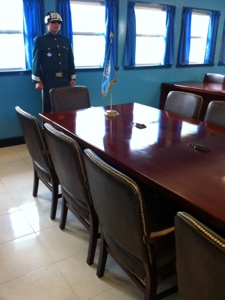
It’s hard to defend the JSA – it’s even hard to explain it. I’ve been there – and I’m not sure I totally understand the point. As far as I can figure – the current situation is that North Korean can not go any closer to the line that divides the 2 countries than 2 km – except in the JSA. And the same is true of South Koreans. Even in the JSA – there is only one building (its the size of a double wide mobile home – and painted bright blue) that ‘crosses’ the line – and if a group from North Korea is in the building, the door on the South is locked. If a group from South Korea is in the building, the door to the North is locked. When we were inside – there were 2 guards on duty – one guarding the door to the north, one standing at attention along the line of demarkation. That line is indicated by a line of microphone stations on an oak conference table.
20130509-053558.jpg

This room is very sad. A conference room where no one meets to talk. Where one side is locked out at all times. Visited only by tourists with cameras under heavy guard.

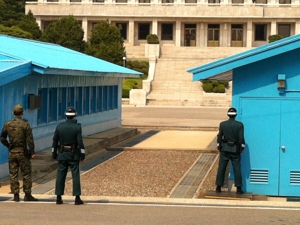
There is one North Korean – with binoculars watching us from the front of their building. According to Gina – there might be more soldiers inside – but we can not see them. On the South Side – there are soldiers watching the North side to be sure nothing happens to us. So our pictures are just of their backs. There are UN forces, there are ROK (Republic of Korea) forces, and there are MP’s. It’s all very very proper.

We enter ‘Freedom’ House – which is the one place that crosses into North Korea, and are allowed to take pictures. We then form 2 lines, and march back onto South Korean soil where we are allowed to take pictures of the guy watching us.
20130509-053615.jpg

From there – it’s back to the bus. We stop twice more – at the sites of the 2 ‘incidences’ – and then there are no more pictures until we are back at the Gift shop.

My feelings – these guys are armed – and stand all day facing down an enemy that is also armed. They all wear sunglasses – even at night – so that eye contact can not be made (that was determined to be too dangerous). They take their jobs very seriously – although according to our guide – a large part of their job these days is to find and de-fuse all the land mind that were planted in the DMZ – over 90% of which have not been found.

It is a very sad place. I’m personally not proud of what happened here – and I can only hope, like all the South Korean’s I spoke with – that some days, some how – re-unification happens. Over 10 million families were separated when the DMZ was created. The personal agony is considerable, but the South Koreans have hope that the resolution will come in their lifetimes.
Getting Flushed in South Korea – More then enough about Seoul Toilets!


Little old ladies pay attention to Toilets – you just never know when you are going to need one – rush. So here’s the down and dirty on the toilet situation in Seoul.

In a word – it’s great. Seriously. We should take a lesson. There are toilets everywhere, even in the metros! I mean who ever designed the Montreal Metros as a toilet free zone should be eternally cursed with diarrhea – it would serve him right.

And there are always western (flushing with seats) toilets available. And at the Lotte Hotel – the public toilets even have bidet’s attached. That’s service.

20130506-044426.jpg

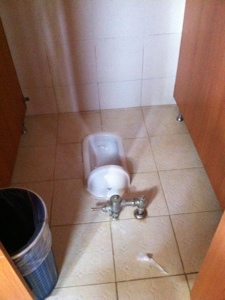
Sometimes both the stand up kind and the sit down kind are provided – but I’ve never seen just the stand-up kind in Seoul.

20130506-044417.jpg

And that includes in the metro, in public parks, at the Museums, in the restaurants, even in malls. Toilets are plentiful, Western Style, have Toilet paper, are clean, and are easy to locate. Amazing. And perfect for traveling ladies of a certain age!

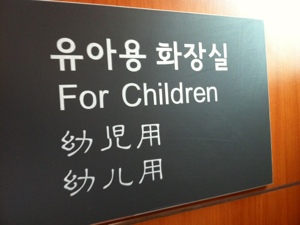
Even better – they think about the kids.

20130506-044350.jpg

I know if you are a parent – you’ve had this problem. Your underage son has to pee – and you (the Mom) definitely don’t want to take him into the boy’s room. What to do? Well the Korean’s have 3 different solutions that I’ve seen so far.

Solution 1: A kids only bathroom in the lady’s room. Is this the cutest thing ever. And don’t worry – Jill wasn’t going to use them!

20130506-050855.jpg

Solution 2: A completely separate bathroom – labeled for families. I didn’t peak inside, but Im guessing there are miniaturized toilets for both sexes inside.

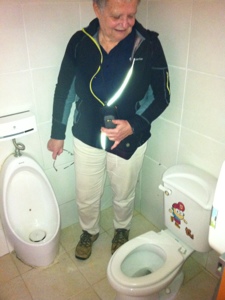
Solution 3: This cracked me up – a mini kid sized urinal in the lady’s room! The entire thing came just to my knees – prefect for a little boy – and hardly offensive to the ladies.

My discussion wouldn’t be complete if I didn’t discuss the Toilet paper. There is always toilet paper in the stalls and it is soft – a miracle I think. I’ve never been to an Asian country that took their toilets this seriously. But if the dispensers in the ‘chambers’ should run out – there is a dispenser on the wall by the entrance – you just help yourself before you enter – or ask someone to hand some over.

One tiny complaint – they put the dispenser for toilet paper a lot further back toward the rear wall then we are used to. That means you have to twist to get the paper. I don’t know if they notice the difference – but for me it’s just a bit awkward. Maybe they can get away with it because Korean women are more flexible than us. Who knows?

One more curiosity related to toilet paper – they love to use toilet paper for paper napkins on the tables of the hostels. Gross – but there you are. The cute thing – they don’t just set a roll on the table – there are dispensers that look like onions designed just for the purpose of hiding the toilet paper. Too funny. And trust me – a bit of a surprise the first time you ask for a napkin and get pointed to an onion.

Good job Korea! You win the Montreal Madame’s seal of Approval for taking public toiletting seriously!

Bulgogi and Korean BBQ – Yum


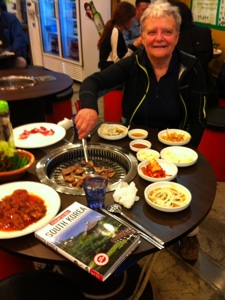
I’ve discovered that I love Korean BBQ – in all it’s many flavors and tons of variety. And here in Korea – they really do it right. So far we’ve enjoyed 3 completely different versions of Korean BBQ – each more enjoyable – and I might say delicious – than the last.

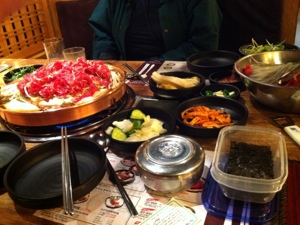
Our first Korean BBQ was perhaps the most traditional – we ordered Beef Ribs and Pork Ribs – and while the baby-sitting by the host felt a bit like being in kindergarten and having our food cut up for us – it was fun. They brought out a selection of different side dishes – which we now know to be traditional, and two plates of chopped up small portions of meat for us to cook. Yum.

20130505-193827.jpg

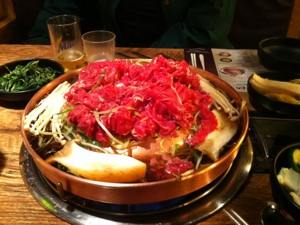
Our second Korean BBQ experience – last night actually – was very different. We ended up getting (not sure what we ordered, actually) – Bulgogi. Thin slices of marinated beef – and instead of grilling the meat, a ‘sauce’ was poured into a shaped pan. The center of the pan was used to ‘cook’ the meat – then the meat and lemon grass was slid off the ‘roasting’ section into the soup to finish cooking. Oh, it was good. And the kimchi was my favorite so far – not as spice as some versions, and very easy to eat. Yum.

20130505-195451.jpg

20130505-195431.jpg

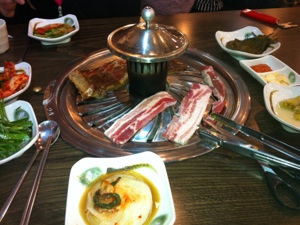
Tonight – we enjoyed our third BBQ – and it was different again. The traditional assortment of sides was presented – the kimchi was good – better than the first version, not as totally yummy as the 2nd, and there were pickles. The meat this time was pork ribs and what can only be called bacon. The slices were very thick, and once cooked had to be cut with scissors to a size suitable for picking up with chopsticks.

20130505-195345.jpg

And in this restaurant – the grill consisted of a bowl filled with hot charcoal, and the stack you see above the meat is connected to a vent that was below the low table, pulling the smoke downward. And in this restaurant, unlike the first two – the traditional floor seating was provided. (We think that about 1/3 of restaurants use floor seating, and another 1/4 offer both types. Interesting – the prices tend to be lower in the traditional seating types)

In the first restaurant – a smaller, more casual and ‘worker’ oriented place – as far as I could tell the venting was done by leaving the front door open. In the 2nd – Bulgogi – version, no venting was provided – I’m not at all sure why it wasn’t required, but the restaurant wasn’t smoky at all.

Bottom line – all 3 versions were yummy – and I’d go back if there weren’t so many other places to try here in Seoul. And Lex, our host here at the Agit, just showed us pictures of street food that we must try!

Just not completely sure I want to try the raw shell-fish restaurant he suggested – maybe a tad more experimental than I’m really to be right now.

Signing off – the Intrepid traveler and the Soup Lady.

Great Knees and Low Matresses


How Low can you go?

In South Korea – the answer might amaze you. Korean’s have the best knees in the world, at least as far as we can tell. They sit on the floor to eat (which totally sets my knees to flame). Chairs are low to the ground – even sofa’s are inches above the surface. And I haven’t even mentioned the beds yet.

Right now I’m sitting in our guest house kitchen – and in the living area, our host – Lex – is watching TV. He is lying on the floor – propped up on what looks like a beach chair – and the TV is set about my waist height. Low, low, low! There are 5 more ‘chairs’ in the space – all basically flat to the floor. The same thing was true at the Namu – the chairs in the living space were basically on the floor – while the chairs in the dining area were standard western height. Very interesting..

And Jill – who claimed the lower bunk – is basically on the floor – probably at most 3 inches above it. While my bunk – the top bunk – sits at my shoulder level. Easy to make, I’ll tell you.

We’ve eaten out every night so far – and 2 of the 4 restaurants have made us sit on the floor – tonight it was Korean BBQ with pork – and we sat on the floor at low tables that held the grill (Food was yummy) – and the first night in Korea we ate at a tradition soup restaurant – again sitting on the floor. We keep this up and my knees are going to be ‘bump’ ready come January.

So – I figure – to get up from the ground all the time – the Koreans must simply have the best knees in the world.

12 Unexpected (but cool) things about Seoul


1. I didn’t expect people to make a fuss about The Intrepid Traveler and myself. I mean people are constantly coming up to us – asking if we need directions, if we know where we are going, asking where we are from. We finally figured out that the issue is that we’re alone. No tour group. I gather that ladies of a certain age (ok – over 65) – just don’t wander the streets of Seoul alone. It’s not that we’re in danger – it’s amazement that we are the kinda folks that would do that.

20130503-231904.jpg

2. I didn’t expect there to be so few ‘North American’s’. In the Namu – our adorable hostel, there are no other North Americans. There is one guy from Edinburgh, (you are not allowed to call him English) – all the other folks are Asian or Indonesian. Interesting eh? We were waiting for a light in the Financial District – Downtown Seoul, and standing in a crowd of 30 to 40 people. Only one other person was Caucasian, and I didn’t ask where he came from.

3. I didn’t expect all the help. We went to a Korean BBQ restaurant – and they literally fed us. They spoke no English, we speak no Korean – so they gave up trying to explain how to cook the food – and did it all for us. That and wait on all the other tables. They even had to demonstrate how to take the leaves they gave us and wrap the cooked meat in them – my favorite – Mint leaves I think. And the BBQ sauce was yummy. Actually – the meal was Delicious – and would have been 5 stars if I hadn’t felt a bit like a 5 year old learning to eat!

20130503-231758.jpg

4. I didn’t expect everyone to be busy. In most of the other countries we’ve visited – there are always groups of people, generally male, just hanging around. Playing board games, smoking cigarettes, lounging here or there. But not in Seoul. Everyone – from 2 years old to 81 (we asked – he told us) is busy, busy, busy.

5. I didn’t expect all the food stalls. I think I should have – in Bangkok – that was one of the things I most remember. But here they take it to an entirely different level. We have seen Fish counters – with ice chests full of fresh fish – set up on the shopping street around the corner. The gal doesn’t lack for customers either. Trucks drive along playing songs and selling food – right off the truck. We saw a chain of street stalls – vendors wearing identical uniforms (beige jackets – cute hats) and pushing carts with bottles of yogurt and milk. And there is the cooked food. In many cases – they actually cook to order while you wait. Fried dough, sauteed fish, I saw one cart that had deep firers with fish on skewers. You ordered a skewer – he dunked it into the firer for you. Now that’s cooked to order. We even spotted a lady with a machine for making creme filled Doughnuts while you waited. I even saw an ‘Expresso’ Van, a Coffee House on wheels.

6. Speaking of coffee – I totally didn’t expect all the coffee houses. Reviews from a year or so ago mentioned the challenge of getting coffee in the morning – while not any more. There is at least one coffee shop a block – a smattering of Dunkin Doughnuts and Starbucks (we export the best, eh?), but mostly clearly Korean owned and operated. Signs that say ‘Best Standing Coffee’, ‘Coffee by Stand and Drip’, ‘Coffee and Bean’ speak to local control and sign making. And they are expensive – signs outside announce prices in the 2500 to 4000 Won ($2.50 to $4.00) range – pricey even by our standards.

7. I am intrigued by the gender roles. In our guest house – the cleaner is the male host – he washed the dishes and vacuumed the floors. The guides at the museums are all women, the waitresses all female, the cooks all male. I don’t know if I’m drawing a conclusion based on insufficient observation or not – but it does appear that while everyone is super busy – there are assumed roles.

8. Did you know that Koreans take off their shoes when they walk into a house, a restaurant, etc.? All the traditional places, including our guest house, provided a space for you to put your shoes before you enter the house. I’m really glad I brought my Slippers. And I went out and bought seriously cute socks to put on if I don’t feel like carrying my slippers.

20130503-231823.jpg

9. All (99.5% at least) of the women wear long sleeves. Now it’s fairly cool in May here – 70 degrees during the day – but the school girls are all wearing long sleeve shirts – and short short short skirts. So it’s not the weather. Even walking around downtown, we never saw a woman’s elbows. Beautiful suits, drappy skirts with uneven hemlines, plenty of short skirts with or without tights underneath – super nice fashion – but always long sleeves.

10. I didn’t expect all the English in the Museums – and the audio tours have been fantastic. All the museums and Palaces we’ve toured so far have English signs on many of the displays – and they all offered an audio tour – sometimes free. These were excellent. And they clearly post the times of English tours. We’ve taken 2 – once was just us – another was with about 20 other people – from a tour group of course. But not a ‘North American’ tour group – They were clearly Asian. So the languages here seem to be Korean – and English. I have seen signs in Chinese and Japanese – it’s easy to tell which are Korean – but always there is English.

11. The cars are amazing – not just the number of them for a city with tiny roads and NO parking – but the size. The two biggest brands are not surprisingly Hundai and Kia – but there are BMW – 7 series no less – and SUV’s. I mean there is no parking. None. People put cars everywhere – if there are rules – I couldn’t figure them out – it’s amazing. Very few bikes, not many motorcycles – just cars and buses everywhere.

12. The metro system is wonderful. It’s modern – there are elevators at every station – there are signs in English – the exits are numbered – and put on the maps – so it’s easy to figure out where you will be when you take exit 5 for example. Just Outstanding. Montreal – take a lesson. Interestingly – there is a wall of glass doors between you and the metro cars. When the metro arrives – the doors on the train line up with the doors on the station – and they both open. It’s rather like the subways in the airports. I know there is talk of doing something similar in Montreal – and frankly – I think it’s a good idea.

Ok – that’s enough cool stuff for one Post. Tomorrow I’ll continue with more cool things I’ve discovered about South Korea.

Signing off – The Soup lady and the Intrepid Traveler.
<br

A tale of 2 Hostels – the Namu and the Agit – Seoul, South Korea


We had originally thought to spend just 4 nights in Seoul before moving on – but our age and ability to recover from a long flight has definitely taken its toll – and we need more time here to see things properly.

So – we ended up wanting to spend 4 more nights in Seoul (it’s a fab city) – and that meant a change in sleeping locations. We had to move from the Namu in the Hongdae district to the Agit – near the Yaksu metro stop. So here-in lies the tale of 2 hostels.

The Namu is highly regarded in the hostel world – it is part of the Lee & Co ‘chain’ – and while small – just 4 rooms – it is warm, friendly, well built and extremely well located. The Hongdae district is home to a major university, and most of the student life of Seoul. It buzzes with action from 1:00 pm until late in the evening. Later than we ever made it up for sure. The Namu serves a wonderful breakfast of cereal, cakes, toast, eggs if you want, coffee (brewed – not instant) – jam, fruit – you name it – they offer it. And they prepare it for you – no fuss, no muss. It’s great.

Good things: There is a washing machine – no dryer – and people are very friendly. As reported earlier – I loved the public shared lounge area, with its tiny outdoor sitting space. We met some great fellow travellers – took fun pictures – had a great time.

Down sides – we had to share a bathroom – why do some people manage to splash water everywhere? – I really hate sharing my bathroom. Plus the room got cold at night. I ended up sleeping with socks, long-sleeve shirt, and my fuzzy travel blanket. Good news – it was an excuse to get cute socks.

But we had to leave. So we said good-bye to Sunny and Stella – our hosts – and headed out to the Agit. It is a lot less expensive for starters. Almost 1/2 the price. And we would have our own bathroom. Bad news – only room available had bunk beds. I’m getting the upper bunk – hope I can climb in – and get out without falling!

The beginning wasn’t great. We got lost. We exited at the right metro stop – but couldn’t locate ourselves – or the hostel on the map. And the killer – to exit the metro we climbed up 5 flights of stairs – with our suitcases. We were wiped. But – the kindness of strangers came to our rescue – again. A wonderful young man on a motor cycle figured out how to call the Agit – and Lex – the surprising tall and skinny host told him to tell us to stay put. He’d come and find us.

And find us he did. Plus he showed us where the elevator was to the metro – no more climbing 5 flights.

The Agit at first glance isn’t nearly as fancy as the Namu – the public space is small – and there is someone sleeping in the shared living room. I haven’t figured out who she is, but she does watch a lot of TV and Movies. And the kitchen arrangement is quite different. There is a long shared table, and Lex just opened doors and fridge explaining that everything is up for grabs. Just take what you want. He even had us fix a lunch to go. Ham and cheese sandwiches, Korean style – which means with pickles and mustard.

I had my concerns – but a little exploring showed me a fantastic outdoor space on the upper floor – tables and chairs so we can enjoy a dinner al fresco. And while our room is tiny – the advantage of having a private bathroom is huge. Plus the washing machine sits alongside a dryer! It’s clothes washing time tonight.

We slept in the Agit last night – and while it is now Sunday – still it was amazingly quiet – we slept in until 9:00. Jill admits that she hasn’t slept in that long – in well – since the last time we travelled together.

Our fellow travellers are a very quiet bunch – mostly Asians with one french gal – so that explains the sleeping in – even though our room is off the kitchen. No noisy folks to wake us up early.

And we may well be getting used to the hard beds! (Personal note – didn’t fall out of top bunk either)

So – how ends the tale of 2 hostels – both work. The location of the Namu is better, the rooms decidedly ‘fancier’, the private bathroom at the Agit trumps the nicer breakfast at the Namu, and I am really looking forward to enjoying tea on the outdoor balcony at the Agit.

Our decision – both work. So pick and enjoy.