3 Museums – One Day – Don’t do it!


Only the foolish would try for 3 world class museums in one day – well color me foolish!

One of the big reasons I stopped doing group tours was the rush rush wait kind of thing. The tour leader would have a huge long list of things that we must see that day – and his job was to carol the rest of us into going along – regardless of what we’d miss along the way.

So I wasn’t too keen to discover that we were going to attempt the same crazy stunt – but without a tour leader! In Munich – there are 4 major museums – all art museums – within about 1 minute walk of each other. Alte Pinakothek, Neue Pinakothek, the Museum of Modern Art and the Brandhorst. We’d picked the 2 Pinakotheks and the Museum of Modern art as our targets of the day – and got a good start, arriving at the front of door of the Alte Pinakothek at about 9:30. Unfortunately – it doesn’t open till 10:00. Sigh.

I’m not keen on sitting or standing around in the cold and wet – under any circumstances – so naturally we opted to stroll the neighborhood. Which put us back at the Alte Pinakothek at about 10:15. So much for that early start. Bathroom, ticket purchase, ear phone instructions – and we’re off. The Alte Pinakothek was built by Ludwig I around 1800 for one purpose and one purpose only – to house the most amazing painting by Rubens you’ve every seen. It’s huge – its stunning – and its in a room filled with other examples of his (Peter Paul Rubens) work. I loved that part of the museum the absolute best. There were seats, the explanations were interesting, and the art incredible. There is something so emotional about the works – you can feel the tensions of the damned and glee of the demons without even understanding the story.
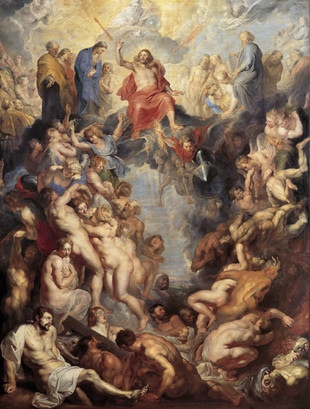
20131014-000220.jpg

Also on display are a group of Rembrandt’s. The best to my mind is his rendition of the story of Jacob and Issac on the mountain. Jacob has bent back the neck of his favorite son in preparation for the sacrifice – and is literally saved by the bell. Stunningly beautiful.

There were lots of other paintings to gauk at of course – but the work of those 2 artists is reason enough to go to Munich!

Next up – a smuggled in lunch and the Neue Pinoteck. This museum was set up by Ludwig II – and takes up where the other leaves off – starting around 1810 or so. The highlight here are the two Vincent Van Gogh paintings. The sunflower series is known world-wide, it’s iconic – and here is one of them – close enough to touch if the museum guards turn their backs. There is also one of his from the late Arles period – gay to look at quickly, emotionally depressed and isolated you feel as you identify the details – the water separating the viewer from safety and warmth, the lone peasant hunched against a cold wind only he can see. Glorious.
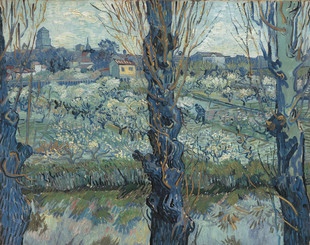
20131014-000457.jpg

Third – there’s the Modern Art Museum. We scored free tickets – not sure how that happened – got our ear phone sets and started to Explore. This gigantic space (are all Modern Art Museums huge?) is sub-divided into 5 sections – A special exhibit with art collected by one gentleman – Theo Wormland – consisting of mostly Max Ernst and Rene Magritte paintings, there’s the collection of the museum, there was another special exhibit of prints by Andy Warhol, there is the ‘Architecture’ Space, and final there is the Museum of Design. Each could stand on its own – as a group they are overwhelming and exhausting. Wouldn’t miss seeing it – but boy was I tried afterwards.

My clear favorites – some of the drawings – simple lines, yet so much emotion. I loved the collection called Dream Scapes. While Max Ernst’s work leaves you feeling depressed and unhappy – I have always loved the work of Magritte and Dali. What leaves you stunned is the thought that this one man would have the foresight to invest in this art when all the rest of the world thought these artists were completely crazy.

At closing time we drag ourselves out – we have dinner reservations at 7:00 (check out my review of the Atelier – it was dynamite) – but before that we must pay homage to the tomb of Josephine’s son from her first marriage and Napoleon’s Step-son – Eugene de Beauharnais. He’s buried in the Church of St. Michael – and we arrive just as services begin. Organ playing, lights on – beautiful. After the service ends, we check out the tomb. Victor is quite disappointed – they’ve dressed Eugene in a toga. Whatever for – he was in charge of the Chasseurs à Cheval of the Imperial Guard – surely a Chasseur uniform would have been better? But if it’s your tomb – you can do what you want.

We walk quietly back towards the restaurant – I’m thinking about my cold wet feet – Vic is still mad that Eugene is wearing a toga for all eternity.
12 Surprising Things about Munich


1: Escalators can go both ways – and they stop when no one is using them. This is so cool. You walk up to an escalator that isn’t working (reminds me of Concordia – for those in the know) – and when your foot hits the bottom pad – it starts. Like Magic. And it can be a foot race – winner hits the pad first! If it’s the person going down – then either you take the stairs – or wait till the escalator stops!

2. Outdoor cafes provide blankets on their chairs. Is that not the smartest thing? You can use the blanket as a seat – or drap it over your shoulders. Upscale cafes go for the fux fur look – exactly what you’d expect of course!

3. The city controls where Cafe’s can put their chairs – in a very subtle way. On the sidewalk outside of every food supply house are carefully painted, very subtle white circles. These paint splotches mark the limit of chairs and tables. You don’t have to put out any chairs – but if you do – don’t put them past that invisible line.

4. There are a lot types of BMW’s and Audi’s then we see in North America. I’m not just talking about the smaller cars – I mean options are different. The most suprising difference, and one I can’t figure out for the life of me – BMW owners can choose to not put the version of the car on the car. IE: you can’t tell a 350 from a 750 by the label. Odd, eh?

5. Bread can be beautiful. There are zillions of bakeries in Munich, so the competition must be fierce beyond belief. The solution – make yourself unique – and it helps if your bread looks pretty. Bow’s on pretzels, Gnomes in shop windows, Wedding cakes made from loaves of bread. If the imagination can think of it – the shop keepers will try it!

6. Grocery stores aren’t all the same. In Montreal, and most other cities in North America that I’ve visited, if you go into a Metro, a Piggy Wiggly, a Grand Union, a Price Chopper, or an IGA – the layout will look different – but the contents will be mostly the same. The same brands, the same sizes, the same selection – and sometimes even the same layouts. Some of the more unique Grocery Stores – Trader Joe’s say – make their mark by being unique and different – but those are few and far between. In Munich – all the grocery stores I walked into, even if the ‘brand’ was the same – had different layouts, different selections, different products. Amazing.

7. There are easily at least 15 different sizes/shapes/brands of Advent calendars. Not all stores have their Christmas goods on display – but in the ones that have gone Noel – the selection of Advent calendars simply blew me away. I don’t think I’m making out of Germany with out at least one.

8. The sidewalks are a lot cleaner than I remember. The last time I was in Germany there was dog poo all over the sidewalks – you literally couldn’t walk with your head up – it was head down and feet dodging all the time. That has totally changed. The sidewalks are completely clean. How neat is that.

9. Beware the Munich bike riders. Unlike Montreal, where bike lanes are carved out of streets – resulting in less room for cars – In Munich, the huge sidewalks have been subdivided clearly by lanes for bikes. And there are lots of bikes. And they go fast. And if you walk on the sidewalk and stray into their space – it’s not pretty. I’ve dodged the bullet several times – and Vic is getting very good at pulling me out-of-the-way of speeding bikes. The nice thing – the bike riders don’t yell at you – they might run you down – but they would be smiling while they did it!

10. The cheapest food is around the HautBanHof – that’s the main train station. Well, it might not be totally the cheapest – but the turn over is so fast – it’s clearly the freshest. Yum.

11: You have to pay to go to the bathroom. In one place – they actually had turnstiles set-up. Put in a Euro – or no pee-pee for you! At least they gave you a coupon good for .5 Euro off your next cup of coffee. Sort of feeding the system don’t you think. Even if they havent gone ‘mechanical’ – toilets almost always have a lady with her omnipresent tip plate. Often they use a coin to knock on the plate to remind you that it’s not there for food. In one toilet, there was even a conductor – she told you which stall to use, and walked in before you to wipe the seat – and hold her hand out for money.

12: Even king size beds have separate duvets – This has to be the oddest thing. You walk into a hotel room – there’s a king size bed. But on top are 2 duvets – one for him, one for her. It’s like having 2 sleeping bags on a king size air mattress. You only think you are sleeping together. But they are warm and cozy – and it’s so cold – I’ll settle for warm on cozy. In one hotel – I actually used 2 duvets!

Deutsches Museum in Munich – less than the sum of it’s parts


Don’t get me wrong – the biggest ‘Technology’ and ‘Science’ Museum in Germany is well worth visiting – it’s just that the parts are so large – it’s hard to focus.

The Deutsches Museum is all about ‘size matters’. Unlike most museums that are content with models, or electronic aids – this Museum wants the real thing. So there’s a life-size section of a Lufthansa Passenger jet showing the typical 2 – 4 – 2 seating- with the luggage containers below. There’s a real U-boat – the last of its kind, saved from destruction in 1919 by the founder of the museum, and sliced open so visitors can see the insides – from stem to stern. There are full-sized water wheels, running of course – even a full-sized sail boat used for fishing off the North Atlantic sea. At one point, you walk into the staterooms and then onto the deck of a cross Atlantic steamer – circa 1950.

It would be impossible to list all the stuff crammed into the museum – let alone see it all. But I did have one favorite part – and it’s wasn’t even on the must see sections!

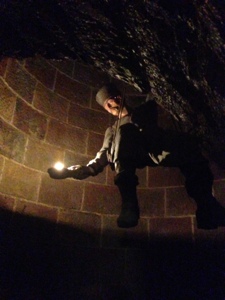
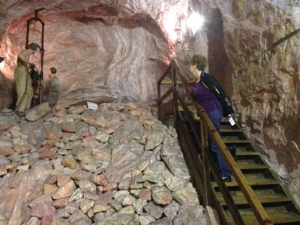
To me the highlight of the museum was the Mining section. Why – because they devoted basically 1/2 the basement to full-sized, walk thru, mines. Dark, dripping with water, dirt or wooden floored as appropriate – these ‘mines’ felt like the real thing. And since I’ve been in the real thing several times – I feel justified in saying that.

20131008-231348.jpg

To trace the changes in mining technology over the past 200 years – they have created mines worked by hand, complete with miners using lamps to claw coal from the earth. Exit that mine – and you are in a salt mine – with life-sized miners using pick-axes to cut salt ‘cubes’ from the walls. Walk a bit further, and you are in more mechanized times – horse-drawn sleds, tracks running beneath your feet, electric lights. Just a bit further – and you are face to face with gigantic mining machines with bits larger than a human. This is a truly impressive bit of display work – it would be hard to leave without a feeling of pity for anyone who would have to earn their living under the earth!

20131008-231400.jpg

Another truly fascinating section dealt with nano-technologies. This section used the very latest in museum technologies – you passed your hand over an object – and in German and English the object was explained in quite significant detail. Neat technology – but not the best at conveying information. Because you had to pick what to learn about – it was easy to by-pass important things, and get intrigued by something less critical. Basically a confusing exhibit – but very cool technology.

Another exhibit that couldn’t help but admire – but have to admit that the designers went so far – and then dropped the ball – was in the Pharmaceutical section. There you see a picture of a naked woman (this is Europe – no clothing, no problems), are forced to focus on her eye, from there to a piece of skin above her eye, and from there to a skin cell. You then turn right – and actually enter the cell – blown up 10000 times to make room for probably 30 visitors at once. So far – so cool – but then the designers ran out of ideas. Once in the cell – it’s back to basic explanation – mostly in German. Oh well. I did like that one section of floor looked like cell wall – I think the entire floor should have been made like that – it would have been far more impressive.

There’s also a model train layout – huge of course – HO scale – that is ‘animated’ 3 times a day. When animated, the cameras on the front of the trains are turned on – and you see the scene from the perspective of the engineer. A very neat effect.

Under the – scare the wits out of people heading – they have a huge exhibit on static electricity – which ends with a house bursting into flames from a lightning strike. Very noisy – but not something I haven’t seen before.

The very highly reviewed Physics section has every mechanical advantage demonstration tool I’ve ever seen – very hands on – very fun – but limited explanations. I was left thinking that kids probably press the buttons – pull the levers – and roll the balls – and then walk out – none the wiser.

Bottom line – Do go. It’s way cool to see the full-sized planes, boats, power tools, printing presses, telephone exchanges, even an old IBM 360 – the computer I learned to program on in 1966. Be sure to visit the Mining section – you’ll have to hike down stairs quite a bit – and then gradually work your way up thru the various exhibits – but it’s truly amazing. Don’t be surprised at the lack of English – some sections are well labeled, others have nary a word of English. And Don’t expect an audio guide. You will be disappointed. But I’d rate the Mining section alone a must see in Munich. I’ve never seen anything better anywhere – and that includes really coal and silver mines!

Beer and my long lost tea pot – Color me Happy!


Sometimes a little imagination can go a really long way – and that’s pretty much sums up the art of Friedensreich Hundertwasser – or Fred Hundred Waters. I first saw his work in Montreal – the Museum of Fine Arts mounted an exposition – and I was totally blown away. Known for his outstanding use of colors and design – and lack of anything resembling straight lines – I promptly invested in one of his posters.

Several years later – in around 2005, I saw his tea cups – well, not really his tea cups – but tea/coffee cups that one of the high-end German porcelain producers made featuring his art. It was love at first sight. But I could only afford 6 mugs and saucers – the tea-pot that matched just seemed an impossible purchase. Naturally – I’ve mourned that decision for years – and have carefully been keeping my eyes out for it. Never saw it again.

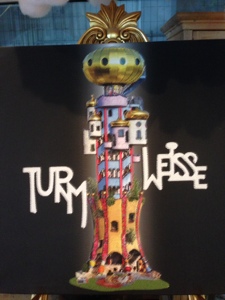
Fast forward to October 2013 – Our wonderful German hosts suggested that we visit one of the best and oldest breweries in Bavaria – Kuchlbauer. Being rather keen beer drinkers – and always fond of the lighter ‘Wheat’ beers – we promptly agreed. Now imagine our surprise when we found out that not only are they known for their beer, their copy of the last supper (full size and painted in a grotto), and their singing dwarfs (I kid you not) – they have an amazing Hundertwasser designed tower. Beer and probably my favorite artist – it’s a plan!

20131007-124107.jpg

So we drive to the brewery. Next to the parking lot is the newest work being built life-sized from his plans – I think it’s a church – but you can judge for yourself.

20131007-130652.jpg

After taking a long hard look at this newest example of art on the loose, we enter and sign up for the tour. It’s a bit pricy as these things go – but the gal selling tickets promises us it will be worth it. Things don’t start off that well – because it’s German Unification Day – there are no workers to observe – so while we can admire the equipment – it’s not really functional.

20131007-124127.jpg

Things go from ok to weird when we enter a grotto and are serenaded by dwarfs that represent the steps to beer making. Or at least I think that’s what they were singing about – it was all in German.

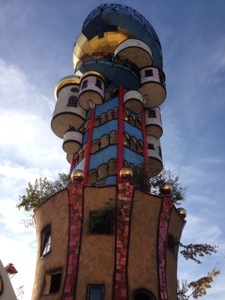
From there it was out into the daylight – and finally our look at the tower. It’s pretty cool.

20131007-124205.jpg

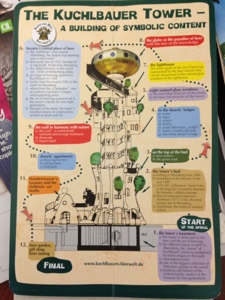
Inside the brewery there were demo versions, at least one built by Hundertwasser himself, the rest built by local artists following his designs. But for the real thing – you must go outside. Wow. What a tower. We climb the 150 steps to the top – admire the view of the totally solar-powered brewery below us – and then climb down.

20131007-125153.jpg

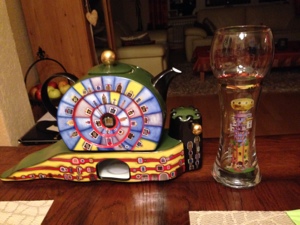
Now it’s time for beer tasting – and in German a taste is at least a 1/2 litre! They give us 4 bottles of beer and 4 wonderful tasting pretzels, my favorite part. We enjoy the beer, scarf down the pretzels, and then decide to buy 4 of the very unique beer glasses they are using. Victor sends me into the shop on my own – and what do I see? My tea-pot! Finally – I found it. Or perhaps better said – it found me.

20131007-130243.jpg

We have an emotional reunion, and I leave the proud owner of the most amazing tea-pot – and 4 beer glasses – gift from the owner of the brewery who was delighted to finally sell the tea-pot!

Great tour, Good beer, and my tea-pot – I’m happy!

20131008-104535.jpg

BMW Welt (World) – It’s all about the Cars!


Our friend Helmut works for BMW – so a visit to their house was definitely going to include a plant visit. What I didn’t expect to find was an organized touring schedule – replete with packaged video’s, museum quality audio projection system for the tour guide, and naturally – a up close and personal visit with your friendly robots! But BMW sees plant tours as a marketing tour – and packages them accordingly. Unlike Porsche, which wanted over $700 to do a plant tour – the BMW tours are reasonable, which explains why they were complete booked the day we went. Thank goodness for reservations.

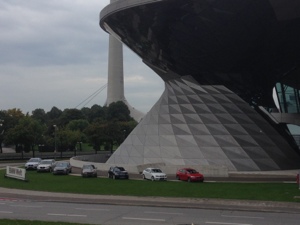
Anyway – the tour. You begin at the BMW welt – a specially designed massive building part of which is shaped like 2 stacked cones.

20131007-132333.jpg

Inside the glass doors are several huge areas devoted to various BMW product lines – there’s a section for the mini, there’s a ‘junior’ world exhibit to keep kids entertained (and informed), and on the 2nd floor – the personal car pick-up zone. If you come to Munich to take possession of your new car – you can expect only the best! A private dining room, your car presented on its own rotating platform, and then a personal ‘road’ out of the Welt and onto the streets of Munich. Nice.

For the average Soup Lady and friends – there’s a cafe offering drinks and light meals, a BMW life-style shop, a motorcycle demo which had the helmeted rider going up and down huge staircases, and the plant tour. The tour starts with a nicely produced video of the history of BMW, including an apology for using forced labor during WWII. Then a quick safety lecture (no walking outside the yellow lines, no pictures, no cell phones, no leaving the group), and we’re off.

The sprawling plant was originally built far from the city center, but the city of Munich has grown around it. There’s now a metro station right at the entrance – and across the street are the left-over buildings of the 1972 Olympics. Surrounded on all sides by housing, shops, and streets, the BMW plant blends into its surroundings, hidden in plain view.

Our tour takes us into the starting point of every BMW vehicle – the press room. Huge automated presses take flat steel and create the frames of the cars. These frames are then transported to huge rooms filled with Robots that pick up each piece, identify the type of car to be built, and then glue or bolt or spot weld the frames together.

The Munich plant only makes 3 types of BMW cars – the 3 series coupe and wagon, and the 4 series coupe. That means only 2 basic body types – but lots of options for paint color, engine, and interior. And every car is pre-sold! So each car – starting at the press room – is already pre-defined for its final look. The task is to make this happen without stopping between the steps.

Once the humanoid acting robots do the spot welding, the frames go to the body shop for their paint jobs. Robot ‘artists’ open the doors, spray on the multiple coats of paint, all while the cars are slowly moving continuously thru the plant. Attached to each frame is a transponder telling the robots what type of car, what color, what finishing needs to be done. The robots just follow the directions.

After painting, the cars spend several hours drying before the electronics, the seats, the dashboards, the chrome is carefully attached. As each car is pulled from the drying room – it joins an endless parade of cars – each being assembled. In the electronics section, there is a human ballet happening. Co-workers are assigned multi-function positions, and they rotate around the cars, standing on the conveyor belt so that they are standing still relative to the moving cars. The gas tanks are added, the padding inserted, the electronics attached. After each group of steps, a photograph is taken, and compared by both human and computer to the ‘model’. Any variation from the model is flagged – and the car removed from the assembly line for ‘repair’. Our guide explains that the system is so good that days can go by without a single car flagged for a ‘fix’.

We couldn’t tour the engine assembly room (the tour section is under renovation), but we did get to watch seats being assembled and put into moving baskets that would join up with the car assembly line just as the car for which they were intended made its appearance. Cool, eh?

It takes approximately 40 hours from rolled steel to finished car – as long as there is no problem on the line. When the cars roll off the line they are either loaded onto a train, or onto a truck for ‘local’ delivery. ‘Local’ includes the personal pick-up – but a truck is required because the cars must cross a road – and there would be too many individual cars.

We end up back where we started – having walked about 3 km around the plant.

Awesome tour – great robots – and naturally – now I really want to buy a BMW. Guess the marketing worked!

Antioxidants to the Max – Super Foods Part 4


Super Foods and Antioxidants – a match made in your local kitchen!

I didn’t invent these lists, for that I must give credit to Rebecca Katz’s “The Longevity Kitchen” and my favorite source for advice to the aging – the AARP Magazine. But as I’ve said before and will say again – the comments are all mine!

Food 11: Pomegranates
I’ll never forget being in China and seeing how Pomegranates grew. Who knew that they grow in baggies. Well, they do – at least in China. It was explained to us that putting the fruit when they are small in clear plastic bags encourage them to grow bigger – and juicier. Interesting, eh? Like Apple Trees, Pomegranate Trees are kept short for easier picking. But it’s not just about the yum – it’s about the antioxidants! Pomegranates are loaded with antioxidants, and a 17 oz glass a day was shown to lower blood pressure in a study in Britain, but that might just have been the result of getting all that liquid out of the Pomegranates!

Food 12: Green Tea
The signature dish of China – second only to BBQ Duck in my book – Green tea is known to be delicious – and not surprisingly – good for you. It’s abundant in catechins, a type of super antioxidant known to protect cells. And it turns out that green tea may also reduce the risk of certain types of cancer – particularly those of the stomach and esophagus. So drink up and be merry! (We know how that ends – but at least you get to be merry first)

Food 13: Blueberries
I unabashedly love blueberries. Those and raspberries are probably my favorite summer fruit snacks. And I admit to a total passion for Lac St. Jean wild blueberries. Unlike the huge, and sometimes tasteless store-bought Blueberries – the wild ones are tiny – but packed with flavor. But it’s not just about flavor with Blueberries – it’s about even more antioxidants. Blueberries rank among the top disease-fighting foods – including but not limited to reducing a woman’s risk of heart attack by 33%. Even better – blueberries are good for staving off the loss of memory – by several years. So eat up – Today.

Recipe from Allrecipes: Green Tea Cheesecake

Makes 1 – 9″ Cheesecake, cooking time is over 2 hours including the wait for the cake to ‘set’

16 oz of fat-free or low-fat cream cheese, softened
2 eggs beaten
3/4 cup white sugar (or use Splenda)
1 tbs green tea powder (some reviewers went up to 3 tbs for a stronger flavor)
2 tsp vanilla extract
1 9″ prepared graham cracker pie crust (some reviewers when with lady fingers – another prefered a short-bread crust. So reader – you choose)
Lots of Blueberries and Pomegranates for Garnish

Step 1: Pre-Heat oven to 350 degrees

Step 2: In a large bowl, beat together the cream cheese and sugar until smooth. Mix in the green tea powder, eggs, and vanilla extract until lightly and creamy; pour into the prepared crust.

Step 3: Bake in preheated oven for 25 minutes, or until the center jiggle evenly when the case is shaken lightly. Refrigerate at least 1 hour before serving – more is merrier.

Step 4: Garnish with Walnuts, Blueberries, and Pomegranates. You can even add the mint.

4 Low Cost Cures for Smelly Feet


Hey – talk about a seriously embarrassing little problem. My son’s feet can stink so badly – I have permanently banished his shoes from my house. Those babies have to stay in the garage when he visits!

But there are other options, and not one requires him to stop visiting, or cut off his feet, or even spend a lot of money.

First though – why do feet smell? Good Question. Research suggests that the primary cause are the thousands of sweat glands in your feet – and sweat enclosed in tight spaces is a great breeding ground for odor-causing bacteria. So any cure is going to start with getting rid of the bacteria – and secondly – dealing with the sweat.

Smelly Feet Cure #1: Air out your shoes. 24 hours between wearings is the suggested time frame – so buy a 2nd pair! Alternate your shoes every day – you’ll get twice the life – and less smell.

Smelly Feet Cure #2: Buy shoes that self ‘air’. Mesh inserts, bacteria ‘eating’ insoles, anything that will get air into the shoes – and kill off the bacteria will help. You know that this is going to help if your smelly feet problem is much worse in the winter (tight-fitting air sealed shoe season) and non-existent on the beach when you wear flip-flops!

Smelly Feet Cure #3: Dab antiperspirants deodorant on you feet – or spray it into your shoes. Hey – cut off the source of the smell – (sweat) – and you are less likely to encourage those odor-rific bacteria.

Smelly Feet Cure #4: For hard-core smell – try disinfectant spray or a sprinkle of cornstarch or antifungal/antibacterial powder – in the shoes – not on the feet. No need to pay lots of money for this stuff either – we’re talking grocery store cleaning supply aisle.

Still having issues – I did read once that Botox injections halt the function of sweat glands – so I suppose you can try that. Won’t make for smiling feet though! Personally – go for option 1 – really – is a 2nd pair of shoes that hard to break in?

Super Foods – Part 3 – Asparagus and Avocados


Super Foods Part 3 – yummy ways to eat yourself into better shape!

I didn’t invent these lists, for that I must give credit to Rebecca Katz’s “The Longevity Kitchen” and my favorite source for advice to the aging – the AARP Magazine. But the comments are all mine!

Food 9: Asparagus
The problem with Asparagus – it makes your pee smell! Otherwise – it’s the best food ever. Low calorie, elegant, sophisticated, and if it wasn’t for that very unfortunately ‘smell’ problem – I’d love it every day. And best of all – it’s a Super Food. A natural diuretic (makes you pee), it’s high in B12 and Potassium – seriously important for cell repair. Plus B12 has been shown to boost the auditory system – if you have low levels of B12 in your blood – you are 39% more likely to have hearing issues.

Food 10: Avocados
Unfortunately – Avocados are high in fat – but eaten in moderation (like in the recipe below), they are great sources of glutathione – and antioxidant that improves overall hormone function. So – win some, lose some. But since Avocados are delicious – I say – why not up the fat just a bit – in exchange for better hormone function. You can just walk it off!

Recipe from Allrecipes: Asparagus Angel Hair Pasta!

Makes 8 servings – takes 30 minutes start to finish!

16 oz package of angel hair pasta
1/4 cup extra virgin Olive Oil (Super Food # 4)
2 cloves garlic, minced (Super Food # 6)
1 pound fresh asparagus – trimmed and chopped
2 cups grape tomatoes
1 quart of chicken broth
1 tsp dried dill weed
ground pepper to taste
2 avocados – peeled, pitted, and mashed
1/2 lime, juiced
1/2 tsp garlic powder (got to love that Super Food)
1 cup shredded white Mexican Cheese (substitute any bland cheese here!)

Step 1: Bring a large pot of lightly salted water to a boil. Add pasta, cook 5 to 6 minutes, drain and toss with t tbs of olive oil.

Step 2: Heat remaining 3 tbs of olive oil in a skillet over medium heat, and cook the garlic for 1 to 2 minutes. Add the asparagus and tomatoes, stirring to coat. Pour in the broth, continue cooking uncovered 10 minutes, or until the asparagus is tender by still bright green.

Step 3: Place pasta in a large bowl, toss in asparagus and tomato mixture. Season with dill and pepper. In a separate bowl, mix the avocados, lime juice, and garlic powder together until blended.

Step 4: Serve pasta with a dollop of the avocado mixture, and top with shredded cheese.

6 Movies in 10 Hours! Why would one do that?


Clearly – I was stuck on an airplane with individual TV’s! So I indulged: Stardust, Star Trek Into Darkness, Parental Guidance, the Big Wedding, Legend of Sarila, and finally The Internship.

The only seriously good movie on the list was Stardust – and that’s based on the awesome performance by Michelle Pfeiffer as the wicked witch. I can’t help but feel sympathy when she tries to ‘magic’ away an age spot – and ends up with sagging breasts! I also must admit to a fondness for Robert de Niro’s “poffy” captain of the airship. Charmont to say the least.

“The internship”, my second favorite on the list, is a fairly predictable but still amusing outing by Owen Wilson – typecast as the hopeless endearing shaggy mop-man, but still a glimpse into what it must be like to do an internship at Google with a job as the high-stake prize. Having super smart kids who are struggling with the shrinking job market – their predicament is all too real. If only it was as easy as winning a soccer match, or selling a pizza place on advertising with Google.

The worst of the bunch – and that’s saying a lot because it’s hard to find something good to say about Parental Guidance, is the Star Trek mishap. Fancy visual effects aside – and managing to take down a good portion of San Francisco without ‘killing’ anyone is a pretty weird bit of story telling – the fake romance between Uhura and Spock is so decidedly off-putting and off-story that it makes the rest of the movie ignor-able. How can I believe Kirk is real when there’s this strange back-story? I’m amazed to see that Rotten Tomatoes managed to get past that bit of insanity, but I just couldn’t.

Middle of the road – and really the saving grace is the believable scenery – is the ‘cartoon’ feature – Legend of Sarila. I’ve actually traveled into Northern Quebec, Nunavik, and Greenland. And I can tell you first hand – it actually looks like that. Even the oil lamp/bowl looks exactly like items we saw the Inuit using. Yes it’s a legend – but the story it tells – and the people it portrays are real. Problems? Well – it’s too clean, it’s too simple, and Sedna – a major goddess to the Inuit – is too easy to please. But as a kid friendly introduction to a life that most of us can’t imagine trying to live – this movie does work.

As for Parental Guidance and the Big Wedding. Skip’m!

Super Foods Part 2 – yummy yourself into better health


I didn’t invent these lists, for that I must give credit to Rebecca Katz’s “The Longevity Kitchen” and my favorite source for advice to the aging – the AARP Magazine. But the comments are all mine!

Food 5: Kale
Ok – not one of my favorite veggies – so I’m more into hiding it than featuring it – but Kale is a definite Super Food. It’s rich in vitamin K (for Kale) – which is essential for blood clotting. Kale also contains lutein – which reduced the risk of cataracts and eye disorders. A surprising fact – one serving of Kale has almost 3 times the amount of Lutin as Raw Spinach. (So if you have to pick between Spinach and Kale – pick Kale!)

Food 6: Garlic
Not just for scaring off Vampires – Garlic is a great Super Food – and you can use it just about anywhere. It contains antioxidants, and antimicrobials. And when it’s crushed, it releases allicin, which wards off heart attacks, strokes – and vampires!

Food 7: Thyme
Beyond being famous for being in the title of a song from Simon and Garfunkle, Thyme fights bacteria. And in tincture form, it has recently been found to be effective in the treatment of acne. Pretty sure you don’t want to put the food on your face – but still, interesting to know, eh?

Food 8: Dark Chocolate
Ok – this is clearly my favorite Super Food. Honestly – ask me to eat more dark chocolate – I’m so there! Notice its dark chocolate – not milk and not white – that’s good for you. It’s lower in calories, rich in flavonoids, can aid in decreasing blood pressure and cholesterol levels. And – at the 60% or more cocoa level – it may reduce heart attacks and strokes in high risk individuals if consumed daily. Let’s see – daily consumption of dark chocolate. I can handle that.

Another yummy recipe from MyRecipes.com using 3 of the 4 Super Foods described above!

Whole-wheat Lasagna with Butternut Squash and Kale

You can assemble and chill the lasagna a day ahead, but add 10 to 15 minutes to the baking time. You can also freeze the lasagna, wrapped well in plastic wrap, for up to 1 month and bake it frozen (add 1 1/4 hours to the oven time).

Yield: Makes 8 servings
Total: 2 Hours

Recipe Time
Total: 2 Hours
Nutritional Information
Amount per serving
Calories: 424
Calories from fat: 38%
Protein: 20g
Fat: 18g
Saturated fat: 7.4g
Carbohydrate: 51g
Fiber: 8g
Sodium: 659mg
Cholesterol: 39mg

Ingredients

4 tablespoons olive oil, divided $
1 medium red onion, peeled and sliced
3 peeled garlic cloves (1 minced, 2 left whole)
2 cans (14 oz. each) crushed tomatoes
1 teaspoon dried oregano
About 1 tsp. each salt and freshly ground black pepper, divided
6 cups (about 2 lbs.) butternut squash, peeled and cut into 1/2-in. cubes
1/2 tsp. dried thyme
1 pound Lacinato kale (often sold as dinosaur or Tuscan kale)
9 whole-wheat lasagna noodles (about 8 oz.)
1 container (15 oz.) part-skim-milk ricotta cheese
1/8 teaspoon ground nutmeg
2 cups shredded mozzarella cheese, divided
Preparation

1. Preheat oven to 400°. Heat 2 tbsp. olive oil in a 2- to 3-qt. pot over medium heat. Add onion and minced garlic; cook, stirring occasionally, until onion is soft and translucent, 5 minutes. Add tomatoes, oregano, and 1/2 tsp. each salt and pepper. Reduce heat and simmer until thick and flavors are combined, about 30 minutes. Set aside.
2. While sauce is cooking, in a 12- by 15-in. baking pan, sprinkle squash with thyme, remaining olive oil, and salt and pepper to taste. Add garlic cloves and toss squash mixture to coat with oil. Bake until soft, 10 to 15 minutes. Meanwhile, bring 3 qts. salted water to a boil in a large pot.
3. Reduce oven temperature to 350°. Transfer squash and garlic to a food processor and purée until smooth.
4. Tear kale leaves from center ribs and discard ribs. Boil leaves until soft, 5 to 8 minutes. Drain; let cool. Squeeze out as much water as possible and chop finely.
5. In the same pot, bring another 3 qts. salted water to a boil. Add noodles and cook until tender to the bite, about 10 minutes. Drain; rinse with cold water.
6. In a bowl, mix ricotta, nutmeg, 1 cup mozzarella, and remaining 1/2 tsp. each salt and pepper.
7. Coat the bottom of a 9- by 13-in. pan with 1/3 of tomato sauce (about 1 1/2 cups). Lay 3 noodles in a single layer over sauce. Top noodles with squash, spreading evenly. Sprinkle 1/2 of kale evenly over squash. Arrange 3 more noodles on kale and top with ricotta, spreading evenly. Top with remaining kale and noodles. Cover noodles with remaining tomato sauce and sprinkle with remaining 1 cup mozzarella.
8. Bake lasagna until juices are bubbling and cheese is melted, about 30 minutes. Let stand 10 minutes before slicing.
Note: Nutrition analysis is per 4 1/2- by 4 1/2-in. serving.