English in Korea – It happens!


Koreans love English words. They use them everywhere – not always correctly of course – but with delight and enthusiasm. I love it – but it does throw one off occasionally (ok – often actually).

Example 1: English on a brochure cover means nothing! – Here in Kim’s Guest House there is one labeled ‘Spring Tourist Guide’ on the outside – without a word in English on the inside! It’s completely in Korean. So why put English on the cover? Your guess is as good as mine.

Example 2: The signs – There is so much English on signs here in Korea – I sometimes forget that people may not actually speak the language. It’s quite a funny feeling. You pass a store – the slogan is in English – like Paris Baguette with its ‘Fresh and Ready’ – and no one inside speaks English at all! It happens a lot – and it is always a bit of a shock. Street signs are often translated, stores advertise ‘Sale’, you see ‘Bank’, ‘Steak and Pasta’, and ‘Korean traditional Restaurant’. But while it makes it clear what service they are offering, don’t expect more than a ‘hello’ in English – you might be pleasantly surprised – and then again – you might be reverting to sign language pretty quickly!

Check out this picture – it’s advertising a water park – English on the sign includes ‘California Water Park’ and ‘Open’ – but I’m willing to bet that no one who works there speaks English – why should they? Clearly this is for Koreans to enjoy – despite the clearly California look of the bathing beauties.

20130512-170334.jpg

Example 3: Marketing Slogans – or What exactly did you mean by that? Consider this one for the city of Gyenogju – “Meeting place – The Scent of Culture – Time to Surpass”. What do you think they were trying to say? I get meeting place – but Scent of Culture? What ever does that mean? Do you think they were hinting that the place smelled? Can’t be, right?

Or here’s another one that amuses me – In Gyenogju, they make a special Barley cake (they sometimes refer to it as ‘bread’, but it is really 2 pancakes with red bean paste spread to hold the pancakes together). What is remarkable about it in my opinion is not the cake (it’s pretty bland) – it’s the number of ‘bakeries’ – often 2 or 3 on the same block. They all have the special ovens, and use the special boxes to make these cakes. How can there possibly be enough sales to keep them all in business? We got to try (for free) cakes from 2 different bakeries – and I must admit they tasted different. Can’t say I cared for either – but they definitely didn’t taste the same. But its the marketing in English that cracks me up. On one store – the Sign cheerfully proclaimed “The Barley Way to Health”, on another it announced that here you’d find the “Rich Chewy Texture of Sticky Barley”. Yummy sounding, eh? On a third I saw “100% domestic glutinous barley” – well, that’s definitely reassuring. Do some people import the Barley? Or perhaps not all Barley is Glutinous.

But my favorite language mis-adventure happened yesterday in the Gyenogju National Museum. This is a wonderful museum that attempts to explain – in a variety of languages, just a bit of the very complex history of this remarkable city. The artifacts on display are well presented – and the audio tour quite complete, if a bit robotic sounding. But it was the free English tour in one section that was over the top. There was an older gentleman responsible for giving the tour – and he proudly explained that he was a retired English teacher. Problem? His English was literally incomprehensible. At one point we thought he was talking about growing rice, and he really meant that they had a lice problem in 800 AD – which he explained by scratching himself.

But I really shouldn’t complain. The ability of Koreans to at least attempt to communicate in ‘my’ language puts us in North America to shame. We ran into trouble at the Metro – and despite our lack of Korean – and our helper’s lack of English – we muddled through. He didn’t give up – even when it was clear that we couldn’t communicate at all. Even if it meant carrying our bags up a staircase – forcing us to sit and wait while he got help – throwing in the towel just wasn’t option – Thank goodness.

And this willingness is official – Museums here have signs in 4 languages – and not just the name of the object – the entire description is translated. Even the subway maps and signs on the metro cars use both Korean and English names. I’ve been on Metros and Buses that announced the next station in Korean and English, can’t be to help the locals. I’ve even heard cross-walk signs speak English. Bank machines and Metro card vending machines always offer an ‘English’ language button, and Audio tours in even more languages are the norm – and not just in Seoul. It’s all pretty impressive – and very tourist friendly.

So as a prospective tourist to this intriguing country – you can rest easy. You might not quite understand everything – but I can guarantee you that the Koreans will make sure you have a wonderful time. It just comes naturally to them. What a country!

20130512-170424.jpg

On the Road to Gyeongju – South Korea


My favorite seat on a bus is in front – I love the 180 degree view you get – and I must admit to watching the bus driver. So imagine my surprise when our bus driver here in South Korea – while driving – washed his hands, the steering wheel, the gear shift, the side window – then put on white gloves in order to eat lunch. That’s new and different.

He also removed the fancy leather shoes he was wearing when he put our luggage on the bus, and is now wearing comfy clean white sneakers. And he has his own set of ear phones. Wonder what channel he listens to while he drives?

I’d been told that buses here are the way to travel – and I have to admit – it’s nice. There’s satelite TV (in Korean – but that is the language here), very comfy seats that recline, clean windows (Montreal – smarten up – it is possible to have clean windows on buses), and curtains.

Leaving Seoul and heading south – we started on an 8 lane highway, driving past a surprisingly beautiful city scape of skyscraper and towering sound barriers interspersed with old-fashioned residential neighborhoods followed by huge apartment complexes. I’m guessing zoning in non-existent.

Eventually the 8 lanes became 4 lanes about an hour out of Seoul – as we steadily head south toward Gyeongjue – our next destination. The highways cuts through hills, and the signs of civilization are everywhere – this is not Vermont, people.

We are passing traditional looking (but new construction) buildings, and modern factories mixed between rice paddies and farms. If you can farm it – you farm it. I even saw vegetables planted between the highway and the fences that mark private property. Everywhere peach trees are in bloom – their flowers a brilliant offset to the freshly churned but not yet planted rice paddies. There are also Ginseng farms – recognizable by the sun shades. I’m definitely going to have to try some Ginseng.

Another observation – the use of sound barriers when the highway goes past residential areas is astonishing. And they are huge – I’d guess 40 to 50 feet above the highway. Some have glass tops, many have become supports for green vines. And there is no graffiti anywhere. This was true in Seoul as well. A surprising change for us North Americans.

Arriving in Gyeongju – we check into our next guest house – a traditional style house off an alley between two motorcycles repair shops. Like most traditional homes – the front gate is plain and unassuming – but when you round the corner into the yard – you discover that there is wooden building with 4 traditional rooms – which means you sleep on the floor.

To enter the room, your shoes come off – you climb up onto a wide wooden porch, unlock your double wide doors, and then slide back rice paper screens to reveal a 10′ by 14′ room. Korean’s heat their floors – so the floor is raised off the ground. But to get to the attached bathroom or kitchen – you must step back down to ground level – about 18″. And there are ‘kitchen’ shoes and ‘bathroom’ shoes to wear in those areas. Traditionally – the floor would be wood – but this is a modern constructions – so the floor is linoleum that looks like wood. Regardless – it’s still shoes off to enter!

Our bedding is simple comforters that we unfold to sleep on – and re-fold in the morning. There is a 27″ flat screen TV – and electric lighting – two welcome modern touches.

The biggest surprise – the pillows are barley stuffed. The intrepid traveller takes both – I’m sticking with my travelling temperpedic’s thank you!

The only other piece of furniture is a small low table with folding legs. Handy for putting stuff on.

And that’s it.

We grab dinner (read about that in another post) and make ourselves comfy. It’s very quiet – and while the floor is hardly soft – I’m so tired that I think I could sleep on anything.

Signing off –

The Soup Lady and her side kick – the Intrepid Traveller.

DMZ – Scarier than you’d think…


As a tourist in South Korea – you can’t miss going to the DMZ – and apparently that’s true for Korean school kids as well! We were told that there are 800,000 visitors a year to the DMZ – about 70,000 of whom also visit the JSA (Joint Security Area). Naturally – I opted to do both, and the Intrepid traveller didn’t put up a fuss. She’s a history person – so seeing the DMZ was high on her list too.
20130508-193941.jpg

Some surprising facts – 1 out of 100 of South Korea’s population of 50 million serves in the army – and 21 months of service is mandatory for all men. Generally, men do their service between their sophomore and junior years of college – and as our informant told us – leave as kids and come back as adults. In North Korea (as explained by Grace, our lovely English South Korean Guide), the numbers are very different. 1 in 25 of North Koreans are in the military (1 million out of a population of 25 million), and men must serve for 10 years. Women serve for only 7. But they are serving between the ages of 17 and 27 – prime child rearing age – which in my book goes a long way towards explaining the smaller population in North Korea.

Back to the DMZ.

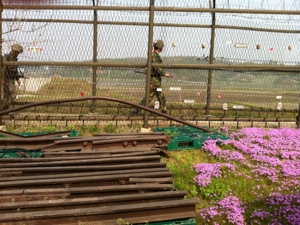
Our trip started in Seoul. After a passport check (you have your passport – good), and a clothing check (no pseudo military looks allowed – and no nose rings), we headed up Highway 1 along the Han River – the 2nd longest river in Korea. The river is considered a favorite infiltration point for North Korean Spies – and is completely fortified. Every 50 yards there is a guard station, manned and armed of course, and there are frequent patrols. There is even a system of flag turning that is used by one patrol to another to clearly keep track of who has passed most recently. Given that the river is extremely wide and that there are rice paddies between the observation posts and the river itself, survaliance must be a challenge. But they take it seriously none-the-less.

I think it’s pretty important to mention here that there are have been very few incidents since the war ended in 1953 – that’s 60 years ago! During the cold war – the North Koreans built at least 4 infiltration tunnels – we’re going to visit tunnel #3 today – and there was a debate that turned bloody over a popular tree in the 1970’s.

And this entire complex was built in the days of tank warefare. Today consider the uselessness of the idea of a DMZ – A single missle launched from any where in North Korea could take out Seoul. What’s the point of 4 km of space between 2 countries at war?

Some more facts – From 2000 to 2008 – the time of warmest relationships – the South Korean’s – hoping for reconciliation like that of East and West Germany, built a railroad station just south of the DMZ – and in North Korea built 132 factories. Employees were selected by the North Korean government, and given princely wages of over $200 a month. Primo salaries by North Korean standards. These factories were employing 50,000 North Korean workers until just 30 days ago – when they were shut down due to rising tensions.

Speaking of rising tensions – you wouldn’t even know there was a DMZ – let alone rising tension in Seoul. Even our guides – when directly asked – said it’s just hot air and posturing. Apparently despite the desperate press in our country – the South Korean’s think this is all just a lot of bad-smelling wind. (you know what word I’d be typing – right?)

Anyway – back to the fortifications. Once you get close to the DMZ – you can see some of the steps that have been taken in case North Korea does decide to attack. There are dynamited tank traps, mine fields, double rows of barbed wire, manned observation posts, and the like. On the DMZ tour – we visited 4 areas – First up was Imjingak park (part amusement park with kiddie rides, part memorial to lost Korean lives, part moving plea to Re-Unification) near the freedom bridge – where the exchanges of prisoners have happened in the past. From there we boarded different buses that were authorized (and I’m guessing – inspected) to enter the Civilian Control Zone – which is 2 km beyond the DMZ, which is 2 km from the line dividing the 2 countries. This distinction is important – only the JSA tour actually crosses into the DMZ – the more popular, and cheaper by far, DMZ tours do not cross into the DMZ – they just go pass the Civilian Control Points. I didn’t actually know this prior to making our arrangements – and it’s not clear in the marketing materials – so buyer beware.

2nd stop was the Dorasan Station – the railway station renovated in 2000-2002 and dedicated by George W. Bush. The South Koreans hope that someday this station will be the start of the trans-Siberian Railroad. If they can convince North Korea to build the missing track. Until a month ago – it was the staging area for materials coming from the factories built by South Korea in North Korea, unfortunately now both the factories and staging areas are empty. Oh well.

3rd stop was the Dora Observatory. I particularly liked the 3D map of the area with the locations shown under a huge glass window that looked out over the DMZ and into North Korea. You could clearly see the ‘fake’ village on the Northern side with its giant 170 meter (that’s 510 feet) tall flag pole, and the counter point of the populated village on the South side with its 100 meter (that 300 feet) tall flagpole. There were binoculars like you see on tall building all along the wall – and through these you could see people working in the fields in the North. You could see the buildings of the Industrial area – but of course there were no people there. According to our guide – the military can see 27 km into North Korea from this location.

Curiously – we were not allowed to take pictures. There was a yellow line about 20 feet from the edge – and if you lifted a camera beyond that line – they confiscated your sim card or film. That pretty much convinced everyone to not take pictures.

4th stop was the most interesting, and I agree with other reviewers – you don’t want to miss this. It’s the site of the Third Tunnel (discovered in 1978) – and on the left is a movie theatre and an exhibit hall. To the right is the entrance to the Third infiltration Tunnel. The movie was a professional overview of the DMZ – in English. If you wanted to listen in Korean (or any other language) you needed head phones. After the movie, there was the exhibit hall – which Grace rushed us through to be sure there would be enough time to walk the 350 meters down to the tunnel – then the 270 meters of tunnel open to the public – and then the 350 meters back up. Jill opted to stay out of the tunnel – but I gamely put on a hard hat and began the walk. The entrance to the tunnel is wide and easy walking, just highly graded. So down, down, down to the level of the tunnel I went. Not the fastest walker, it shouldn’t surprise anyone to learn that I arrived last – just after Grace finished her introduction speech. But the advantage was mine. Since I was last to arrive – I was first to enter the actual tunnel – and thus had the very best view at the end. Grace pointed out that we were finally in the DMZ – albeit underground. The tunnel starts in North Korea – goes under the demarkation line, and 3/4 of the way across the DMZ. It ends just 52 km from Seoul – and easy hour drive for a tank.

The tunnel built by the North Koreans is apparently 1.3 km long, and roughly 2 m (6 feet) wide and 2 m (6 feet) tall. But to add ventilation, the South Koreans have added pipes and bracing – so the effective height is under 5’6″ – and I’m just 5’4″ and hit my hard hat – hard – twice.

Tall guys beware – you are going to be walking bent over!

According to Grace – South Koreans are sure that there are more tunnels – but they have only found 4. In this one, the North Koreans had painted black lines – and later claimed that the tunnel was drilled to mine coal. No one believed them of course.

I exit the tunnel eventually – and walk past a group of about 50 Korean eight year olds – quietly (NOT) waiting their turn. Our timing was perfect – just imagine being trapped in a 4 foot wide tunnel with 50 screaming kids. But there’s a problem – Jill is nowhere to be seen. Grace refuses to let me look for her (guess she didn’t want 2 lost little old ladies) and she leaves to search the rest room and gift shop. I finally tell her that Jill is much more likely to be in the exhibit hall – and she has me make an announcement. “Jill Guedon – your bus is leaving” – sure enough Jill had been in the exhibit area chatting up Korean veterans that had come to the DMZ for a re-union. They observed that while there are very few US veterans of Korea still alive, there are many more Korean Veterans. This they felt was due to the much healthier diet of the Koreans.

Tour group now complete – we get back on the bus and retrace our steps to the Imjingak Park. From there, Jill and I are dropped off at a very touristy restaurant for a not great lunch of Bulgogi, and then our 2nd tour gets started. Our leader this time is Gina – and the group is much larger – around 20. But this time we are going into the DMZ – and all the way to the demarkation line in the JSA (Joint Security Area). This is the ONLY place that Civilians – or even Officials from either country can legally enter. It is the only neutral area of the entire DMZ.

We again enter the Civilian Control Zone, and proceed past the observation point to Camp Boniface. This is the UN military camp that provides soldiers to the JSA. We have to fill in forms (the UN is not responsible if we’re injured – we’re entering a military zone and know it, that kind of thing), and wait. We must be assigned a solider to guide us, and we must be led into and out of the JSA by a miliary vehicle. And the timing of these is totally up to the powers that be at Camp Boniface. Meanwhile we get to watch 2 helicopters land and ‘deplane’ a general or two, and we see the soldiers practicing with hand-held rocket launchers. Really reminds you that this is, in fact, a war zone.

Assigned our guide – we drive past the gates, around the various barriers, and up into the camp proper. There is a building there, very modern, with a theatre and a gift shop, plus bathrooms with bidets built-in. Very nice. Gina gives us a quick briefing of what we’ll be seeing, reminding us of the incidences that have occurred (all 2 of them), and warning us that we will see North Korean soldiers. We are not allowed to wave at them, gesture at them, even speak to them. This is strictly off-limits. We can take pictures only when permitted to do so – and that puts all of the DMZ between us and the JSA off-limits. We can not point our cameras towards ‘our’ side – only towards their side. I ask why – and am told – them’s the rules.

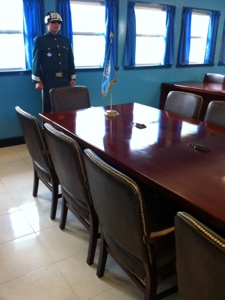
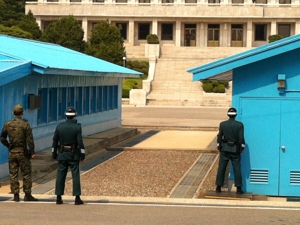
It’s hard to defend the JSA – it’s even hard to explain it. I’ve been there – and I’m not sure I totally understand the point. As far as I can figure – the current situation is that North Korean can not go any closer to the line that divides the 2 countries than 2 km – except in the JSA. And the same is true of South Koreans. Even in the JSA – there is only one building (its the size of a double wide mobile home – and painted bright blue) that ‘crosses’ the line – and if a group from North Korea is in the building, the door on the South is locked. If a group from South Korea is in the building, the door to the North is locked. When we were inside – there were 2 guards on duty – one guarding the door to the north, one standing at attention along the line of demarkation. That line is indicated by a line of microphone stations on an oak conference table.
20130509-053558.jpg

This room is very sad. A conference room where no one meets to talk. Where one side is locked out at all times. Visited only by tourists with cameras under heavy guard.

There is one North Korean – with binoculars watching us from the front of their building. According to Gina – there might be more soldiers inside – but we can not see them. On the South Side – there are soldiers watching the North side to be sure nothing happens to us. So our pictures are just of their backs. There are UN forces, there are ROK (Republic of Korea) forces, and there are MP’s. It’s all very very proper.

We enter ‘Freedom’ House – which is the one place that crosses into North Korea, and are allowed to take pictures. We then form 2 lines, and march back onto South Korean soil where we are allowed to take pictures of the guy watching us.
20130509-053615.jpg

From there – it’s back to the bus. We stop twice more – at the sites of the 2 ‘incidences’ – and then there are no more pictures until we are back at the Gift shop.

My feelings – these guys are armed – and stand all day facing down an enemy that is also armed. They all wear sunglasses – even at night – so that eye contact can not be made (that was determined to be too dangerous). They take their jobs very seriously – although according to our guide – a large part of their job these days is to find and de-fuse all the land mind that were planted in the DMZ – over 90% of which have not been found.

It is a very sad place. I’m personally not proud of what happened here – and I can only hope, like all the South Korean’s I spoke with – that some days, some how – re-unification happens. Over 10 million families were separated when the DMZ was created. The personal agony is considerable, but the South Koreans have hope that the resolution will come in their lifetimes.

First you pack – then you go! South Korea here we come!


Why does travel always start with frantic packing? Is this just me? Somehow, no matter how long ahead I plan – it seems that I’m tossing things in and out of my tiny carry-on suitcase as the taxi is pulling up to the door.

And another puzzle – why are the flights so long. Ok – I totally realize that it’s distance related – but 17 hours of travel. Is it really necessary? Oh – to beam me up Scotty.

But I got packed and noticed that my entire luggage is smaller than the carry-on’s of some of the other passengers. Did I forget something – of course – but that’s always the challenge. I don’t want to carry much – I have to lift it – so leaving something important at home is just expected.

And what do 2 little old ladies pack for 5 weeks in South Korea? Not much. 1 pair of pants packed, 1 pair of pants on, 3 tops packed, 1 top on, my favorite jean jacket with the big pockets, my rain jacket, PJ’s, slippers, a few pieces of underwear, my favorite warm jacket/sweater, 1 long-sleeved shirt in case it’s cold, and most importantly – books. I have an ipad – which really should be enough – but I love holding a book – so I grabbed 5 novels intending to donate them to strangers as Jill and I finish them.

And we’re off.

Flight from YUL to Detroit was uneventful. Hey – they gave us pretzels. That was nice. Then we hung around Detroit till the flight for Seoul was announced. Nice airport by the way – in case you plan trips by the quality of the airport. The Delta/Korean Air flight to Seoul was packed. Absolutely full. So much for thinking that the news would discourage visitors.

We had taken a window and an aisle, hoping that the middle would stay empty. No such luck. Our middle was a Colonel from the US Army – stationed in South Korea. Kinda reassuring actualy. He’s been here for 3 years – says it’s the safest place he’s ever been stationed. He and his wife and 2 kids are thinking of moving to South Korea when he finishes up in a year.

For meals they offer a Western and a Korean option (I take the Korean choice – it was yummy) – and we settle down for the long haul across half the US and all the Pacific Ocean. I can’t sleep – so I watch movies – Les Miserables, Coraline, Hyde Park on the Hudson, Parental guidance, Aribtrage. It was fun. My favorite – probably Les Miserables. Hard to admit – Parental guidance, while embarrassing predictable did make me cry. No one wants to be the “other” grand-parents. Coraline would give me nightmares if I was a kid, Aribitage was a waste of celluloid (but probably shot in digital – so no film was sacrificed).

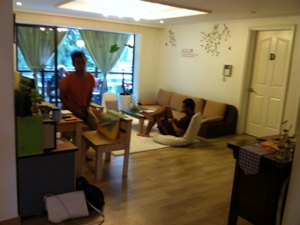
We arrive in Seoul with no problems – and relying on the kindness of strangers, make our way to our adorable hostel – the Namu. It’s really an apartment that has been renovated into 4 bedrooms of various sizes – our ‘deluxe’ twin which has 3 beds, a 6 bed dorm with their own bathroom, and 2 other rooms – both with a double bed and a bunk bed. The main area has a nice comfy sofa, a lovely porch (Jill is sitting and reading as I type), a kitchen, a smallish dining table and 2 computers for everyone to use. Not a lot – but perfect for us. They even have free use of a washing machine.

20130502-223644.jpg

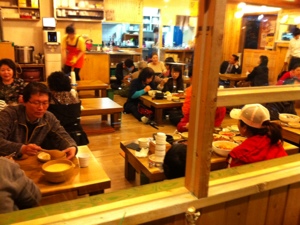
The location is the best part – on a quiet street right off a major ‘dining’ street packed with inexpensive restaurants of all types. There are at least 6 Korean BBQ places, a sushi place, and several coffee shops. We opt for a traditional Korean Restaurant – that means you sit on the floor – and get a bowl of Noodle and dried Shrimp soup to share. The soup was just $12 – and it was enough to feed at least 3 people – we left a lot. Food notes: We ordered mild – and trust me – that was spicy enough for me. And we didn’t care for the dried shrimp. Both Jill and I carefully picked out all the dried shrimp – so much for the protein part of the meal. And as you can tell – we sat on the floor – and needed help getting up!

20130502-223708.jpg

Back to the Namu – and to bed. One note before I go – beds in Korea are hard. Really hard. No – I mean like board hard. Beyond firm. But we are so exhausted we figure it doesn’t matter.

Good night Moon, Good night everyone!

The soup lady and the Intrepid traveler – signing off.

Vote for me to win the Biggest Baddest Bucket List Contest – Please!


Please Vote for me on Biggest Baddest Bucket List contest. You just check one of the social media links in the big green box.

http://www.mydestination.com/users/thesouplady2/bbb#tab

vote 2

This is the coolest website by the way – they are offering a prize of $150,000 in traveling money – plus $50,000 in cash – and you get to travel around the world for 6 months. Oh yes, and you have to blog from all the places you visit. I can so do that.

But the fun part (after you vote for me of course) – is watching the other videos. Some are surprisingly good, others are amazingly bad. I mean – really terrible. I think those are more fun than the good ones – but don’t say I said so.

If you really want to help me out – send my link around to all your facebook friends – ask them to just vote for me. I so appreciate it!

And if you want to know what I said for my ‘tour’ guide piece – here’s my written copy. Enjoy. And have a café aux lait – and a 2 cheek kiss on me.

Beinvenu a Montreal

Welcome to Montreal –  home of the 2 cheek kiss

Come visit the Old world in the new world.

We are more than just big buildings, church steeples, cobble streets, Mt Tremblant, the Olympic Park, Celine Dion, and Claches (horse-drawn carriages – yes – even in winter).

We have World class art – both inside and out, fascinating Museums, magnificent churches, 75% of the worlds maple syrup, shop till you drop shopping – both underground and above ground, over 5000 restaurants (that 1 a week for 100 years – you’ll never be bored) – and world-class festivals.

You can come to see our Museums and Parks including Mount Royal

You might come to see the Oratory St. Joseph – one of the top Catholic pilgrimage sites in the world or

You might just come to shop.

But you really should come for our festivals –

In February – during the darkest days of the year we light up the skies, the buildings, and the night with our Festival of Lights. Fabulous restaurant meals at all price ranges – from free to unbelievably expensive are on offer. All you need is interest, an appetite, and a reservation.  Not curious about food – no problems, there are dozens of theatrical happenings, culminating in Nuit Blanche (White Nights in English) – over 1000 different (and free) activities to choose from – DJ’s, Dancing, Dance lessons, Concerts, Art challenges – all yours to enjoy. And the city parties hardy till dawn.

In June – The Grand Prix takes over the city – the truly wealthy rub shoulders (and the occasional Ferrari) with the locals, and the roar of the F1 cars can be heard over the hum of the big city.  The next weekend our world-famous Jazz Festival takes over the Quartier des Spectacles – free concerts by the famous, and not so famous on every corner. Couple that with indoor concerts by the truly famous and you have events worth a special trip to Montreal.

In July – The multi-lingual Juste pour Rire (our Comedy festival) rolls into town and out onto the streets. Comedy – and not just verbal either – remember we’re the home of the Cirque de Soleil – becomes the reason to visit – and to return. And our terraces (places to eat outside) are open – when your summer is short – you must make the most of it. Some local’s joke that you missed summer – it was yesterday! And as with most jokes – there’s a grain of truth. My Dad came to visit in early July – and wore everything he brought – at the same time.

There are multiple film festivals in multiple languages, Balloon Festivals, Dance Festivals, and Parades for any and all occasions.

In August – We even have a Graffiti festival! Talk about taking fun to a new – and legal – level.

So come and enjoy our festivals – they are as Montreal  – as the 2 cheek kiss – and a cafe aux lait!

Vote for me

8 ways to Get Skinny – by eating Eat Out!


OK – I agree – that seems impossible. But you can do it if you really really want to. How do I know – well I  managed to lose 30 pounds in 6 months following Weight Watchers with complete devotion – and I eat out almost every single night. That was in 2002 – so not only did I lose the weight – I’ve kept it off for 11 years – visiting my local Weight Watcher’s every single month. But this isn’t about Weight Watchers – it’s about my tricks of the trade, so to speak, and these I gladly share.

1) Plan, Plan, Plan. It doesn’t take a lot of effort to get a look at a menu – if you’re searching the internet you can find the menu’s for most restaurants on-line. And even if they don’t help you out by offering clearly labeled low-fat/low-calorie options – the safe bet is to go for Fish and Salad avoiding like the plague any sauces or sweet dessert. Just make sure there is a fish option (preferably grilled – not fried and  not baked) before you agree to go.

2) Have a No-No list. My No-No’s (I love this stuff – so saying no is hard) – Anything fried, Anything breaded, Any salad dressing, No mixed drinks (super fattening), No sodas except straight up soda water. One glass of wine preferably with seltzer water – tops. Notice what is not on my no-no list. I can have a bite of dessert, I can enjoy baked potatoes, and I love beef.

3) Have a Yes-Yes list and put Vegetables on the top. Veggies are always a better idea than potatoes, bread or rice, and most restaurants will cheerfully double up the veggies instead of putting on the potatoes. Your diet is bound to be better with more veggies – and your waist will thank you too. Other Yes-Yes foods – plain baked potatoes with Mustard, Salads with no salad dressing, Grilled fish, quesadilla, lasagna, edamame at Japanese restaurants. Butter is neither a Yes-Yes, nor a No-No. But Mustard is a lot better – and definitely on the Yes-Yes list.

4) Drink Water or Tea – Lots and lots of water and tea. Why? It keeps your hands busy (and out of the bread basket), and it tells your body that water is plentiful. That’s critical to weight loss because if your body decides that water isn’t going to be easy to get – your body will hold on to water like mad. You’ll get bloated, and weigh more. So drink up – as long as there’s no sugar involved of course.

5) Leave food on your plate. The more the merrier. Clearing a plate is definitely not for losers! And one bite is all you need to feel you’ve tried the dish. All bites afterwards aren’t totally necessary. A similar idea I read elsewhere – ask for that carry out container as soon as you sit down, and put 1/2 your meal in it before you start to eat. Out of sight – Out of mind. Plus less cooking for tomorrow. (I actually can’t do this – it feels gross. So I take a knife and drawn line down the middle. Then I try not to eat past the line.)

6) Don’t go out hungry. Really bad idea. You can’t stop eating if you are starving – so it’s a lot easier to have a low-calorie snack before you leave for dinner. Cuts down on how much you will order, how much you will eat – and how much you will pay. Good idea no matter what. My preferred snack – low-fat microwave popcorn at 3:30. Works like a charm.

7) Turn back the bread basket. One of the handy things about eating out in Europe is that they charge you for the bread – so it’s quite clear that not having the bread unless it is seriously special is a waist and pocket friendly idea. Here in North America we love our bread baskets – and it shows. So just say No!

8) Pick at dessert. You really don’t need or want that whole piece of whatever – so take one bite and STOP. My husband jokes that often my dessert is an extra fork. I love just getting one taste of his dessert – I feel privileged, and I cut the calories. If you are lucky and eating out with a friend who isn’t as controlled about their food – they will eat the rest. If not – try ordering a ‘finish’ that is lower in fat and calories – fruit cups are great for example. But I’d rather get a single Biscotti and a low fat cappuccino. Half the Biscotti can come home for Breakfast – and I have a very special ‘finish’ to my delicious dinner.

Just remember – Nothing tastes as good as Skinny and Energetic Feels.

Mahre Ski Camp – Deer Valley Uath – Feb 2013


Mahre Camp – Or how to learn to ski much better in just 3 days.

According to the Deer Valley website – the Mahre Ski Camp is for skiers at all levels – I mention this because I’m a pretty good downhill skier. I take lots of group lessons – and unless the competition is very stiff – I place in the top group. As I will freely admit – I can ski pretty much any run that’s in bounds – badly!

So this report is from my personal experience – I didn’t interview other ‘campers’ – and I didn’t take a survey to determine group attitudes. This is how I liked it – a Personal bias – but there it is.

I’ve taken ski clinics before. Well just two actually – a Centered Skier week about 30 years ago and a much more recent clinic at Deer Valley. This more recent experience – before the Mahre camp – was a women’s 3 day clinic. Unfortunately, I was so disappointed with it that I gave up ‘clinics’ for several years. I found it way too social, the featured “Ski with an Olympic Skier” consisted of a quick glimpse one afternoon, and there was simply not enough about getting better on moguls, powder, and trees. One skier in our group was afraid of powder (and you call yourself an expert – I think NOT!) – and the group ended u avoiding things she was afraid of doing. Not good. While skiers with less ability might have had a good time – I was mostly annoyed.

But that said – I’ve been eying the Mahre Clinic folks for several years now. I liked the idea that Steve and Phil Mahre were very involved – although I wouldn’t have know how much until I took the clinic, and I liked the idea that they used a system of exercises that had been tried out and evaluated on skiers of all kinds of abilities. I also liked the promise in their literature – we form groups on ability – not on friendship or relationships. In any case – Feb 2013 the stars aligned. I was going to be in Park City, Utah on the right dates, my friends were willing to ski without me for 3 days, and I had a bit of money to spend on lessons.

The Mahre Clinic takes place at one of my top favorite (after Jackson Hole) places to ski – Deer Valley. It’s not just the grooming and the food that’s great there – they have lots of hidden powder stashes, and there are some short – but very nice mogul runs to play on. In addition, if the snow is good, there are plenty of tree runs to explore – at lots of different ability levels.

So – long story short – I decided to sign up for a 3 day clinic. They offer 3 and 5 day versions – and after chatting with lots of people who had some knowledge of the clinics, I knew that while the 5 day was ‘better’ – taking the 3 day would be OK too.

Like all clinics, you start with a breakfast gathering – a chance to chat up some of the other people participating, and meet some of the instructors. To my surprise – the Mahre brother were there as well. In fact – they were involved and on the ski hill or in the video room or eating lunch with us every minute of all 3 days. Wow – that’s what I call a personal involvement. Of course it’s a bit hard to tell which is which – as they are identical twins. One brother – I think it’s Steve – wears glasses – but otherwise – can’t tell them apart. I didn’t realize they were twins actually until we were on the slopes – and saw both in quick succession.

After breakfast, they did the traditional ski off – on a fairly flat section of trail. They weren’t looking for our ability to do moguls, they wanted to see how balanced on our skis we were. But before the ski-off they divided us into 2 groups – those who had done a Mahre Clinic previously, and those who had not. A surprise to me – about 1/3 of the 40 participants were repeats. That’s a lot! Says something good about the clinic when people take it over and over again, eh?

One negative comment – they also asked people who wanted to be in the same group to ski down one after the other – I assumed that they would be put in the lower skier’s group – it’s bad to have a better skier in your group, but it’s a disaster to have a worse skier. Why? Because the class will naturally gravitate to that level – making it too easy for the other members of the group. That is what happened in my last clinic – I assumed that it wouldn’t happen in the Mahre Clinic. Turns out that in at least one group – I’d have been wrong. So moral here – if it happens to you – Speak up NOW! Don’t let them get away with doing that to you – it’s all fine for the people who want to ski together – but it will ruin your experience.

Enough of the aside – I placed in the 3rd from the top group. But since there were only 2 other skiers – both male – I wasn’t complaining. At least the social aspect would be kept to a minimum. And I thought they were both good skiers . Our instructor was Don Hill – like all Mahre instructors, a PSIA level 3 – (that’s the top) – with additional training in the Mahre method.

Another disclaimer here – I ski hard. All day if I can. So I’ve had issues with ‘skiing’ better skiers under the table. It’s not that I’m that good – I just don’t stop. So at 3:30, when the other members of my class are begging for a break, I’m looking forward to another mogul run. This can be a problem if the group isn’t equally determined to ski, ski, ski. But this group looked strong. I was optimistic.

We started off with simple balancing exercises – a bit touchy-feely – but the idea was to make us aware of exactly how we balanced on our skis. According to the brothers, there
are 3 keys to great skiing – Balance, Balance, and Balance. By this they mean fore and aft balance (I’m good at that – I don’t ski sitting backwards – thank goodness), lateral balance (need to work on that. I just don’t angulate like I should. Oh well), and vertical balance. (I’m good at getting down – not so hot on getting back up!)

Day one, except for 2 mogul runs after lunch, was basically spent exploring and correcting obvious balance issues. First they had to make you aware of your issues – and trust me – denial is the name of the game there. I couldn’t believe that I don’t angulate (do the banana) enough – but sure enough….

One key message of the day – skiing shouldn’t make you tired. If your legs hurt – you are doing it wrong! And you shouldn’t need to rest 1 day in 3. Your skis might – but you should be able to ski day after day if your balance issues are under control.

Day two we got to ski with Phil Mahre in the morning – and then after being video-taped, he personally critiqued our skill level. Imagine – an Olympic Gold Medalist and World cup Skier looking at your video and slowly and patiently explaining what he could see were problems to be corrected.

The rest of Day Two was spent with Don, our instructor with his two new knees and one new hip, going over and over what Phil had pointed out were our personal issues. In the evening, Steve gave us a summary lecture of their key techniques – and then spent time talking racing tactics. Worth the price of admission. He actually got tears in his eyes when he was describing one particular race. I was very impressed.

Day Three was the most interesting for me. We re-did the video taping, and again our flaws were pointed out (and thank goodness – some improvements), and then spent the afternoon working on mogul skiing techniques. Effectively, we took the balance lessons and applied them to more intense terrain. Not too surprisingly – I ended up alone with the instructor at the end of the day. Managed to ski both my fellow skiers under the table. At least they had the smarts to quit before they got hurt. Even Don eventually had to quit – but here’s the best part. When we got back to base – Phil was taking some people up for one last run – I gleefully joined in – and got 2 more runs in before the mountain shut down the lifts on me. Well – that worked out well.

That evening, each instructor gave each of their students something to remember their lessons by – a pair of glasses with ski tips attached (so you stop looking down), a toy motor bike to remember to keep your hands in front, and in my case – a mantra – Do the banana (Angulate) and what goes down MUST come up!

But it’s not during the lessons that the quality of a clinic becomes clear. It’s in the days afterwards when you find yourself able to ski with grace on terrain that you’d avoided in the past, and in my case – while still not at the speed of my husband – at least coming a lot closer to keeping up!

Bottom line – I would definitely take the Clinic again – just for the personal nature of the very directed instruction, and I would highly recommend the clinic to any skier – regardless of ability. During the ‘awards’ party – it was made very clear that there were plenty of participants with precious little previous skiing ability – all the way up to speed demons and mogul buffs. So the lessons, as explained, apply to everyone!

Thanks a bunch Steve and Phil. I had a really good time. Learned a lot too!