As a tourist in South Korea – you can’t miss going to the DMZ – and apparently that’s true for Korean school kids as well! We were told that there are 800,000 visitors a year to the DMZ – about 70,000 of whom also visit the JSA (Joint Security Area). Naturally – I opted to do both, and the Intrepid traveller didn’t put up a fuss. She’s a history person – so seeing the DMZ was high on her list too.
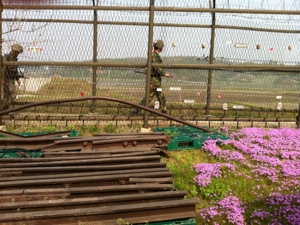
Some surprising facts – 1 out of 100 of South Korea’s population of 50 million serves in the army – and 21 months of service is mandatory for all men. Generally, men do their service between their sophomore and junior years of college – and as our informant told us – leave as kids and come back as adults. In North Korea (as explained by Grace, our lovely English South Korean Guide), the numbers are very different. 1 in 25 of North Koreans are in the military (1 million out of a population of 25 million), and men must serve for 10 years. Women serve for only 7. But they are serving between the ages of 17 and 27 – prime child rearing age – which in my book goes a long way towards explaining the smaller population in North Korea.
Back to the DMZ.
Our trip started in Seoul. After a passport check (you have your passport – good), and a clothing check (no pseudo military looks allowed – and no nose rings), we headed up Highway 1 along the Han River – the 2nd longest river in Korea. The river is considered a favorite infiltration point for North Korean Spies – and is completely fortified. Every 50 yards there is a guard station, manned and armed of course, and there are frequent patrols. There is even a system of flag turning that is used by one patrol to another to clearly keep track of who has passed most recently. Given that the river is extremely wide and that there are rice paddies between the observation posts and the river itself, survaliance must be a challenge. But they take it seriously none-the-less.
I think it’s pretty important to mention here that there are have been very few incidents since the war ended in 1953 – that’s 60 years ago! During the cold war – the North Koreans built at least 4 infiltration tunnels – we’re going to visit tunnel #3 today – and there was a debate that turned bloody over a popular tree in the 1970’s.
And this entire complex was built in the days of tank warefare. Today consider the uselessness of the idea of a DMZ – A single missle launched from any where in North Korea could take out Seoul. What’s the point of 4 km of space between 2 countries at war?
Some more facts – From 2000 to 2008 – the time of warmest relationships – the South Korean’s – hoping for reconciliation like that of East and West Germany, built a railroad station just south of the DMZ – and in North Korea built 132 factories. Employees were selected by the North Korean government, and given princely wages of over $200 a month. Primo salaries by North Korean standards. These factories were employing 50,000 North Korean workers until just 30 days ago – when they were shut down due to rising tensions.
Speaking of rising tensions – you wouldn’t even know there was a DMZ – let alone rising tension in Seoul. Even our guides – when directly asked – said it’s just hot air and posturing. Apparently despite the desperate press in our country – the South Korean’s think this is all just a lot of bad-smelling wind. (you know what word I’d be typing – right?)
Anyway – back to the fortifications. Once you get close to the DMZ – you can see some of the steps that have been taken in case North Korea does decide to attack. There are dynamited tank traps, mine fields, double rows of barbed wire, manned observation posts, and the like. On the DMZ tour – we visited 4 areas – First up was Imjingak park (part amusement park with kiddie rides, part memorial to lost Korean lives, part moving plea to Re-Unification) near the freedom bridge – where the exchanges of prisoners have happened in the past. From there we boarded different buses that were authorized (and I’m guessing – inspected) to enter the Civilian Control Zone – which is 2 km beyond the DMZ, which is 2 km from the line dividing the 2 countries. This distinction is important – only the JSA tour actually crosses into the DMZ – the more popular, and cheaper by far, DMZ tours do not cross into the DMZ – they just go pass the Civilian Control Points. I didn’t actually know this prior to making our arrangements – and it’s not clear in the marketing materials – so buyer beware.
2nd stop was the Dorasan Station – the railway station renovated in 2000-2002 and dedicated by George W. Bush. The South Koreans hope that someday this station will be the start of the trans-Siberian Railroad. If they can convince North Korea to build the missing track. Until a month ago – it was the staging area for materials coming from the factories built by South Korea in North Korea, unfortunately now both the factories and staging areas are empty. Oh well.
3rd stop was the Dora Observatory. I particularly liked the 3D map of the area with the locations shown under a huge glass window that looked out over the DMZ and into North Korea. You could clearly see the ‘fake’ village on the Northern side with its giant 170 meter (that’s 510 feet) tall flag pole, and the counter point of the populated village on the South side with its 100 meter (that 300 feet) tall flagpole. There were binoculars like you see on tall building all along the wall – and through these you could see people working in the fields in the North. You could see the buildings of the Industrial area – but of course there were no people there. According to our guide – the military can see 27 km into North Korea from this location.
Curiously – we were not allowed to take pictures. There was a yellow line about 20 feet from the edge – and if you lifted a camera beyond that line – they confiscated your sim card or film. That pretty much convinced everyone to not take pictures.
4th stop was the most interesting, and I agree with other reviewers – you don’t want to miss this. It’s the site of the Third Tunnel (discovered in 1978) – and on the left is a movie theatre and an exhibit hall. To the right is the entrance to the Third infiltration Tunnel. The movie was a professional overview of the DMZ – in English. If you wanted to listen in Korean (or any other language) you needed head phones. After the movie, there was the exhibit hall – which Grace rushed us through to be sure there would be enough time to walk the 350 meters down to the tunnel – then the 270 meters of tunnel open to the public – and then the 350 meters back up. Jill opted to stay out of the tunnel – but I gamely put on a hard hat and began the walk. The entrance to the tunnel is wide and easy walking, just highly graded. So down, down, down to the level of the tunnel I went. Not the fastest walker, it shouldn’t surprise anyone to learn that I arrived last – just after Grace finished her introduction speech. But the advantage was mine. Since I was last to arrive – I was first to enter the actual tunnel – and thus had the very best view at the end. Grace pointed out that we were finally in the DMZ – albeit underground. The tunnel starts in North Korea – goes under the demarkation line, and 3/4 of the way across the DMZ. It ends just 52 km from Seoul – and easy hour drive for a tank.
The tunnel built by the North Koreans is apparently 1.3 km long, and roughly 2 m (6 feet) wide and 2 m (6 feet) tall. But to add ventilation, the South Koreans have added pipes and bracing – so the effective height is under 5’6″ – and I’m just 5’4″ and hit my hard hat – hard – twice.
Tall guys beware – you are going to be walking bent over!
According to Grace – South Koreans are sure that there are more tunnels – but they have only found 4. In this one, the North Koreans had painted black lines – and later claimed that the tunnel was drilled to mine coal. No one believed them of course.
I exit the tunnel eventually – and walk past a group of about 50 Korean eight year olds – quietly (NOT) waiting their turn. Our timing was perfect – just imagine being trapped in a 4 foot wide tunnel with 50 screaming kids. But there’s a problem – Jill is nowhere to be seen. Grace refuses to let me look for her (guess she didn’t want 2 lost little old ladies) and she leaves to search the rest room and gift shop. I finally tell her that Jill is much more likely to be in the exhibit hall – and she has me make an announcement. “Jill Guedon – your bus is leaving” – sure enough Jill had been in the exhibit area chatting up Korean veterans that had come to the DMZ for a re-union. They observed that while there are very few US veterans of Korea still alive, there are many more Korean Veterans. This they felt was due to the much healthier diet of the Koreans.
Tour group now complete – we get back on the bus and retrace our steps to the Imjingak Park. From there, Jill and I are dropped off at a very touristy restaurant for a not great lunch of Bulgogi, and then our 2nd tour gets started. Our leader this time is Gina – and the group is much larger – around 20. But this time we are going into the DMZ – and all the way to the demarkation line in the JSA (Joint Security Area). This is the ONLY place that Civilians – or even Officials from either country can legally enter. It is the only neutral area of the entire DMZ.
We again enter the Civilian Control Zone, and proceed past the observation point to Camp Boniface. This is the UN military camp that provides soldiers to the JSA. We have to fill in forms (the UN is not responsible if we’re injured – we’re entering a military zone and know it, that kind of thing), and wait. We must be assigned a solider to guide us, and we must be led into and out of the JSA by a miliary vehicle. And the timing of these is totally up to the powers that be at Camp Boniface. Meanwhile we get to watch 2 helicopters land and ‘deplane’ a general or two, and we see the soldiers practicing with hand-held rocket launchers. Really reminds you that this is, in fact, a war zone.
Assigned our guide – we drive past the gates, around the various barriers, and up into the camp proper. There is a building there, very modern, with a theatre and a gift shop, plus bathrooms with bidets built-in. Very nice. Gina gives us a quick briefing of what we’ll be seeing, reminding us of the incidences that have occurred (all 2 of them), and warning us that we will see North Korean soldiers. We are not allowed to wave at them, gesture at them, even speak to them. This is strictly off-limits. We can take pictures only when permitted to do so – and that puts all of the DMZ between us and the JSA off-limits. We can not point our cameras towards ‘our’ side – only towards their side. I ask why – and am told – them’s the rules.
It’s hard to defend the JSA – it’s even hard to explain it. I’ve been there – and I’m not sure I totally understand the point. As far as I can figure – the current situation is that North Korean can not go any closer to the line that divides the 2 countries than 2 km – except in the JSA. And the same is true of South Koreans. Even in the JSA – there is only one building (its the size of a double wide mobile home – and painted bright blue) that ‘crosses’ the line – and if a group from North Korea is in the building, the door on the South is locked. If a group from South Korea is in the building, the door to the North is locked. When we were inside – there were 2 guards on duty – one guarding the door to the north, one standing at attention along the line of demarkation. That line is indicated by a line of microphone stations on an oak conference table.
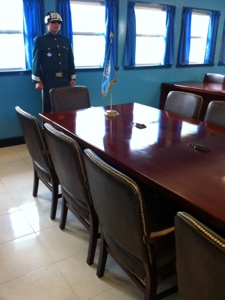
This room is very sad. A conference room where no one meets to talk. Where one side is locked out at all times. Visited only by tourists with cameras under heavy guard.
There is one North Korean – with binoculars watching us from the front of their building. According to Gina – there might be more soldiers inside – but we can not see them. On the South Side – there are soldiers watching the North side to be sure nothing happens to us. So our pictures are just of their backs. There are UN forces, there are ROK (Republic of Korea) forces, and there are MP’s. It’s all very very proper.
We enter ‘Freedom’ House – which is the one place that crosses into North Korea, and are allowed to take pictures. We then form 2 lines, and march back onto South Korean soil where we are allowed to take pictures of the guy watching us.
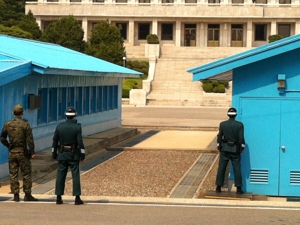
From there – it’s back to the bus. We stop twice more – at the sites of the 2 ‘incidences’ – and then there are no more pictures until we are back at the Gift shop.
My feelings – these guys are armed – and stand all day facing down an enemy that is also armed. They all wear sunglasses – even at night – so that eye contact can not be made (that was determined to be too dangerous). They take their jobs very seriously – although according to our guide – a large part of their job these days is to find and de-fuse all the land mind that were planted in the DMZ – over 90% of which have not been found.
It is a very sad place. I’m personally not proud of what happened here – and I can only hope, like all the South Korean’s I spoke with – that some days, some how – re-unification happens. Over 10 million families were separated when the DMZ was created. The personal agony is considerable, but the South Koreans have hope that the resolution will come in their lifetimes.












 Musings and Mutterings of a Montreal Madame