The Pergamon Museum – Justifiably one of the top Museums in the world


I love Berlin – Munich was fun, Nuremburg was intriguing, the Battle of Leipzig was a lot of work but well worth doing, but Berlin – ah, Berlin.

I keep thinking that I’ll round a corner and bump into Sally Bowles – or at least someone with painted nails and an over-the-top carefree attitude. Instead I’m seeing students on their way to class, well dressed women and men heading here, there, and wherever – and of course lots of tourists. There are glorious shops, bakeries with goodies that defy description, out-door terraces even in late October, trams everywhere – and a remarkable lack – at least here in the ‘old’ city – of sky scrapers. It’s a city scape without the negative aspects. I love Berlin.

And I adored the Pergamon Museum. All the guide books mention it, it’s on every list, every top ten compilation, and was even featured on Museum Secrets. But all the hoo-ha aside – nothing prepares you for the glory of this museum.

We knew the crowds might be an issue – even as off-season as we are – so we pre-purchased a 3 day museum pass for 24 Euros (12 for me with my student card). This acts as your ticket – and allows you to by-pass every line. Cool deal – save money and time. My kind of discount card! Even so – we showed up at the door to the Pergamon at 9:45 (it opens at 10) – just to be on the safe side. At the dot of 10 they opened the doors, we picked up our free (nice price point) audio guides, and walked in.

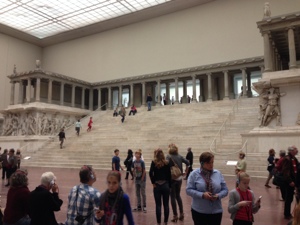
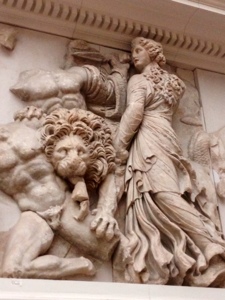
Oh My. Wow. Amazing. Astounding. Mind-blowing. Words simply don’t describe the glory of the Pergamon Altar. I had to sit down, it is that stunningly beautiful. The building was actual built just to house the Altar – and you can argue about moving antiquities out of situ all you want – this totally works.

20131025-180649.jpg

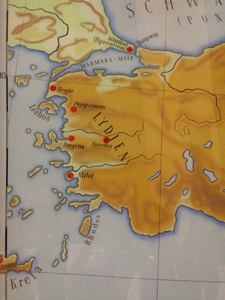
I’ve actually been to Ephesus, 180 km from Pergamon in Turkey, and one of the other 7 churches of Asia cited in the book of Revelations – and I have to tell you – seeing the Pergamon Altar was just as amazing – without the hours of travel, the heat, the crowds, and the challenges of visiting turkey. Plus it’s in a lot better condition.

http://en.wikipedia.org/wiki/Ephesus

20131025-180642.jpg

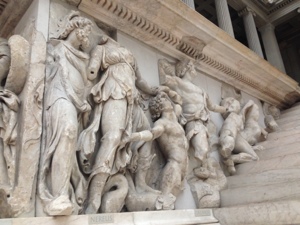
The extremely well done audio guide talks you through not only the altar itself – but through the models also presented, as well as giving you a brief over-view of the history of the find and the challenges of getting it to Berlin. Underneath the Altar in the back is a quick, but fascinating introduction to the challenges involved in piecing together the magnificent frieze that run around the altar. The entire thing – Altar, Frieze, description, Models, Museum – are simply breath-taking.

20131025-180656.jpg

20131025-180703.jpg

But that’s not all!

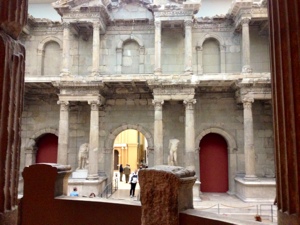
In the same building is the Market Gate of Miletus – along with one of the best preserved large Roman mosaics I’ve ever seen. You literally walk through a narrow door from the Pergamon Altar to the Gate. At 50 feet tall – the marble gate quite literally towers above your head – impossible to take in at one glance.

20131025-180710.jpg

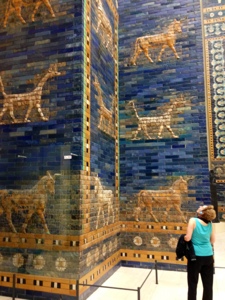
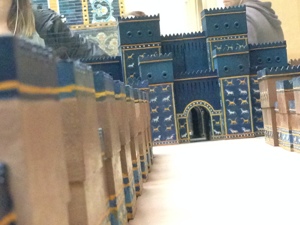
After admiring this feet of ancient engineering – you proceed to the ultimate expression of Ancient Building Technique – the Istar Gate.

20131025-180718.jpg

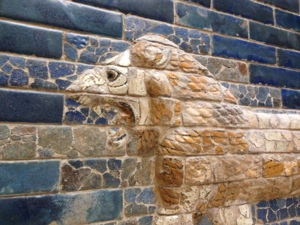
Jaw droppingly beautiful – It accomplishes exactly the desired result – admiration for the King that could commission such magnificence to be built-in Babylon. It is impossible to face this gate without feeling the awe and fear that anyone coming into this city must have known. You literally are surprised when there are no camels, no bells, no procession.

20131025-180725.jpg

20131025-180733.jpg

After these 3 uniquely huge and marvelously well-preserved examples of ancient art, it wouldn’t even matter if the next door was the exit. You’d have gotten your money worth.

But of course – there is still more. There’s a copy of the Stela of Hammurabi, a huge part of the walls of the Caliph’s Palace of Mshatta, and finally the Aleppo Room. The processional way of Babylon, the huge carved half beast half men that guard the entrances to palaces in the ancient world, and even the elaborately beautiful jewelry takes a bad second place to these incredible finds.

Did I tell you I love Berlin yet? Well I do.

Best History Museum Ever!


Ok – it’s an odd fascination – but I actually enjoy History Museums – particularly if they are well done. They always tell you something about the culture of the country – or at least about what the government thinks is important to know.

Given the outlines of Current German history – Loved Napoleon, Hated Napoleon, Wanted a Democracy, Didn’t want a Democracy, Started World War I, Lost World War I, Had a Democracy that actually elected Hitler, Started World War II, Lost World War II, Got Divided, Got United, and now has a Democracy – well – the history museum in Berlin was bound to be interesting.

Particularly in comparison to say – Canada.

So we coughed up the big bucks – thank goodness for my Student Card – I was 1/2 price – and immediately started with the special exhibit on Leipzig 1813. Given that we’d just been there re-enacting the battle – seeing what the curators at the Deutsches Historisches Museum had to say was bound to be interesting. And it was. The exhibit – clearly taking the German point of view, started with a very famous painting showing the victors of the battle – the King of Prussia (Germany), Emperor of Austria and the Emperor of Russia – getting news of the victory. From there – the curators decided what to show – and what not to show.

The exhibit started with guns, wagon wheels and cannons – the tools of war. It also featured the skelton of a horse – found in a mass grave at the battle field site. From there it went into a brief history of Napoleon, from the point of view of his opponents. His errors are pointed out – and while mention of the Code Civil is made, the point is also made that the application of the Code was hardly even. Yes, feudal estates were broken up – but often they were just handed over to his relatives. And while his emphasis on promotion thru ability rather than family position was mentioned, it was also pointed out that his opponents learned the same lesson, and applied much of the same strategy by the end of the war. A lot of attention was focused on the forced draft in France – and the ‘volunteer’ armies of his opponents. Certainly the history they showed, and the history we thought we knew were quite different.

And as I’ve mentioned before – that’s what makes going to history museums in other countries so fascinating – there is always more than one point of view.

The exhibit ended with a short video about the re-enactment of the battle of Leipzig in 2012 – and in many ways – this was the most striking section. Instead of 6000 re-enactors – there were about 600 – and instead of using a portion of the actual battle field – they used the small field that we’d used to assemble just the french troops. Oh what a difference a year makes.

I left the exhibt amazed at the organization required to put on the re-enactment I had just participated in. It was incredible.

From that special exhibit, we worked our way over to the general section of the history museum, admiring the architecture as we went. The museum is huge – and we opted to skip most of it, and focus just on the sections that interested us most – 1778 onwards. The section for 1778 to 1816 – which covered the battles against Napoleon featured some wonderful pieces of art – including a painting of Napoleon in his corination robes – and most impressively – his hat, sword, and stirrups – left in his carriage at Waterloo in 1815 when he excaped after the disaster to Paris. Cool.

From there we read with great interest – and some surprise – the German perspective on the lead-up to World War I, the elation followed by the depression of the results of that war, and then the negative feelings about the treaty of Versaile. In the German history – it is that treaty more than anything else that brought about the conditions that allowed Hitler and his minons to appeal to such a wide audience. The museum contains a significant section effectively appologizing for the treatment of the Jews, the Roma, and the handicapped. There is no attempt to sugar coat that truth. The run-up to World War II is covered in great detail, as is what was happening in Germany during the war. After the war, the division is described, and the museum ends history in 2000 – 10 years after the fall of the Wall and the re-unification of Germany.

This is an outstanding muesum. Not one that you want to zip thru – but one that you want to slowly see – hear – experience. There are English signs in most sections, but getting the audio guide is well worth the small expense. The descriptions are absolutely reviting. We effectively got ‘kicked’ out by the closing bells.

Great Museum. Definitely a must go!

20131025-103006.jpg

The Madness Continues – Another stunning castle, another wasted 3 years


Ludwig II continued… Or where he really lived…

Ludwig never lived in Neuschwanstein. He did spend some time overseeing the construction work from the Gate House. So where was he living while his dream castle was being built?

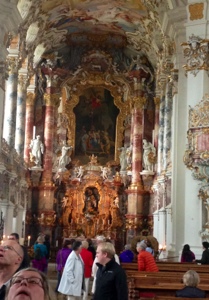
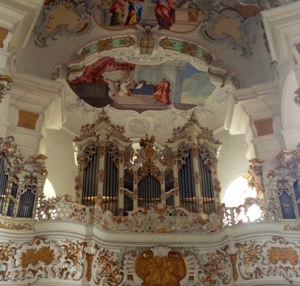
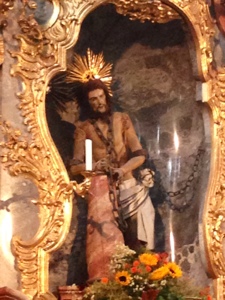
Linderhof Castle – our stop after a quick visit to the glorious pilgrimage Church at Wies.

20131017-001212.jpg

You can read all about it – and its miraculous statue of Christ here:

http://en.wikipedia.org/wiki/Wieskirche

20131017-001220.jpg

20131017-001228.jpg

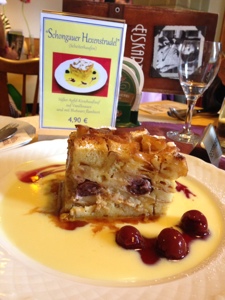
The Church boggles the mind – it’s a whirlwind of Rocco madness. If you’ve seen one cherub – you’ve seen a hundred. After our walk thru, and hungry for lunch, we popped into the restaurant just opposite the door to the church. Surprisingly yummy – I opted for dessert – HexenStrudel – and I had the best meal! Oh it delcious. Color me content if there a nice sweet cake to enjoy.

20131017-001238.jpg

Tummy happy – it’s on to the Linderhof.

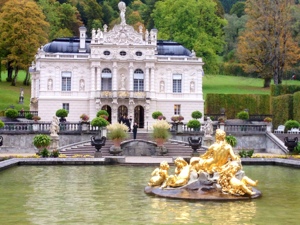
Linderhof Castle is located in an isolated area – a short distance as the crow flies from the drop dead splendor fo Neuschwanstein – but if the crow is driving a gear shift car – it’s an hour on curvy country roads. Worth the trip though – this is a wonderful castle to see – made more interesting by the fact that Ludwig II actually lived here in almost absolute isolation for the last 3 years of his life.

20131017-001246.jpg

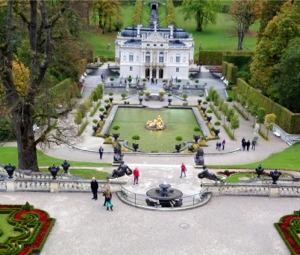
Linderhof, unlike Neuschwanstein, is located on rolling grounds that lend themselves nicely to some serious landscape gardening. Opposite the front door is a large pool – with a highly decorative and very attractive fountain that ‘erupts’ every 15 minutes. Ludwig II had been to the worlds fair in Paris (1867) – and had seen Versailles – so he decorated Linderhof to honor the Sun King – Louis XV. It’s filled with gifts given Ludwig from various monarch, and planned so that Ludwig could live here without seeing his servants.

For example – his dining room features a table that sinks into the kitchen so it can be set and served – then ropes pulled to raise the table in front of the king. No servants to ignore. Perfect.

Like Neuschwanstein, you must take a guided tour. Unlike Neuschwanstein, the out-of-the-way location and less dramatic appearance keeps the crowds away. In our tour group there were just 7 people – the guide, us (English), our friends (German), and a couple of Russians. So our guide handed out printed books to our friends and the Russians – and gave us the best tour ever. She showed us hidden cabinets and staircases that the servants used to hide from Ludwig. She pointed out details on paintings and explained Ludwig II’s fascination with the Sun King and his mistresses. And most importantly – made sure we knew to go visit the ‘Venus Grotto’.

Following her directions, we wandered into the extensive gardens, admired the arbors and various planting – including the magnificent waterfall system framed to perfection by the windows of Ludwig II bedroom. You can see it behind the Castle in the picture taken from the top of the landscaped buildings in front of the castle.

20131017-001305.jpg

Eventually we make it to the Venus Grotto – and again must wait for a tour group. Well worth the wait I have to tell you! Ludwig II was enraptured by Richard Wagner’s operas – and the fact that scene painters not architects were asked to design Neuswanstein is well know. Less well-known is that he had the same person design for him a personal grotto. The place is huge – completely artificial of course – with a oversided rough shaped pool and a swan boat for the king to relax in while singers and the chorus performed Wagner’s operas from ‘shore’. All for an audience of exactly one. The hight of extravagance – a 25′ waterfall that turns on and off on command.

Futher foolishness – while at the Worlds Fair in 1867, Ludwig saw the Moroccan exhibit – and bought it! It now sits proudly in the garden of Linderhof.

Magnificat decor, beautiful furniture, and a fascinating back history. The Linderhof is worth driving out-of-the-way for.

Ludwig II – Never envy the life of the rich and bored!


In 1868, at age 18, Ludwig II became the king of Bavaria. But the times they were a-changing! He could never be an absolute ruler as he wished – instead he had to tread a very careful path around Bismark – a task for which he was apparently ill prepared. The result – a war that ended badly, and a rank of king only in name.

But he had money – and nothing really to do. So he retreated into a life of fairy tales and Wagner inspired Grand gestures. Friendless at the end, but surrounded by servants – his cause of death in 1886 remains a mystery – although the ill minded might wonder about his uncle, who became regent upon Ludwig II death and ruled for quite some time.

Sad life aside – Ludwig II wanted to build things – things that people would remember. And build he certainly did. We visited only 2 of his 8 palaces, one of which I’ll chat about today – the other tomorrow.

20131016-232925.jpg

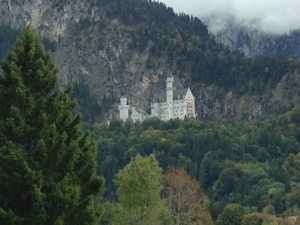
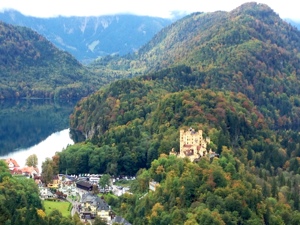
We also saw a third (Hohenschwangau) from a distance. That was more than enough to get the general idea- this was a king that loved the ornate, the over-the-top, the extreme. And he had the money to make it happen.

20131016-232851.jpg

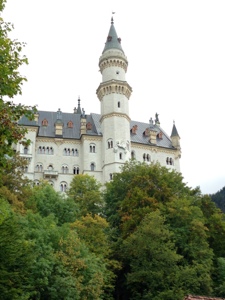
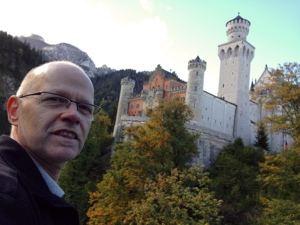
Neuschwanstein Castle is the stuff of picture books and Disney fairy tale fame. It’s not hard to imagine that Disney used Neuschwanstein as his model for Cinderella’s castle – even the guide books admit that this is one of the most famous buildings in the world.

But Ludwig II only spent about 8 nights here – by all accounts he visited during the multi-year construction, but there were never any parties, any balls, any sparkling lights and magnificently dressed people – not in reality. But on the walls – Ludwig fished his wish. Heros of Wagner Operas are everywhere – proud, glorious, and for many – insane. The tour (it’s required that you take a tour – no self touring) needs to be reserved ahead – but if you are aware of that – the reservation is free, and the time you will save is counted in multiple hours. We walked in, walked up to the booth, paid and left. Others were less lucky – and dealt with snaky lines that looped and curled. Don’t do that – reserve your tour!

Just a note – I don’t think you actually reserve a time – just a date. I’m not sure – but I typed in 11:00 as my desired time – and when we arrived – our tour ticket was 11:30. Not completely sure how that happened – I wasn’t the one who paid for the tickets. On the other hand – since we had 2 German speakers and 2 English speakers – they may have decided the only good choice was the tour with audio guides!

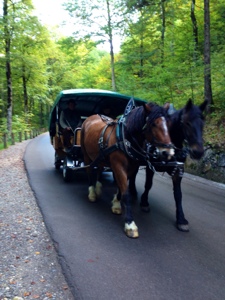
Anyway – cars are not allowed on the access road – only horse-drawn carriages and people walking.

20131016-232819.jpg

Shuttle buses take a completely different route. We thought we’d take the carriages – realized that the line was seriously long – and opted to walk. Good thing. No carriages passed us on the entire walk up. And it was a very easy walk, along a paved road through a forest. About 3/4 of the way up is the ‘carriage’ stop – and from there the views just get better and better.

It’s a completely beautiful castle. No wonder it’s one of the top tourist spots in Germany. I get it. Totally get it!

20131016-232808.jpg

We had plenty of time to wander around the outside and take pictures – if the tour starts at 11:30 – it’s going to start at 11:30. This is Germany you know. There are normally so many tourists – they have a loading now – and a pre-loading line. And still the wait without reservations can be hours. Part of the reason – it’s not that horribly expensive. Combine relatively inexpensive with seriously famous and you have a winner.

I carefully read the tripadvisor reviews before hand – and while the advice to get reservations is a winner – along with the advice to come early – the occasional complaint about the number of rooms you can see is completely unfounded. The issue isn’t the number of rooms you visit – it’s the number of rooms that were completed! And the rooms are huge. confiding that Ludwig was effectively hermit – it makes the castle even more amazing.

Ludwig II had two floors completely done when he fled here in an attempt to escape the government representatives who were coming to put him in an insane asylum. But those 2 floors are wonderful. The life-size murals telling the legends that Wagner immortalized in his opera are simply stunning.

The only sad thing is the speed that you must move thru in order to stay with your group. I actually ended up with the group after mine – caught between locked doors. No matter – that guide just waved a smile and continued on with their explanations.

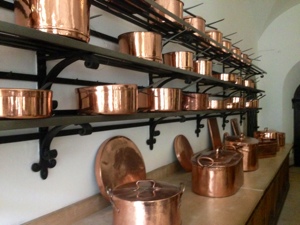
You are not allowed to take pictures inside (they want to sell those postcards) – but you can take pictures in the kitchen. Got to love copper pans, eh?

20131016-232902.jpg

One of the best parts of the tour is one not often mentioned in the reviews. After you tour the castle, you end up at the restaurant. Decent prices, and standard German food awaits there. But across the hall is a stellar exhibit – a video subtitled in at least 3 languages that shows using animated sequences the history of the building of the castle. it shows the original medieval forts that determined the shape of the foundation, it showed the castle being built step by step – and most importantly it showed what was on the original plans, but never brought to fruition.

Ludwig had planned on a Knight’s bath – effectively a private hot tub just for him. He’d also imagined a huge secondary terrace and overview on the Western side of the castle – the one overlooking his childhood home, the Schloss Hohenschwanagau. That’s the castle we saw from a distance, but never visited.

20131016-232830.jpg

After seeing the castle and watching the video, I was so impressed by the beauty of the paintings – not to mention the gold and gilt and ornamentation – I actually bought a story book that summarized the legends emblazoned on the walls.

Bottom line – worth the trip!

3 Museums – One Day – Don’t do it!


Only the foolish would try for 3 world class museums in one day – well color me foolish!

One of the big reasons I stopped doing group tours was the rush rush wait kind of thing. The tour leader would have a huge long list of things that we must see that day – and his job was to carol the rest of us into going along – regardless of what we’d miss along the way.

So I wasn’t too keen to discover that we were going to attempt the same crazy stunt – but without a tour leader! In Munich – there are 4 major museums – all art museums – within about 1 minute walk of each other. Alte Pinakothek, Neue Pinakothek, the Museum of Modern Art and the Brandhorst. We’d picked the 2 Pinakotheks and the Museum of Modern art as our targets of the day – and got a good start, arriving at the front of door of the Alte Pinakothek at about 9:30. Unfortunately – it doesn’t open till 10:00. Sigh.

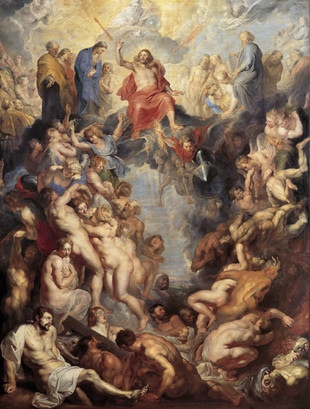
I’m not keen on sitting or standing around in the cold and wet – under any circumstances – so naturally we opted to stroll the neighborhood. Which put us back at the Alte Pinakothek at about 10:15. So much for that early start. Bathroom, ticket purchase, ear phone instructions – and we’re off. The Alte Pinakothek was built by Ludwig I around 1800 for one purpose and one purpose only – to house the most amazing painting by Rubens you’ve every seen. It’s huge – its stunning – and its in a room filled with other examples of his (Peter Paul Rubens) work. I loved that part of the museum the absolute best. There were seats, the explanations were interesting, and the art incredible. There is something so emotional about the works – you can feel the tensions of the damned and glee of the demons without even understanding the story.

20131014-000220.jpg

Also on display are a group of Rembrandt’s. The best to my mind is his rendition of the story of Jacob and Issac on the mountain. Jacob has bent back the neck of his favorite son in preparation for the sacrifice – and is literally saved by the bell. Stunningly beautiful.

There were lots of other paintings to gauk at of course – but the work of those 2 artists is reason enough to go to Munich!

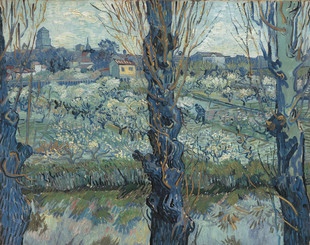
Next up – a smuggled in lunch and the Neue Pinoteck. This museum was set up by Ludwig II – and takes up where the other leaves off – starting around 1810 or so. The highlight here are the two Vincent Van Gogh paintings. The sunflower series is known world-wide, it’s iconic – and here is one of them – close enough to touch if the museum guards turn their backs. There is also one of his from the late Arles period – gay to look at quickly, emotionally depressed and isolated you feel as you identify the details – the water separating the viewer from safety and warmth, the lone peasant hunched against a cold wind only he can see. Glorious.

20131014-000457.jpg

Third – there’s the Modern Art Museum. We scored free tickets – not sure how that happened – got our ear phone sets and started to Explore. This gigantic space (are all Modern Art Museums huge?) is sub-divided into 5 sections – A special exhibit with art collected by one gentleman – Theo Wormland – consisting of mostly Max Ernst and Rene Magritte paintings, there’s the collection of the museum, there was another special exhibit of prints by Andy Warhol, there is the ‘Architecture’ Space, and final there is the Museum of Design. Each could stand on its own – as a group they are overwhelming and exhausting. Wouldn’t miss seeing it – but boy was I tried afterwards.

My clear favorites – some of the drawings – simple lines, yet so much emotion. I loved the collection called Dream Scapes. While Max Ernst’s work leaves you feeling depressed and unhappy – I have always loved the work of Magritte and Dali. What leaves you stunned is the thought that this one man would have the foresight to invest in this art when all the rest of the world thought these artists were completely crazy.

At closing time we drag ourselves out – we have dinner reservations at 7:00 (check out my review of the Atelier – it was dynamite) – but before that we must pay homage to the tomb of Josephine’s son from her first marriage and Napoleon’s Step-son – Eugene de Beauharnais. He’s buried in the Church of St. Michael – and we arrive just as services begin. Organ playing, lights on – beautiful. After the service ends, we check out the tomb. Victor is quite disappointed – they’ve dressed Eugene in a toga. Whatever for – he was in charge of the Chasseurs à Cheval of the Imperial Guard – surely a Chasseur uniform would have been better? But if it’s your tomb – you can do what you want.

We walk quietly back towards the restaurant – I’m thinking about my cold wet feet – Vic is still mad that Eugene is wearing a toga for all eternity.

Deutsches Museum in Munich – less than the sum of it’s parts


Don’t get me wrong – the biggest ‘Technology’ and ‘Science’ Museum in Germany is well worth visiting – it’s just that the parts are so large – it’s hard to focus.

The Deutsches Museum is all about ‘size matters’. Unlike most museums that are content with models, or electronic aids – this Museum wants the real thing. So there’s a life-size section of a Lufthansa Passenger jet showing the typical 2 – 4 – 2 seating- with the luggage containers below. There’s a real U-boat – the last of its kind, saved from destruction in 1919 by the founder of the museum, and sliced open so visitors can see the insides – from stem to stern. There are full-sized water wheels, running of course – even a full-sized sail boat used for fishing off the North Atlantic sea. At one point, you walk into the staterooms and then onto the deck of a cross Atlantic steamer – circa 1950.

It would be impossible to list all the stuff crammed into the museum – let alone see it all. But I did have one favorite part – and it’s wasn’t even on the must see sections!

To me the highlight of the museum was the Mining section. Why – because they devoted basically 1/2 the basement to full-sized, walk thru, mines. Dark, dripping with water, dirt or wooden floored as appropriate – these ‘mines’ felt like the real thing. And since I’ve been in the real thing several times – I feel justified in saying that.

20131008-231348.jpg

To trace the changes in mining technology over the past 200 years – they have created mines worked by hand, complete with miners using lamps to claw coal from the earth. Exit that mine – and you are in a salt mine – with life-sized miners using pick-axes to cut salt ‘cubes’ from the walls. Walk a bit further, and you are in more mechanized times – horse-drawn sleds, tracks running beneath your feet, electric lights. Just a bit further – and you are face to face with gigantic mining machines with bits larger than a human. This is a truly impressive bit of display work – it would be hard to leave without a feeling of pity for anyone who would have to earn their living under the earth!

20131008-231400.jpg

Another truly fascinating section dealt with nano-technologies. This section used the very latest in museum technologies – you passed your hand over an object – and in German and English the object was explained in quite significant detail. Neat technology – but not the best at conveying information. Because you had to pick what to learn about – it was easy to by-pass important things, and get intrigued by something less critical. Basically a confusing exhibit – but very cool technology.

Another exhibit that couldn’t help but admire – but have to admit that the designers went so far – and then dropped the ball – was in the Pharmaceutical section. There you see a picture of a naked woman (this is Europe – no clothing, no problems), are forced to focus on her eye, from there to a piece of skin above her eye, and from there to a skin cell. You then turn right – and actually enter the cell – blown up 10000 times to make room for probably 30 visitors at once. So far – so cool – but then the designers ran out of ideas. Once in the cell – it’s back to basic explanation – mostly in German. Oh well. I did like that one section of floor looked like cell wall – I think the entire floor should have been made like that – it would have been far more impressive.

There’s also a model train layout – huge of course – HO scale – that is ‘animated’ 3 times a day. When animated, the cameras on the front of the trains are turned on – and you see the scene from the perspective of the engineer. A very neat effect.

Under the – scare the wits out of people heading – they have a huge exhibit on static electricity – which ends with a house bursting into flames from a lightning strike. Very noisy – but not something I haven’t seen before.

The very highly reviewed Physics section has every mechanical advantage demonstration tool I’ve ever seen – very hands on – very fun – but limited explanations. I was left thinking that kids probably press the buttons – pull the levers – and roll the balls – and then walk out – none the wiser.

Bottom line – Do go. It’s way cool to see the full-sized planes, boats, power tools, printing presses, telephone exchanges, even an old IBM 360 – the computer I learned to program on in 1966. Be sure to visit the Mining section – you’ll have to hike down stairs quite a bit – and then gradually work your way up thru the various exhibits – but it’s truly amazing. Don’t be surprised at the lack of English – some sections are well labeled, others have nary a word of English. And Don’t expect an audio guide. You will be disappointed. But I’d rate the Mining section alone a must see in Munich. I’ve never seen anything better anywhere – and that includes really coal and silver mines!

Life Styles of the Rich and Famous – the Princess of Thurn and Taxis for example


Regensburg, Germany is a relatively small – but historically important walled city in Germany. The old town dates back to the stone age – and for quite some time – it served as the capital of Bavaria. The ecclesiastical part of Charlemagne’s General Assembly was held here in 792. So this town is no sleeper!

We visited for 2 main reasons – one to visit the ‘Schloss’ or Palace of the Prince of Thurn and Taxis, and 2nd to see the stone bridge that part of Napoleon’s army (the 3me ligne) fought hard and long to win in 1809.

Seeing the bridge was easy. It’s just there. But seeing the Palace – naturally that required some planning ahead. Regine (one of our German friends who lives in Switzerland) made reservations for us weeks ago – and it was a good thing too – getting English tours is consistently challenging here in Germany.

Why did Regensburg rate having the Prince of Thurn and Taxis build a Palace? It turns out that from 1663 until 1806 – Regensburg was the permanent seat of the Imperial Diet of the Holy Roman Empire, which of course made it very important. That wasn’t enough – what got the Palace built was the relocation of the Reichpost to Regensburg in 1748 – and as the head of the Post – the Prince of Thurn and Taxis needed a new home. However – they didn’t take possession of this Palace until 1812, when secularization laws forced the Benedictine Order to give up possession of the Cloisters of St. Emmeram, and the property came into the ownership of the family of Thurn and Taxis.

According to our tour guide – the family of Thurn and Taxis rated the inherited title of Postmaster General because the idea of postal stations was their invention. The pony express concept – horses and riders waiting at stations along the route – so the mail never starts – was invented by this family between 1200 and 1400.

Don’t believe me – check it out at Wikipedia:
http://en.wikipedia.org/wiki/Thurn_und_Taxis

With all the visitors coming and going – having a nice place to entertain was important. And so the Palace was built using part of the Monastery of St. Emmeram. It’s been maintained because the family still lives on the upper floors and is reported to be one of the wealthiest in Germany!

Their story doesn’t end badly – despite eventually losing all the lucrative postal business to the government starting in 1806 as Germany was increasingly centralized. They recovered part of the business for a while by creating a company (Thurn and Taxis Post) – but eventually the entire thing became a government monopoly.

http://en.wikipedia.org/wiki/Thurn-und-Taxis_Post

Because the Palace and the Monastery are in fact co-joined – a visit to the Palace includes a tour of the remaining portion of the Cloister – primarily the hall and the church. Outside of the Palace compound, but also part of the same complex is the Church of St. Emmeran – also worth visiting. It’s wooden painted ceiling is hundreds of years old. When we were there – they were setting up for a wedding – a combination of old and new – with music ranging from ‘You light up my Life’ to ‘Somewhere beyond the Sea’. Blue and White balloons contributed to the festive air!

If the Palace were just a museum – it would be interesting. But what make the Palace special, as I mentioned before, is that current Princess of Thurn and Taxis (Gloria) still lives in the Palace, along with her son and 2 daughters. She has her own line of jams, jellies, and wines – and has written (with maybe some help) several books on what it is like to be a member of royalty. She was quite young when she married the former prince – so it’s not a huge surprise that today she’s the regent for her son. If you check out her history – she had quite a wild youth (from a being a waitress in St. Moritz to becoming the wife of a hugely wealthy, much much older man has to have been a challenge), but when hit with inheritance taxes (by some reports – over $2 billion), she quickly settled down into a remarkable business woman. Check her out in detail at:

http://en.wikipedia.org/wiki/Gloria,_Princess_of_Thurn_and_Taxis

Until 1998 the family owned a brewery, and despite selling the ‘firm’ to the Paulaner Group, they still have their own brand – Thurn and Taxis of course.

They even have their own board game.

On the walls were several outstanding pieces of modern art – nestled along side century old tapestries, glorious inlaid tables, and magnificent ceiling paintings. My favorite painting is of one of Therese, wife of Karl Alexander, 5th Prince of Thurn and Taxis – painted in 1811 – and showing her sporting the new style of ‘undress’ or Regency Style clothing made famous by Josephine, wife of Napoleon!

20131007-223340.jpg

http://en.wikipedia.org/wiki/Duchess_Therese_of_Mecklenburg-Strelitz

My favorite part of the house? The ballroom of course. Decorated extensively in high fashion Rocco gold and gilt – and fitted with electric lights (the family still lives here – remember) – you can easily envision elegantly clad men and women dancing the evening away.

Sigh

Beer and my long lost tea pot – Color me Happy!


Sometimes a little imagination can go a really long way – and that’s pretty much sums up the art of Friedensreich Hundertwasser – or Fred Hundred Waters. I first saw his work in Montreal – the Museum of Fine Arts mounted an exposition – and I was totally blown away. Known for his outstanding use of colors and design – and lack of anything resembling straight lines – I promptly invested in one of his posters.

Several years later – in around 2005, I saw his tea cups – well, not really his tea cups – but tea/coffee cups that one of the high-end German porcelain producers made featuring his art. It was love at first sight. But I could only afford 6 mugs and saucers – the tea-pot that matched just seemed an impossible purchase. Naturally – I’ve mourned that decision for years – and have carefully been keeping my eyes out for it. Never saw it again.

Fast forward to October 2013 – Our wonderful German hosts suggested that we visit one of the best and oldest breweries in Bavaria – Kuchlbauer. Being rather keen beer drinkers – and always fond of the lighter ‘Wheat’ beers – we promptly agreed. Now imagine our surprise when we found out that not only are they known for their beer, their copy of the last supper (full size and painted in a grotto), and their singing dwarfs (I kid you not) – they have an amazing Hundertwasser designed tower. Beer and probably my favorite artist – it’s a plan!

20131007-124107.jpg

So we drive to the brewery. Next to the parking lot is the newest work being built life-sized from his plans – I think it’s a church – but you can judge for yourself.

20131007-130652.jpg

After taking a long hard look at this newest example of art on the loose, we enter and sign up for the tour. It’s a bit pricy as these things go – but the gal selling tickets promises us it will be worth it. Things don’t start off that well – because it’s German Unification Day – there are no workers to observe – so while we can admire the equipment – it’s not really functional.

20131007-124127.jpg

Things go from ok to weird when we enter a grotto and are serenaded by dwarfs that represent the steps to beer making. Or at least I think that’s what they were singing about – it was all in German.

From there it was out into the daylight – and finally our look at the tower. It’s pretty cool.

20131007-124205.jpg

Inside the brewery there were demo versions, at least one built by Hundertwasser himself, the rest built by local artists following his designs. But for the real thing – you must go outside. Wow. What a tower. We climb the 150 steps to the top – admire the view of the totally solar-powered brewery below us – and then climb down.

20131007-125153.jpg

Now it’s time for beer tasting – and in German a taste is at least a 1/2 litre! They give us 4 bottles of beer and 4 wonderful tasting pretzels, my favorite part. We enjoy the beer, scarf down the pretzels, and then decide to buy 4 of the very unique beer glasses they are using. Victor sends me into the shop on my own – and what do I see? My tea-pot! Finally – I found it. Or perhaps better said – it found me.

20131007-130243.jpg

We have an emotional reunion, and I leave the proud owner of the most amazing tea-pot – and 4 beer glasses – gift from the owner of the brewery who was delighted to finally sell the tea-pot!

Great tour, Good beer, and my tea-pot – I’m happy!

20131008-104535.jpg

BMW Welt (World) – It’s all about the Cars!


Our friend Helmut works for BMW – so a visit to their house was definitely going to include a plant visit. What I didn’t expect to find was an organized touring schedule – replete with packaged video’s, museum quality audio projection system for the tour guide, and naturally – a up close and personal visit with your friendly robots! But BMW sees plant tours as a marketing tour – and packages them accordingly. Unlike Porsche, which wanted over $700 to do a plant tour – the BMW tours are reasonable, which explains why they were complete booked the day we went. Thank goodness for reservations.

Anyway – the tour. You begin at the BMW welt – a specially designed massive building part of which is shaped like 2 stacked cones.

20131007-132333.jpg

Inside the glass doors are several huge areas devoted to various BMW product lines – there’s a section for the mini, there’s a ‘junior’ world exhibit to keep kids entertained (and informed), and on the 2nd floor – the personal car pick-up zone. If you come to Munich to take possession of your new car – you can expect only the best! A private dining room, your car presented on its own rotating platform, and then a personal ‘road’ out of the Welt and onto the streets of Munich. Nice.

For the average Soup Lady and friends – there’s a cafe offering drinks and light meals, a BMW life-style shop, a motorcycle demo which had the helmeted rider going up and down huge staircases, and the plant tour. The tour starts with a nicely produced video of the history of BMW, including an apology for using forced labor during WWII. Then a quick safety lecture (no walking outside the yellow lines, no pictures, no cell phones, no leaving the group), and we’re off.
The sprawling plant was originally built far from the city center, but the city of Munich has grown around it. There’s now a metro station right at the entrance – and across the street are the left-over buildings of the 1972 Olympics. Surrounded on all sides by housing, shops, and streets, the BMW plant blends into its surroundings, hidden in plain view.

Our tour takes us into the starting point of every BMW vehicle – the press room. Huge automated presses take flat steel and create the frames of the cars. These frames are then transported to huge rooms filled with Robots that pick up each piece, identify the type of car to be built, and then glue or bolt or spot weld the frames together.

The Munich plant only makes 3 types of BMW cars – the 3 series coupe and wagon, and the 4 series coupe. That means only 2 basic body types – but lots of options for paint color, engine, and interior. And every car is pre-sold! So each car – starting at the press room – is already pre-defined for its final look. The task is to make this happen without stopping between the steps.

Once the humanoid acting robots do the spot welding, the frames go to the body shop for their paint jobs. Robot ‘artists’ open the doors, spray on the multiple coats of paint, all while the cars are slowly moving continuously thru the plant. Attached to each frame is a transponder telling the robots what type of car, what color, what finishing needs to be done. The robots just follow the directions.

After painting, the cars spend several hours drying before the electronics, the seats, the dashboards, the chrome is carefully attached. As each car is pulled from the drying room – it joins an endless parade of cars – each being assembled. In the electronics section, there is a human ballet happening. Co-workers are assigned multi-function positions, and they rotate around the cars, standing on the conveyor belt so that they are standing still relative to the moving cars. The gas tanks are added, the padding inserted, the electronics attached. After each group of steps, a photograph is taken, and compared by both human and computer to the ‘model’. Any variation from the model is flagged – and the car removed from the assembly line for ‘repair’. Our guide explains that the system is so good that days can go by without a single car flagged for a ‘fix’.

We couldn’t tour the engine assembly room (the tour section is under renovation), but we did get to watch seats being assembled and put into moving baskets that would join up with the car assembly line just as the car for which they were intended made its appearance. Cool, eh?

It takes approximately 40 hours from rolled steel to finished car – as long as there is no problem on the line. When the cars roll off the line they are either loaded onto a train, or onto a truck for ‘local’ delivery. ‘Local’ includes the personal pick-up – but a truck is required because the cars must cross a road – and there would be too many individual cars.

We end up back where we started – having walked about 3 km around the plant.

Awesome tour – great robots – and naturally – now I really want to buy a BMW. Guess the marketing worked!

The ROM – Big, Overwhelming, Awe-Inspiring, Probably a Must Visit – Certainly a Must Shop


The newly redesigned entrance to this grande dame of the museum world says it all. The ROM is here to stay – and determined to stay impressive. We showed up at opening time – wanting to avoid the crowds that a civil holiday Monday were sure to inspire.

Like most major museums – there are the ‘permanent’ exhibits, and the traveling shows or special exhibits. We opted for a combined ticket that gave us access to everything – $26 each, but we’re talking a full day of walking, reading, listening and thinking. Worth it for adults, maybe not as child friendly as today’s kids might expect.

The ‘Special’ Exhibit during our visit was a very interesting one on Mesopotamia. Replete with some pretty new technology – like carved stone reliefs that came to life to show you the story they were telling in a more ‘modern’ fashion, seeing just this one exhibit took us most of the morning. That said – people shot past us frequently – either unable or unwilling to read and listen. But I found the content fascinating, the short ‘expert interviews’ appealing, and some of the technology on display impressive. My favorite, the recreation of the city of Babylon, complete with people walking the streets.

The permanent exhibits represent a quick look at just about every thing that caught the eye or interest of curators in the past. The guide gives you a handy hot list of the 13 or so ‘not to be missed’ exhibits – easily identified by the presence of a video monitor on a post nearby. Watching these quick intros into the why and wherefores of these major collectables was interesting to say the least. And believe it or not – took up all the rest of the day. It’s a huge place. Trust me on that!

For those who eat in Museums – I must say that I had some of the best food I’ve ever had in a museum in the unassuming ROM cafe. Delicious, reasonable, kid friendly, attractively presented. What’s not to like.

Is this my favorite museum in Toronto? No
Is this a must visit museum? If in Toronto, probably Yes
Would I see this one first? No
Would I see this one on my second day, or if the weather were terrible? Absolutely Yes

There you have it. The ROM
Visited August 2013