On the road again…


Travel is one way to discover who you are when you are not at home!

This time the Intrepid Traveller and I are doing a city tour. For those who have faithfully followed our adventures around the world – you will know that this is a tad unusual. Generally we are more ‘country’ centric – rather than ‘city’ centric. But I can easily explain the difference.

Reason for city tour #1 – we’re getting older. I hate to admit it – but it’s much harder to visit a country than a city. More short stays are hard on old backs and tired knees.

Reason for city tour #2 – we really, really wanted to see one city in particular – St. Petersburg. I know tons of people who’ve been there – and I’ve never heard one of them say – we stayed too long in St. Petersburg. So we figure – 2 weeks is just about a minimum for a city that large, that unique, that different! We shall see of course.

Reason for city tour #3 – I will never be the only driver of a rental car again. Never. I’m a bus, metro, train kinda gal – renting cars with the expense and responsibility involved – nope. So moving between cities is going to be public transit – and in this case – plane!

So – our city tour is centered on 4 cities.

City #1 – Roissey en France. Yes – lowly little Roissey – hard by the Charles De Gaul Airport, and primarily known for it’s zillions of cheap bedrooms for tourists in transit – it’s our first stop. Ok – it’s really a transit city for us too – but we’re taking a full day to explore it before we move on.

City #2 – Berlin. Ah – the sausages – the pretzels – the beer. Well – since the Intrepid Traveller doesn’t ‘do’ beer – perhaps we’ll have to work around that highlight. And of course the Berlin Wall. Our real reason for including Berlin this time – it was on the Intrepid Traveller’s Hit List – and who am I to not want to fulfill her wishes?

City #3 – St. Petersburg. The point of the trip – the highlight, the raison d’etre. 2 weeks here to savor the sights, visit the museums, and go to the Theatre.

City #4 – Brussels. Why Brussels – well, we needed a city that Air Transact flew from non-stop in order to get the Intrepid Traveller back to Montreal. And we needed a city worth visiting, and we really didn’t want Paris. Option – Brussels. Besides – I hear Napoleon might be massing his troups to the south – who am I to avoid good battle?

So that’s the plan – let’s see how it all plays out.

Signing out to fly to Roissey en France (aka Charles De Gaul Airport) – The Soup Lady and the Intrepid Traveller.

Suggestion 2 – How to Travel far from the ‘Madding Crowd’


Connect with people, and try to understand them.

Oh – interesting. How do you ‘connect’ with people in general – and with people who live in a different place and speak a different language in particular.

This is a pretty important question – I have issues meeting my next door neighbors – how do I start up a conversation with someone in Bali? Berlin? St. Petersburg?

Well – in my case – it’s actually easier to meet people when travelling then it is when I’m at home. This is particularly true when I make itinerary decisions that put me out into the public eye – staying in youth hostels for example.

When you stay in a youth hostel – you might not qet quality time with locals – other than the hosts of the hostel – but you can be sure to get quality time with travellers who come from radically different backgrounds and parts of the world. I’ve meet and become friends with families from Polynesia while in Korea, chatted with people from Australia when in Rome, and memorably spent time avoiding Americans in almost every hostel I’ve been in! So – youth hostels, home stays, temple stays, Air BnB – staying anywhere other than a name brand hotel is going to put you in a position of getting to know other people. There is nothing quite like sharing a toilet and a kitchen to force conversation!

Another idea – do a group tour with a company that doesn’t cater to your kinda of folks. I know – it’s hard to break away from just booking with someone based in your country of origin – but the rewards can be huge. We have friends – really really good friends – in Germany and Switzerland because we booked our Botswana Safari thru a tour group based in Europe.

But neither of these ideas will net you local connections. The best way I’ve found to met locals is to smile. Ask Questions. Be interested in what they are doing. My travel partners sometimes get annoyed at me because this slows me down – but the net results are sometimes so amazing! I had dance lessons in Bali because I asked how to bend my fingers just so. I met a bride and groom on their wedding day (and have the pictures to prove it) because I wanted to know why there were fancy decorations outside of their home.

I wandered into a wedding in Vietnam in similar circumstances. Just color me curious – but if I see something interesting – I don’t rush by because I’m on a mission to get somewhere else – I slow down, look, watch, listen, admire, act interested. Language barriers amazingly drop away when your actions say – I’m curious!

Companion advice – don’t be judgmental. This is their world – admire it!

Another – well, let’s call it a trick – I photo-bomb. Seriously. If I see someone taking a picture of someone in their group – I’ll either offer to help – or I’ll join the photo. This is a huge ice breaker for most folks! They laugh – and then we do a group shot – and then logically start sharing our experiences – where are you from, where are you going. I’ve bonded with all kinds of people this way – and had people do the same with me. One memorable experience – in Japan on top of Mt Fuju. We saw people eating eggs with black shells – and were curious. We bought some too – and sat down to figure out what next. And here’s the fun part – people around us noticed our attempts – and immediately came over to offer advice, to give help – and to have their picture taken. I don’t speak Japanese – in those days few people in Japan spoke English – but we had a blast. Made our day!

Similar experience in Bali – we offered to help 3 gals get a group shot – and ended up learning that they were friends from Java – celebrating their 50th birthdays by taking a trip to Bali! We chatted for a few minutes – exchanged email addresses – and moved on. Surprise – a day later – a photo of us, taken by them – just to say hi.

And my last, but not least, piece of advice. Talk to the kids. Smile at them, chat with them, pick easy words and see if anyone knows them. Often there will be one kid in the group that is a bit braver than the rest – and they will at least try to speak to you! Kids are the best hosts in a new (to you) country – and they don’t worry so much about what you are thinking of them. Just a smile works wonders. Hand bumps, high 5’s, even low 5’s all act as ice breakers with kids. They are generally thrilled to know they can relate to someone so foreign – so strange – and yet willing to smile with them.

So – Connect with people – new people – when you travel. Your travel experiences will be richer for the time spent seeing what it like in their shoes. And often the fit is surprisingly great.

Attached is my favorite group hug from Bali – the boys and I spent a good 5 minutes trying to chat – and ended up only knowing each other’s names. But that was enough to ensure that these young men will always have a place in my heart!

Signing off to go smile at someone – The Soup Lady

20150414-142005.jpg

Suggestion 1 – How to Travel far from the ‘Madding Crowd’


I’m been thinking a lot about different ways to travel – and I have some suggestions on how to make your travel experiences different (if you want it that way) – so head’s up These suggestions are coming your way.

Suggestion #1 – Pick an interesting place to go!

In other words – Get out of your comfort zone.

I once attended a lecture on Eco-Travel – and the speaker suggested that there are 3 ways to travel – The Accidental Tourist, The Eco-Traveler, and The Adventure Traveler.

To his mind – the Accidental Tourist wants home in some other place. Same pillows, same bed, same AC, same food – just a different local. Not my way of travelling of course, but I admit to a touch of envy of those to whom this method works. It’s so easy! Cruise Ships are the ideal for this of course – one room that is yours for the entire trip, a different place to quickly check out each day – but no fear. Nothing really surprising is going to happen – well, maybe the restaurant on board you want that night is booked – but nothing truly annoying.

The Adventure traveller is also not quite ‘me’ anymore. I’m too old to take serious chances – I’m not going to climb Everest, I’m not likely to want to kayak up the Amazon, and I’m certainly not going to sleep on the ground if I can help it. Nope – I draw the line at not having my own toilet. The days of climbing ladders in the middle of the night to go to the oh so public bathroom are behind me – I’m a fan of ending the day in a place I can call my own. But again – I envy those who are willing and able to do serious adventure travel – 24 hours on a train in 3rd class sounded like a lot of fun when I was 55 – but it’s not going to work now that I’m 66. Nope – train travel, while huge fun, is no longer on my bucket list.

Which of course leaves the 3rd option – Eco-Travel. Going off the beaten route a bit – for longer – but not crazy. I chatted yesterday with a gal who hated Bali. She had taken a cruise ship that included Bali – and spent 5 hours on the island. Long enough to find out that the main city is just a big main city – and not nearly enough time to experience any of the magnificent culture, see any of the real rain forest (it’s about 4 hours inland from the port – trust me – she didn’t get there), nor even enough time to decently visit a museum or eat a good meal. 5 hours on an island isn’t even enough time to walk past the touristy shops that clog the area near the port. I don’t blame her for not loving Bali – but I do think she should have realized that the issue isn’t Bali – it’s the result of being an Accidental Tourist!

Ok – so where to go, and how long to stay. The 2nd question is the easiest to answer – as long as possible of course. But I’m guessing like me, my readers have lives outside of travel – and there’s a limit to what you can and can not do. So my suggestion – a week is a bare minimum. If there’s a guide-book to your destination that’s thicker than a 1/2″ – you are going to need a week. If the guide-book runs over an inch in thickness – 2 to 3 weeks is a much better plan.

The guide-book for Bali was about 3/4 of an inch thick – but the culture was so unique and wonderful that 3 weeks was really cutting it short.

So – optimum – 1 week to 3 weeks if work schedule allows. Per city. Not per trip. Don’t try to see a city in a day. Impossible to meet anyone in under a day – isn’t going to happen. And it’s meeting people who live where you are the tourist that makes fun stuff happen!

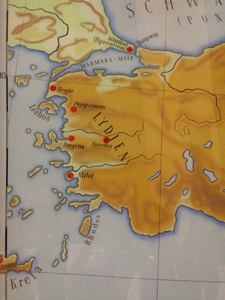
Now – as to the where… Ah – the Where. My next trip is to 3 cities – none of which are on the ‘unusual’ list – but all 3 of which offer tons of things to see and to do. I’m going to Berlin for a week, St. Petersburg, Russia for 3 weeks, and then Brussels for a week. Not as adventuresome as Bali perhaps – but giving these 3 cities enough time will, I hope, result in interesting experiences.

Time will tell

Signing off – The Soup Lady

2 Star Michelin Restaurants – Seriously – are they worth the price?


Hard to say actually. We only ate at two 2-star restaurants this trip – the fabulous Atelier in Munich has only 1 star.

The first was the Essigbratlein in Nuremberg, the 2nd was the Fischers Fritz in Berlin. Both are seriously expensive, very elegant, service intensive restaurants – both are clearly intended to offer ‘blow-you-away’ food at prices that will dent your pocketbook.

First – the Essigbratlein. Nuremberg is not Berlin, and one wouldn’t expect either Berlin prices, nor Berlin quality – and you’d be exactly right. The meal at the Essigbratlein – a tiny 10 table hole-in-the-wall located within spitting distance of the Nuremberg Castle – was good – heavy on veggies (unusual in restaurants of this type) – and generous with the wine. But the courses blur together in my memory – delicious why we enjoyed them, but except for the Brussel sprouts with mandarin – not worth blogging about. The one exception were the Brussel sprouts. Not a vegetable I would quickly assume I would enjoy – and in this case – I’d be very wrong. This was a stunning dish. Light, flavorful, full of texture – completely delicious.

And I must compliment the restaurant on the wine service. Traditionally – I don’t order the wine pairing – it’s a lot of money for a lot of alcohol I simply can’t drink. But at the Essigbratlein they went ahead and poured me a sipping portion of each wine served at the table. I could taste, enjoy – and they didn’t charge us. Cool.

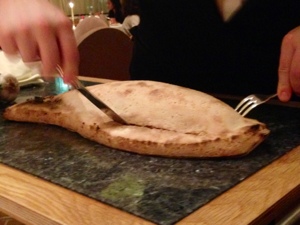
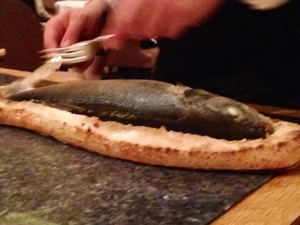
Second – the Fischers Fritz. This is a much larger restaurant – more servers, more tables, more space. And located as it is in the Regency Hotel in Berlin, I’m going to guess a much much larger kitchen. The result is as should be expected – a superior experience. Highlights included the Sea Bass in Sel (an entire fish cooked in a flour/salt pastry shell so that the juices are sealed in), and the Cheese Course.

20131025-233806.jpg

20131025-233813.jpg

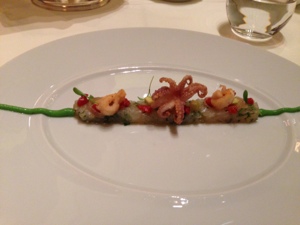
I adore a cheese trolley – and their trolley was outstanding. On the other hand – they did not accompany the cheese with as many treats as did the Atelier in Munich – so I can only give them a B+ for that course. I also loved the first appetizer – a tartare of sea bass with avocado and quickly fried mini-octopus.

20131025-233758.jpg

Wonderful texture, delightful favors, plus it looked great. Unfortunately – the desert was a disaster – I think the Fishers Fritz needs a pastry chef – bad! The ‘franchise’ on the other hand were delightful tiny bites of chocolate truffles, jellies, and treats. They were as good as the desert was bad.

I must admit that while the Fischers Fritz was the better of the two, the Atelier in Munich trumped them both. Oh well – you never know if you never try!

From the Reign of Terror to the Berlin Wall – One day in Berlin


That’s a lot of history to explore in just one day – but in Berlin, it’s not that hard to quickly cover at least most of the major sites for history that I for one clearly remember.

I was born in 1948 – three years after the allies split up Berlin, and just one year after the “Cold War” started. So I was always aware that there were 2 Berlins – an East and a West. I was too young to remember the Berlin Airlift of course – but I was traveling in this part of Europe in 1969 – and the ‘Iron Curtain’ was of course very real to me. I crossed over in Czechoslovakia, had to exchange a specific amount of money at the ‘legal’ rate for every day I would be behind the curtain, and experienced for myself the very real, very popular, black market in currency. In those days $1 US would buy you enough money to live very nicely for a day.

So a huge reason for me to even be in Berlin was the opportunity to see for myself places I’d only read about.

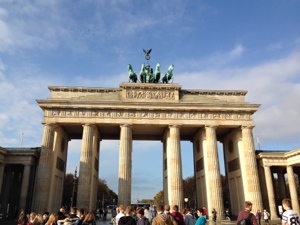
We started the day by walking to the Brandenburg Gate. For my husband, the fact that Napoleon entered Berlin through this gate was of prime importance. For me it was the memory of Ronald Regan challenging Gorbachev to open this gate that made my seeing the gate so impressive.

20131025-233638.jpg

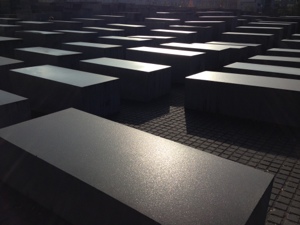
After the gate – which is, in the end, only a gate – we walked the Holocaust Memorial. The 2711 concrete blocks evoke a feeling of both mystery and intense sadness. You can walk the maze considering the fate of so many people killed in the name of baseless hatred – or you can do what so many young people were doing – using the blocks to play hide and seek.

20131025-233645.jpg

We skipped the information center – we have our own personal history to remember.

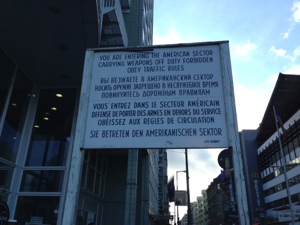
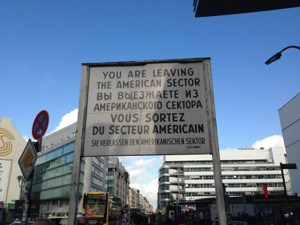
From the memorial – we walked to Checkpoint Charlie. For me – this was another must see site.

20131025-233654.jpg

The free outdoor exhibit was both informative and interesting. I do not remember how large that Checkpoint had become before the Berlin Wall came crashing down in 1989. At the peak – it was at least 10 lanes wide. It was particularly chilling to read the accounts of each of the known successful – and un-successful attempts to get over the wall – the last one of which happened just 2 months before the wall fell.

20131025-233702.jpg

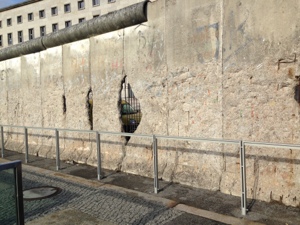
At Checkpoint Charlie – they direct you 500 meters North to the last remaining section of the wall still standing – kept in respect at the “Topographie des Terrors” – an absolutely must see and read and remember account of what happened in Germany from 1933 (the year Hitler became Chancellor) to 1945 (the end of the war).

20131025-233710.jpg

Using photographs taken by members of the Gestapo and multitudes of original documents, including most chillingly – instructions from Berlin to Cologne on how to behaving during ‘Crystal Night’. The increasingly rapid decent from reasonable to rabid is traced in detail in both German and English. A must see display.

A chilling way to spend most of a day – but well worth it.

After a late lunch, we opted to spend the rest of the day doing something a little more upbeat – so we walked to the Gemaldegalerie. This is Berlin’s Grand Survey of Old Masters – and it is awesome. We only managed to hit the highlights – but what highlights they were!

Caravaggio’s Amor Victorius, Pieter Bruegel the Elder’s Dutch Proverbs, a room full of Rembrandt’s – including the famous helmeted man – a painting no longer attributed to the master. All perfectly displayed, and excellent described in the audio guide.

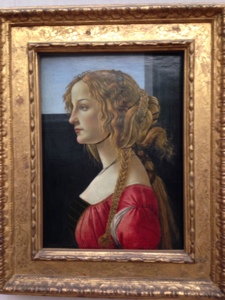
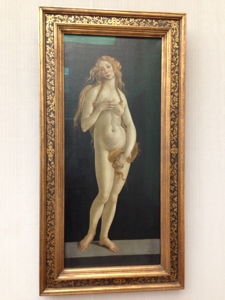
But my top favorites were the Botticelli’s – interestingly enough NOT described in the Lonely Planet guide we’ve been using – but of course described in loving detail in the free with admission Audio Guide.

20131025-233718.jpg

20131025-233728.jpg

Speaking of Admission – we invested in the Museum Pass – which listed this museum as ‘included’. And the permanent exhibition was included. Unfortunately – the special exhibit on Picasso was not included, so we opted to save money and energy – and not go. But it is annoying to have a pass that covers some but not all. Oh well – I guess museums must make money somehow.

We ended the day by trying to see Neue Nationalgalarie – modern art housed in a building designed by Miles van de Robe. Unfortunately – that’s all we go to see – the building. The permanent collection is undergoing refurbishment, and the Museum Pass doesn’t cover the Special Exhibit. Neat building though.

Bottom line – a very interesting, albeit long, day in Berlin.

The Pergamon Museum – Justifiably one of the top Museums in the world


I love Berlin – Munich was fun, Nuremburg was intriguing, the Battle of Leipzig was a lot of work but well worth doing, but Berlin – ah, Berlin.

I keep thinking that I’ll round a corner and bump into Sally Bowles – or at least someone with painted nails and an over-the-top carefree attitude. Instead I’m seeing students on their way to class, well dressed women and men heading here, there, and wherever – and of course lots of tourists. There are glorious shops, bakeries with goodies that defy description, out-door terraces even in late October, trams everywhere – and a remarkable lack – at least here in the ‘old’ city – of sky scrapers. It’s a city scape without the negative aspects. I love Berlin.

And I adored the Pergamon Museum. All the guide books mention it, it’s on every list, every top ten compilation, and was even featured on Museum Secrets. But all the hoo-ha aside – nothing prepares you for the glory of this museum.

We knew the crowds might be an issue – even as off-season as we are – so we pre-purchased a 3 day museum pass for 24 Euros (12 for me with my student card). This acts as your ticket – and allows you to by-pass every line. Cool deal – save money and time. My kind of discount card! Even so – we showed up at the door to the Pergamon at 9:45 (it opens at 10) – just to be on the safe side. At the dot of 10 they opened the doors, we picked up our free (nice price point) audio guides, and walked in.

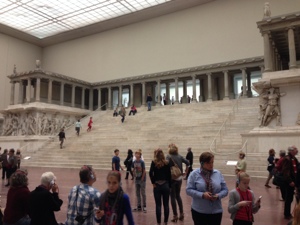
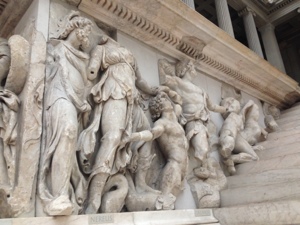
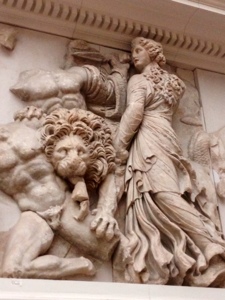
Oh My. Wow. Amazing. Astounding. Mind-blowing. Words simply don’t describe the glory of the Pergamon Altar. I had to sit down, it is that stunningly beautiful. The building was actual built just to house the Altar – and you can argue about moving antiquities out of situ all you want – this totally works.

20131025-180649.jpg

I’ve actually been to Ephesus, 180 km from Pergamon in Turkey, and one of the other 7 churches of Asia cited in the book of Revelations – and I have to tell you – seeing the Pergamon Altar was just as amazing – without the hours of travel, the heat, the crowds, and the challenges of visiting turkey. Plus it’s in a lot better condition.

http://en.wikipedia.org/wiki/Ephesus

20131025-180642.jpg

The extremely well done audio guide talks you through not only the altar itself – but through the models also presented, as well as giving you a brief over-view of the history of the find and the challenges of getting it to Berlin. Underneath the Altar in the back is a quick, but fascinating introduction to the challenges involved in piecing together the magnificent frieze that run around the altar. The entire thing – Altar, Frieze, description, Models, Museum – are simply breath-taking.

20131025-180656.jpg

20131025-180703.jpg

But that’s not all!

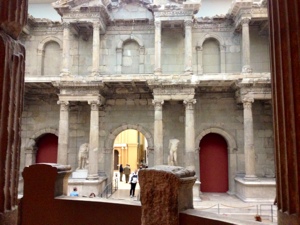
In the same building is the Market Gate of Miletus – along with one of the best preserved large Roman mosaics I’ve ever seen. You literally walk through a narrow door from the Pergamon Altar to the Gate. At 50 feet tall – the marble gate quite literally towers above your head – impossible to take in at one glance.

20131025-180710.jpg

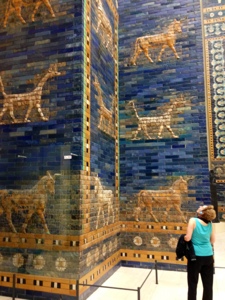
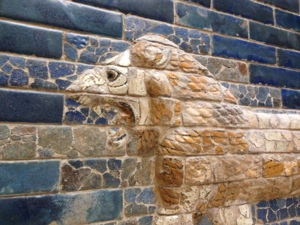
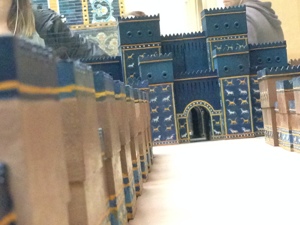
After admiring this feet of ancient engineering – you proceed to the ultimate expression of Ancient Building Technique – the Istar Gate.

20131025-180718.jpg

Jaw droppingly beautiful – It accomplishes exactly the desired result – admiration for the King that could commission such magnificence to be built-in Babylon. It is impossible to face this gate without feeling the awe and fear that anyone coming into this city must have known. You literally are surprised when there are no camels, no bells, no procession.

20131025-180725.jpg

20131025-180733.jpg

After these 3 uniquely huge and marvelously well-preserved examples of ancient art, it wouldn’t even matter if the next door was the exit. You’d have gotten your money worth.

But of course – there is still more. There’s a copy of the Stela of Hammurabi, a huge part of the walls of the Caliph’s Palace of Mshatta, and finally the Aleppo Room. The processional way of Babylon, the huge carved half beast half men that guard the entrances to palaces in the ancient world, and even the elaborately beautiful jewelry takes a bad second place to these incredible finds.

Did I tell you I love Berlin yet? Well I do.

Best History Museum Ever!


Ok – it’s an odd fascination – but I actually enjoy History Museums – particularly if they are well done. They always tell you something about the culture of the country – or at least about what the government thinks is important to know.

Given the outlines of Current German history – Loved Napoleon, Hated Napoleon, Wanted a Democracy, Didn’t want a Democracy, Started World War I, Lost World War I, Had a Democracy that actually elected Hitler, Started World War II, Lost World War II, Got Divided, Got United, and now has a Democracy – well – the history museum in Berlin was bound to be interesting.

Particularly in comparison to say – Canada.

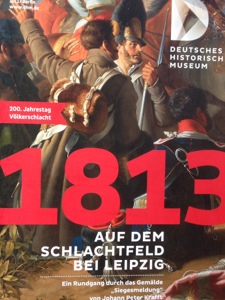
So we coughed up the big bucks – thank goodness for my Student Card – I was 1/2 price – and immediately started with the special exhibit on Leipzig 1813. Given that we’d just been there re-enacting the battle – seeing what the curators at the Deutsches Historisches Museum had to say was bound to be interesting. And it was. The exhibit – clearly taking the German point of view, started with a very famous painting showing the victors of the battle – the King of Prussia (Germany), Emperor of Austria and the Emperor of Russia – getting news of the victory. From there – the curators decided what to show – and what not to show.

The exhibit started with guns, wagon wheels and cannons – the tools of war. It also featured the skelton of a horse – found in a mass grave at the battle field site. From there it went into a brief history of Napoleon, from the point of view of his opponents. His errors are pointed out – and while mention of the Code Civil is made, the point is also made that the application of the Code was hardly even. Yes, feudal estates were broken up – but often they were just handed over to his relatives. And while his emphasis on promotion thru ability rather than family position was mentioned, it was also pointed out that his opponents learned the same lesson, and applied much of the same strategy by the end of the war. A lot of attention was focused on the forced draft in France – and the ‘volunteer’ armies of his opponents. Certainly the history they showed, and the history we thought we knew were quite different.

And as I’ve mentioned before – that’s what makes going to history museums in other countries so fascinating – there is always more than one point of view.

The exhibit ended with a short video about the re-enactment of the battle of Leipzig in 2012 – and in many ways – this was the most striking section. Instead of 6000 re-enactors – there were about 600 – and instead of using a portion of the actual battle field – they used the small field that we’d used to assemble just the french troops. Oh what a difference a year makes.

I left the exhibt amazed at the organization required to put on the re-enactment I had just participated in. It was incredible.

From that special exhibit, we worked our way over to the general section of the history museum, admiring the architecture as we went. The museum is huge – and we opted to skip most of it, and focus just on the sections that interested us most – 1778 onwards. The section for 1778 to 1816 – which covered the battles against Napoleon featured some wonderful pieces of art – including a painting of Napoleon in his corination robes – and most impressively – his hat, sword, and stirrups – left in his carriage at Waterloo in 1815 when he excaped after the disaster to Paris. Cool.

From there we read with great interest – and some surprise – the German perspective on the lead-up to World War I, the elation followed by the depression of the results of that war, and then the negative feelings about the treaty of Versaile. In the German history – it is that treaty more than anything else that brought about the conditions that allowed Hitler and his minons to appeal to such a wide audience. The museum contains a significant section effectively appologizing for the treatment of the Jews, the Roma, and the handicapped. There is no attempt to sugar coat that truth. The run-up to World War II is covered in great detail, as is what was happening in Germany during the war. After the war, the division is described, and the museum ends history in 2000 – 10 years after the fall of the Wall and the re-unification of Germany.

This is an outstanding muesum. Not one that you want to zip thru – but one that you want to slowly see – hear – experience. There are English signs in most sections, but getting the audio guide is well worth the small expense. The descriptions are absolutely reviting. We effectively got ‘kicked’ out by the closing bells.

Great Museum. Definitely a must go!

20131025-103006.jpg

5 Hotels – 5 Cities – all different – all definitely European!


In Europe, the price you pay and the value you get seem quite independent – I say this because we’ve been in Germany and Switzerland for 4 weeks now – and stayed in 5 quite different hotels. All except the last have been ‘middle’ of the road quality – not brand names – not super spectacular – just well located.

Our needs were simple – in each of the cities we visited – Munich, Zürich, Nuremberg, Leipzig, and Berlin – we wanted the best possible location at a reasonable price.

In Nuremberg, Zürich and Leipzig – we had one further requirement – we needed parking.

We used only 2 ways to get our reservations – Hotwire (Berlin) and Booking.com (all the others). The rates we paid varied considerably – and were definitely not in line with the quality of the hotel! I’m guessing it’s more a question of the city and maybe timing than the hotel itself. In any case – despite staying in really quite similar properties for size, location relative to featured attractions, double rooms in all cases with bathroom en-suite – the prices actually doubled from our lowest price option to our most expensive night stay. Amazing.

And in several of the hotels – namely the Atlanta in Leipzig, the Goethe in Munich, and the St. Gotthard in Zürich – our bathroom didn’t even have a tub – just a shower! An acceptable one in all cases though – and I have to say often I prefer a shower to a tub. Easier to get in and out of if you are seriously tired!

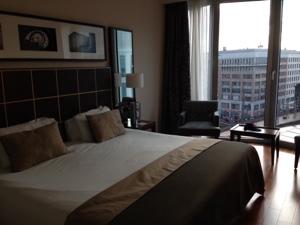
Our least expensive hotel is the Eurostar in Berlin. This is a fabulous hotel – 4 stars, with a breakfast price point to match (17.50 Euro – per person). But over priced breakfast buffet aside, the hotel is extremely well located – right next to the haufbanhof (Main train station), and a 5 minute walk to Museum Island in one direction and the Brandenburg Gate in the other. Ideal for exploring Berlin – although restaurant options – while plentiful, are hardly cheap. In fact – that’s probably my biggest complaint! Our room is on the top floor – with a glorious view of the city. The front desk is extremely pleasant and easy to deal with – and the spa – while lacking a whirlpool, has a lovely indoor swimming pool and 2 – count’m 2 – saunas. Both are clothing optional if you must know. I’d definitely rate this the best hotel we’ve stayed at – and it’s by far the least expensive. Under $100 a night. Go figure. Internet is free – although fussy – you have to sign in separtely for all devices, and repeat the sign-in everytime the device goes to sleep. Bottom Line – 5 Stars and a Definitely Stay here.

Next lowest price – the Hotel Atlanta in Leipzig. In this case – I’m not surprised at the price – just surprised we could get it that cheap since we stayed there during the Battle of Nations celebration. Everything was full! I suspect our great rate is more due to the length of our stay (4 nights) than anything special we did. And it included breakfast – which was absolutely perfect. Unlimited coffee, cereal, fruit, meat, cheese, lots of different breads and rolls and cakes, crepes, sausages, bacon, meatballs, and boiled eggs. I particularly liked the cheese selection – from Baby Bel’s to herbed cream cheese to traditional sliced cheeses. It was yummy. The location for our purposes was perfect. There was a free parking lot – and the hotel was just a 7 minute drive from the bivouac area for our re-enacting group. The spa offered a whirlpool bath (lukewarm – not hot), and a sauna – definitely clothing optional. But the spa had a nice sized resting area – and a lovely view. Room was nice and large – I could have used a fridge with more space – I had to remove their ‘charge’ items to put in my bread and fruit. And if I had to be fussy – the fact that you had to know to ask for bathrobe was weird. We only found out the hard way – went to the hot tub area – and everyone had one but us! Internet was an additional 17.50 Euro’s a week – but at least we only paid once for all our devices. And TV was additional too – if you wanted more than the basic channels. Bottom line here – 5 Stars – and a definitely Stay Here.

Next up – and it’s a big jump – (175 Euro a night) was the Hotel Agneshof in Nuremberg. But location, location! It was a wonderful location – off a quite side street – right under the eves of the Nuremberg castle, and right around the corner from a great antique shop selling discounted pewter mugs. Oh did I enjoy that shop! The Agneshof also offered parking – at 15 Euro a day – but an essential if you drove into Nuremberg with a car and no assigned parking place. Breakfast was a reasonable 7 Euro per person – and quite ample. They even offered my Cafe Macchiato – my favorite. The Spa was in the basement – rather cool whirlpool, but nice and clean, and a glorious sauna. Oddly the fitness equipment was in the same space – hard to exercise in a room full of steam and clorine. We spent every day out on the town – and quite enjoyed our stay. Bottom line – another 5 stars, and a definitely stay there again – but try for a better rate.

Top dollar prizes (Over 220 Euro a night) go to the hotels in Munich and Zürich. And I have to say – the hotel in Zürich was clearly worth the price – of the hotel in Munich – I’m not so sure. I’ll bet other people were staying there for a whole lot less.

In Munich we stayed at the hotel Goethe – picked because it was a middle of the road price – which says something about the prices of hotels around Octoberfest time if over 200 Euros is middle of the road! It was located in a very ‘mixed’ neighborhood, right by the main train station. I call the neighborhood mixed because our neighbors were either Casinos or shops selling sex toys. Walking the streets was an experience as well – there were ladies in full burka with only their eyes visible walking slowly past the bums and homeless you’d expect to see next to a train station. And most annoying – particularly for the price – the hotel is doing a major renovation – so there was no elevator. The front desk clerk had to carry our suitcases upstairs – thank goodness we were only on the first floor! Plus there was scaffolding outside our window – blocking both the view and the breeze. Most annoying – the light in the bathroom was on a movement sensitive switch. If you didn’t move enough while sitting on the toilet – the light went off! Quite a surprise the first time, let me tell you. No Spa, No fitness center, No Whirlpool. Just a tiny sitting area near the front desk, and an equally tiny breakfast area. Speaking of breakfast – at 7.50 Euro per person per day – it was quite a bargain. No fancy coffee – but there was fruit, meats, cheeses, eggs, sausages, and a selection of rolls and sweet breads. I particularly like the Stollen. I know it’s a Christmas Cake – but hey – you cut it, I’ll eat it! Thank goodness we didn’t have a car. Because of the construction – which took out the garden of the hotel, not to mention the entire front of the building – there was barely room to drive by the hotel, let along park. I certainly would have expected a better price given the challenges we had – but I suppose they charge even more when not in the midst of reconstruction. At least the internet was free. Not very powerful, but free. Bottom line – 3 stars and I’d definitely look for somewhere else next time I’m in Munich.

In Zürich we stayed in the Hotel Gotthard. Breakfast not included – and at 32 SF (about $32 per person) not happening for me. I just don’t eat that much food. Awkwardly – the first morning we walked the wrong way – and were in the ‘expensive’ part of town – no breakfast spots to be found. We ended up at the breakfast buffet of a ‘lesser’ hotel – and paid 22 SF ($22 per person) for breakfast. It became my personal goal to locate a better option. Eventually we walked the right way – into the train station – and for just 10 SF ($10) found a lovely breakfast place – they even included my cafe Macchiato for no extra charge. I love you for that! The hotel is an older grande dame – rooms aren’t huge – but they are comfortable, and for our purposes the location and car parking option, which while pricy, totally worked. I won’t say it’s the nicest hotel we stayed in (That definitely goes to the Eurostar in Berlin) but it was comfortable, had 2 elevators, and the staff was very nice. Internet was free – a nice bonus. So a clear recommendation – just try to get a better deal on the price!

So – not a terrible place in the lot, even the Hotel Goethe had its location going for it – but some clear favorites. And I’ve learned something I didn’t know about German’s and Austrians – Clothing is definitely optional in whirlpools and Saunas. So come prepared!

Picture below is our room in the Eurostar –

20131025-103034.jpg

Report from the Battle of Nations 1813 (October 20, 2013)


A day in the life of a re-enactor – Fighting the Battle of Leipzig – 1813
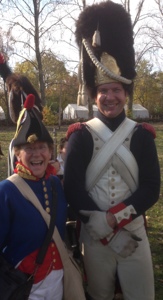
20131022-100439.jpg

I’m the Chirurgien aide-major on the left. On my right is a Grenadier a Pied of the Imperial Guard – Pavel. There’s been some discussion that perhaps I need a new nickname – instead of san-fatigue (tireless) – maybe La petite (The small) would be better.

But back to my day – which really started the day before – when our officers decided that we should get a look at the battle field – rather inconveniently located about 5 km from our bivouac site. So full dress on – and off we march.

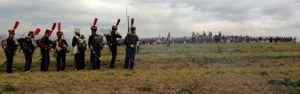
The French army – at least the infantry portion – gathers in a large field about 1/3 of the way to the battle field itself to regroup. There are a lot of us – at least 2000 – representing several different nations – all fighting under the leadership of Napoleon. And boy – do we look good. Great uniforms, tight formations – we’re well-trained, well armed, and ready for battle.

We march to the battle field, drill in sections and then together, and finally march off again – clearing the way for others to get their chance at a look at the field.

On the march back, we finally get to see some of the enemy – it’s a group of Austrians on their way to the battle field – but that doesn’t stop us from mounting bayonets and charging. They mount bayonets and charge back! Such fun.
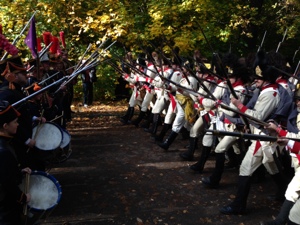
20131022-095301.jpg

We disengage – and march on – back to our bivouac to be told – be ready to fight at 10:00 am tomorrow – but tonight you are free to drink and be merry. Right. For some it’s on to hours in the Rathskeller – for me it’s an early night. My stomach is seriously in knots.

10:00 AM (day of the battle) – We gather again at the bivouac site – we’ve eaten a good breakfast, and our support teams of vivandieres have prepared some slices of sausage for us to take with. As the Chirurgien Aide-Major (that’s Surgeon 2nd Class to you) – I prepare bandages in case the battle goes against us, and make sure I have plenty of water. Keeping the soldiers hydrated is one of my most important duties. And I practice amputations – besides putting on a bandage – as battle field doctors we’re more likely to have to cut off an arm or a leg then just about anything else.

10:45 AM – We march back to the ‘re-grouping’ area – and all the members of the troops fighting on the French side are assembled. Again – over 2000 strong – we’re looking good. No sign of any opponents yet – and that’s probably a good thing. I’m beginning to get nervous – and I’ve run out of water already. A fast trip to refill my bottles – then we’re off on our slow march to the battle field. Cheering crowds surround us en-route – and we feel like heroes. We’ve yet to lose a battle – are we perhaps feeling a bit too confident?
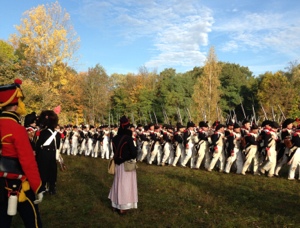
20131022-095244.jpg

11:30 AM – We’re reached the battle field – and it is huge. There are people everywhere – all trying to get into position to watch the battle. I can’t imagine where you would have to sit to see everything – but then I spot a powered Paraglider – and I realize – that’s probably going to be the best view. Yup – he’s got a camera.

12:15 PM – We’re told to eat our lunch – and again – I’m out of water. 45 guys on a hot day – there’s a lot of water required. Another trip to re-fill my bottles – I end up at a local sports facility that’s been turned into a triage/hospital center by the local EMT guys. They have 6 beds ready, along with various other equipment. Issues may not be with the soldiers after all – there are 75,000 spectators expected – plus 6000 re-enactors – that’s a lot of potential for things to go wrong. And one of the beds is already occupied by a bystander – I’m hoping it’s just heat related.

12:35 PM – I’m back where my division of Marine de la Garde had been sitting – and they are gone. Along with my satchel filled with water bottles and bandages. And all the other 2000 members of the French Army. Now what? All that’s left where before there were dozens and dozens of troops is an empty field.

12:40 PM – I spot a troop heading for a break in the huge fences set up around the battle field proper. My troop has gone into position on the field. It’s like chess – everyone has a place to start – and I’m late! I run as best I can – the field is very rutted – and slip thru the opening onto the main battle field.

12:45 PM – How different it looks today – Everyone looks so similar and yet there are significant differences. Calvary rides here and there – I see Polish Lancers in formation to my left. But I need to find the Marine. Where did they go? There are at least a dozen cannons that I can see – and I’m just at the top quarter – the field seems to go on forever. On the far side there are smudges of silhouettes – is that enemy? If it is – there sure are a lot of them!

12:46 PM – I spot what looks like a familiar uniform and head in that direction – when I get close – I realize it’s a completely different unit. But then I hear I high-pitched whistle. Following the sound – its my chief – the Chirurgien Major! He’s seen me and waves madly. I move quickly into position – no time to waste. The battle is set to begin at 1:00 PM – and this is Germany – it might even start on time.

12:50 PM – The emperor is on the field! We hasten into position – he walks by – twice – greeting those of us he recognizes, and generally being encouraging. His entourage is huge – more generals and aides then I imaged. And he’s afoot – I wonder if he’ll mount up later – or run the battle from the background. We shall see. But meanwhile – we give him 3 cheers – and I have to say – seeing him did make me feel better.
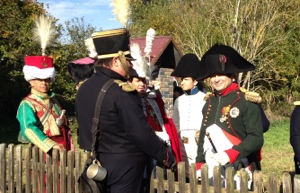
20131022-095253.jpg

12:55 PM – Our troop is looking good. We’re right near the line of spectators – kept off the field by heavy fences set up all around. I spot non-combatants – those are the women and older soldiers who support the troops lined up on our side of the fence. We’re positioned right next to an artillery set-up – hope they don’t fire the cannon while we’re this close. It’s going to be seriously noisy.

1:00 PM – German timing – the Royal Horse artillery posed on the far side of the battle field – looking so small as to be more of a smudge than men – start firing off their rockets. Historically these didn’t work so well – mostly noise, little damage. And they haven’t improved the design. A lot of noise – but not much else.

1:15 PM – finally we’re called into battle. Our first and most important task – get about half way across the battle field and build a bridge over the ‘river’. It’s really more of a stream – but still – we need to get the bridge built so that our army can cross to capture the town on the opposite side. It’s about a km run – over rutted terrain – into the face of the enemy.

1:25 PM – we’re in position – 1/2 of the Marines guard the position from attack – we can see that there are significant troops lined up on the far side of the battle field – and 1/2 start to build the bridge. They get the logs into position, and then realize that during the night someone made off with the nails and hammers and more importantly – the planks – that had been placed near the location of the bridge. What to do – without the bridge – our troops can’t get across!
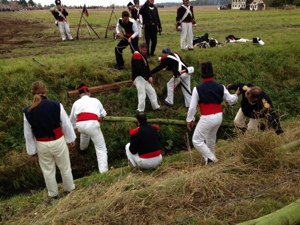
20131022-095310.jpg

1:30 PM – Bridge building continues – and the search is on from nails, hammers, and planks. Meanwhile – one of our men has been hit by a stray bullet – probably from the snipers on the far side of the field – and we are called on to amputate his leg.
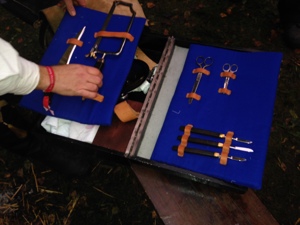
20131022-095330.jpg

1:33 PM – we’re fast – Aprons on (don’t want to get our uniforms dirty), equipment ready – we bring the patient nearer to the spectators so that they can get a good view. 3 guys hold him down while he bites on a piece of wood (more to shut him up then to relieve the pain – if he gets much noisier the team holding him down have been told to hit him hard in the head. The noise is annoying the doctors). Personally I think the thrashing is most annoying. I guess a musket ball in the leg must really hurt.

1:35 PM – We’ve made the first cut – after putting on the tourniquets (couldn’t get it quite tight enough – but hey – it’s only the first patient – we’ll do better next time), the Chirurgien Major takes his scalpel and cuts away the flesh – leaving the bone exposed.

1:36 PM – I hand him the saw – and hold the leg steady against the thrashing of the patient. He saws thru the leg – then hands me the part of the leg with the foot attached to show the spectators! I hold it above my head – then toss it to the ground to help cap the wound.
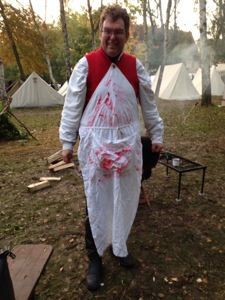
20131022-095338.jpg

1:37 PM – Perfect. Such a good job that the patient can get up and hobble away.

1:40 PM – Bridge is finally done – and we’re ordered into the village to protect the villagers. So we re-group – check on the patient (he’s fine – and back on the line) – and then march into the village. In the village are some members of a Russian Calvary unit whose horses were refused entry to the re-enactment – no papers. So they are afoot – and not that happy about it. But that’s not our problem – our problem is to protect the village. We form up along the village cemetery – to our left is another battalion of French troops – but ahead of us appears the enemy. And they are endless.
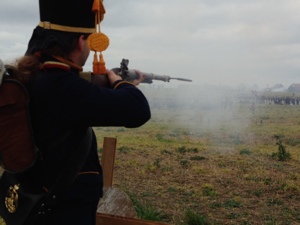
20131022-095322.jpg

2:00 PM – After firing in volleys into the on-coming troops – our Calvary appears to help us. The troops of the enemy retreat – the Calvary rides away – and the troops re-appear. Fighting is hot and heavy! Suddenly their Calvary appears. The infantry men to our left form squares – which protects them. We’re standing in the cemetery – not good ground for Calvary – so they don’t bother us.

2:10 PM – Our Calvary comes back – a Calvary fight ensues – with quite a lot of close combat – and on the part of the Polish Lancers – some stabbing. No one falls off a horse though – they are all excellent riders. There are moments of quiet – followed by periods of so much noise it’s hard to think – let alone hear the commands of our leader.

2:30 PM – Fighting continues hot and heavy. We march out to attempt to take more of the field – and are forced back by heavy artillery fire. But first we take our first real injury. When you fire the musket, you must keep your mouth open to equalize the pressure – one of our soldiers forgets to do that – and is complaining that he can’t hear. We help him equalize the pressure – he eventually returns to the line.
20131022-101806.jpg

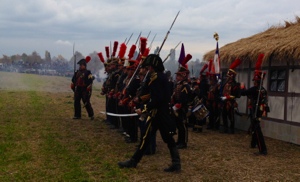
2:45 PM – We retreat back into the village – and re-group. Our orders have changed – we’re to abandon the village – and move to protect another bridge to our far left. At that moment, the enemy mounts a bayonet charge against the remaining forces protecting the village. There’s nothing we can do – so we march out in orderly fashion, abandoning the village and the villagers. They are forced to flee – waving white flags and heading for the bridges.
20131022-095345.jpg

2:50 PM – Looking back I realize that the village buildings are now ablaze. The fresh thatch must have been easy to light. I feel a bit bad for the villagers – but they are no longer our problem.

3:15 PM – we’ve maneuvered out way to our new position – and are defending the bridge at our back. We make a charge – take some causalities – as we pull back – our officer tells myself and the Chef doctor to go see to the wounded. We patch as best we can – and fall back. Another rally – another group of casualties. We’re in trouble.

3:30 PM – Our backs are to the bridge – but we can’t continue to hold that ground. Under orders, we re-group again and cross the bridge – determined to hold that side.

3:31 PM – I realize that we’ve left a soldier behind – and the officer gestures to me to take care of him. I run to his side, figure out where he’s been injured – and put on a bandage – accompanied by significant yelling and screaming by the wounded solider – all to the delight of the onlookers.

3:40 PM – We join up with a large group of Imperial Guard forces, and there’s a change in leadership. Our new leader is the head of the Guard – he’s on horseback – and he’s riding back and forth behind our lines getting us into position to defend the ground we gained earlier in the day. It’s not looking good, though.

3:45 PM – The King’s Foreign Legion is attempting to take our bridge – but we’re ready for them. 1/2 of our company is hidden from their view to our left – when they cross the bridge they are caught in a wicked cross-fire.

3:50 PM – Despite our excellent tactics, the enemy has crossed the bridge – and we’re forced further back. Now the commander of the entire French troop is trying to rally us and get us to stand firm.

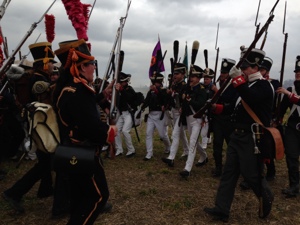
3:55 PM – We’re being forced further and further back onto our original part of the field – between the soldiers coming in endless waves and the Calvary forays – we are unable to stand firm.
20131022-095355.jpg

4:00 PM – The officers call for a cease-fire. There is still random shots being fired as soldiers discharge their weapons. As doctors, we tend to any wounded, adjusting bandages as needed. We also give all the soldiers a drink. Dehydration is a potentially huge problems as the day has gotten warmer and warmer. I’m officially out of water.

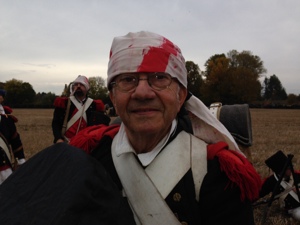
4:05 PM – The wounded requiring professional treatment are identified – there’s one soldier with 4 broken ribs – apparently another soldier got carried away and struck him on the side with the butt end of a musket, and there’s a face wound. A re-enactor with no experience held his musket too close to his face (its supposed to be on your shoulder), and the recoil struck his eye glasses, causing a superficial face wound.

4:25 PM – We get back into line, march up to the rows of spectators and are applauded and cheered. Now we must march all the way back to the bivouac. That’s almost 8 km from our present location – and we are extremely tired.

5:00 PM – We are about 2/3rd of the way home when one of our soldiers drops from dehydration and heat prostration. As the Doctors, we remove his backpack, gibarne (for carrying black-powder cartridges), and take his musket. We find him water from another group of soldiers, and eventually get his body temperature back to normal.

5:30 PM – Back at camp – everyone removes uniform pieces, gets a beer, and in the case of our commanding officer – and his sergeant – takes off their shoes to soak their sore feet. We trade battle stories – and agree that it was probably the best battle ever.
20131022-095405.jpg

Man – did we have fun!
Pilgrimage Churches – What are they, and Why bother going out of the way to see them?


We’ve seen 2 pilgrimage churches so far – both spectacular – when leads me to wonder 3 things – why were they built, how do you find them in the guide books, and why bother going?

Which leads right into a fourth thing I’ve wondered about – is it worth renting a car in Europe.

Starting with the fourth thing first – why rent a car? In the cities – a car is the last thing you want. What you want is a hotel within walking distance of everything – and baring that – a good public transit system. The challenges of finding a place to leave a car are absolutely mindboggling. Car parks are few and far between – aided and abetted by the authorities – which at least in Switzerland have decided that no new parking spots will be built-in Zürich. You build a new building with 100 spots underground for cars – you’d better find 100 other spots to get rid of. sheesh.

So – no point having a car unless you are trying to tour the countryside or visiting towns way outside the beaten path. And since we had decided to tour and part of our touring required some pretty out-of-the-way places – we needed a car. So seeing pilgrimage churches became a possibility.

So how to find them. I’ll be honest – Regine (our friend in Zürich – who really ought to consider a career as travel guide) suggested both. And thus we visited them. But there must be another way. I did find Vierzehnheiligen in Bad Staffelstein in Fodor – with a star (Fodor choice). And once I knew to look for it – even the Insight Guide has a picture. So it’s there – if you know about it. The 2nd pilgrimage church – which honestly I thought even more impressive is called the Wies Church – it’s well documented on the internet – and knowing the name – I found it in Fodor – labeled “Off the Beaten path” – with which I must agree. So – maybe the best thing is to rely on the ‘you’ve really got to see this’ network!
20131021-231727.jpg

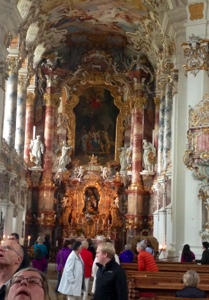
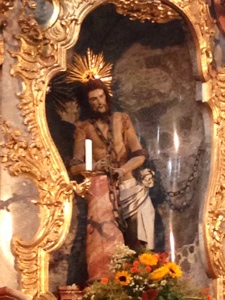
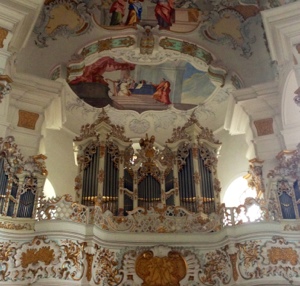
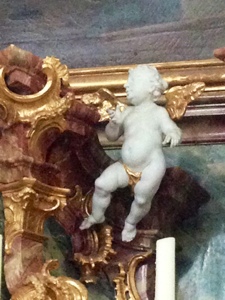
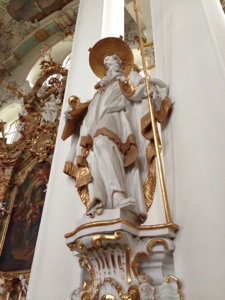
The Wies Church – located rather conveniently between Neuswanstein Castle and Linderhof Castle – is just there. Middle of nowhere. Not near a town, or even a decent highway. It was built in 1745 because a local woman claimed that she saw the wooden figure of Christ crying in 1739. Said Figure of Christ is enshrined in the altar (Fodor described it as a painting – I thought it was a craved statue)- clearly visible to all who visit the church. But it’s the church that will blow you away. It is a glorious love affair with Rocco – abounding with cupids, light, white statues of saints, prophets, or even just unknown heroes tipped in gold, and a mystery that still resonates. Did the painting indeed cry? We will never know – but the fact remains that the church is well worth visiting.

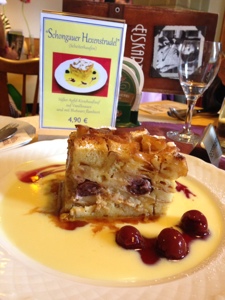
Even better – dessert at the guesthouse/restaurant right opposite the church entrance. My Hexenstrudel (witch’s strudel?) was amazing.

20131021-231814.jpg

Picture note: All the pictures below are from the Wies Church – but trust me – seen one cupid, seen them all. The differences are the structure of the church – and the reason it got built!

Vierzehnheiligen near the tiny town of Bad Staffelstein is actually a lot easier to find. It’s located just 40 km from Bamburg – which in itself is a delight. So this church clearly gets a lot more visitors – so many that starting Saturday afternoon and all day Sunday – all visitors must park at least 1/2 mile away from the church.

But again – oh so worth the trouble!

The first time you see the church is actually from the main road – it is situated on a fairly high hillside – and is clearly something remarkable.

Because we went on a Tuesday, and fairly late in the day as well, the road, the parking lots, and the church were relatively empty. Even better – a group was getting a tour of the organ loft – and had brought with them someone to play the organ – so as we gazed in wonder at the glorious architecture – we were surrounded by magnificent music. They sure knew something about acoustics in those days.

This pilgrimage church was built to celebrate the vision of a Shepard, who in 1445 apparently saw 14 saints along with Christ – striding along the hilltop. The church was built between 1743 and 1772 – in true over the top Rocco style. The shape of the church is exremely unusual. It’s almost completely round – and huge. So large that the main part is called “Gods Ballroom”. Smack in the center, and neatly dividing the church in two, is the altar – decorated of course with cupids, saints, heroes, and images of Mary. White, Gold, sunlight, and over-the-top carvings make the entire church seem to dance. No photo’s allowed – so we just got to look, stare, and wonder at the energy and money spent to build something so out-of-the-way!

Unlike the Wies Church, vendors selling religious (and not so religious) souvenirs line one side of the entrance way. Kinda tacky. But on the other side of the church is a former monetary that has partly been turned into a visitors center. All in German, but at least there is some attempt to document and explain the architecture.

Bottom line – they wouldn’t be pilgrimage churches if they weren’t worth visiting. So go. Enjoy. And say I sent you!

20131021-231738.jpg

20131021-231748.jpg

20131021-231756.jpg

20131021-231805.jpg