From the Reign of Terror to the Berlin Wall – One day in Berlin


That’s a lot of history to explore in just one day – but in Berlin, it’s not that hard to quickly cover at least most of the major sites for history that I for one clearly remember.

I was born in 1948 – three years after the allies split up Berlin, and just one year after the “Cold War” started. So I was always aware that there were 2 Berlins – an East and a West. I was too young to remember the Berlin Airlift of course – but I was traveling in this part of Europe in 1969 – and the ‘Iron Curtain’ was of course very real to me. I crossed over in Czechoslovakia, had to exchange a specific amount of money at the ‘legal’ rate for every day I would be behind the curtain, and experienced for myself the very real, very popular, black market in currency. In those days $1 US would buy you enough money to live very nicely for a day.

So a huge reason for me to even be in Berlin was the opportunity to see for myself places I’d only read about.

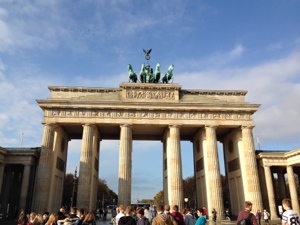
We started the day by walking to the Brandenburg Gate. For my husband, the fact that Napoleon entered Berlin through this gate was of prime importance. For me it was the memory of Ronald Regan challenging Gorbachev to open this gate that made my seeing the gate so impressive.
20131025-233638.jpg

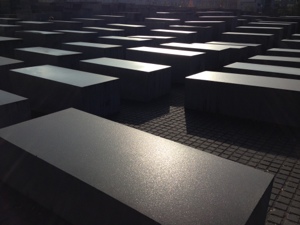
After the gate – which is, in the end, only a gate – we walked the Holocaust Memorial. The 2711 concrete blocks evoke a feeling of both mystery and intense sadness. You can walk the maze considering the fate of so many people killed in the name of baseless hatred – or you can do what so many young people were doing – using the blocks to play hide and seek.
20131025-233645.jpg

We skipped the information center – we have our own personal history to remember.

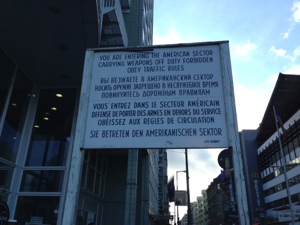
From the memorial – we walked to Checkpoint Charlie. For me – this was another must see site.
20131025-233654.jpg

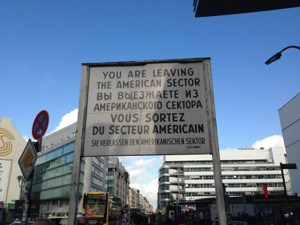
The free outdoor exhibit was both informative and interesting. I do not remember how large that Checkpoint had become before the Berlin Wall came crashing down in 1989. At the peak – it was at least 10 lanes wide. It was particularly chilling to read the accounts of each of the known successful – and un-successful attempts to get over the wall – the last one of which happened just 2 months before the wall fell.
20131025-233702.jpg

At Checkpoint Charlie – they direct you 500 meters North to the last remaining section of the wall still standing – kept in respect at the “Topographie des Terrors” – an absolutely must see and read and remember account of what happened in Germany from 1933 (the year Hitler became Chancellor) to 1945 (the end of the war).
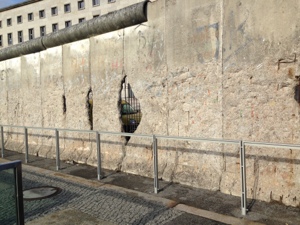
20131025-233710.jpg

Using photographs taken by members of the Gestapo and multitudes of original documents, including most chillingly – instructions from Berlin to Cologne on how to behaving during ‘Crystal Night’. The increasingly rapid decent from reasonable to rabid is traced in detail in both German and English. A must see display.

A chilling way to spend most of a day – but well worth it.

After a late lunch, we opted to spend the rest of the day doing something a little more upbeat – so we walked to the Gemaldegalerie. This is Berlin’s Grand Survey of Old Masters – and it is awesome. We only managed to hit the highlights – but what highlights they were!

Caravaggio’s Amor Victorius, Pieter Bruegel the Elder’s Dutch Proverbs, a room full of Rembrandt’s – including the famous helmeted man – a painting no longer attributed to the master. All perfectly displayed, and excellent described in the audio guide.

But my top favorites were the Botticelli’s – interestingly enough NOT described in the Lonely Planet guide we’ve been using – but of course described in loving detail in the free with admission Audio Guide.
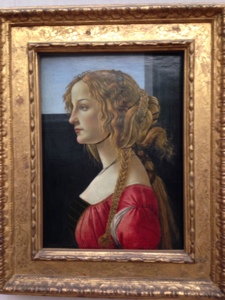
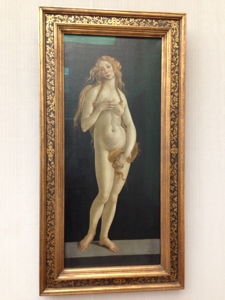
20131025-233718.jpg

20131025-233728.jpg

Speaking of Admission – we invested in the Museum Pass – which listed this museum as ‘included’. And the permanent exhibition was included. Unfortunately – the special exhibit on Picasso was not included, so we opted to save money and energy – and not go. But it is annoying to have a pass that covers some but not all. Oh well – I guess museums must make money somehow.

We ended the day by trying to see Neue Nationalgalarie – modern art housed in a building designed by Miles van de Robe. Unfortunately – that’s all we go to see – the building. The permanent collection is undergoing refurbishment, and the Museum Pass doesn’t cover the Special Exhibit. Neat building though.

Bottom line – a very interesting, albeit long, day in Berlin.
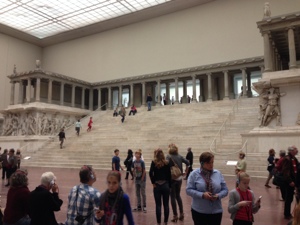
The Pergamon Museum – Justifiably one of the top Museums in the world


I love Berlin – Munich was fun, Nuremburg was intriguing, the Battle of Leipzig was a lot of work but well worth doing, but Berlin – ah, Berlin.

I keep thinking that I’ll round a corner and bump into Sally Bowles – or at least someone with painted nails and an over-the-top carefree attitude. Instead I’m seeing students on their way to class, well dressed women and men heading here, there, and wherever – and of course lots of tourists. There are glorious shops, bakeries with goodies that defy description, out-door terraces even in late October, trams everywhere – and a remarkable lack – at least here in the ‘old’ city – of sky scrapers. It’s a city scape without the negative aspects. I love Berlin.

And I adored the Pergamon Museum. All the guide books mention it, it’s on every list, every top ten compilation, and was even featured on Museum Secrets. But all the hoo-ha aside – nothing prepares you for the glory of this museum.

We knew the crowds might be an issue – even as off-season as we are – so we pre-purchased a 3 day museum pass for 24 Euros (12 for me with my student card). This acts as your ticket – and allows you to by-pass every line. Cool deal – save money and time. My kind of discount card! Even so – we showed up at the door to the Pergamon at 9:45 (it opens at 10) – just to be on the safe side. At the dot of 10 they opened the doors, we picked up our free (nice price point) audio guides, and walked in.

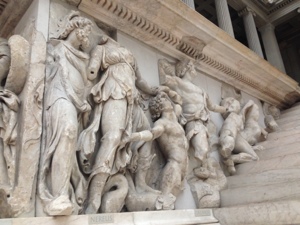
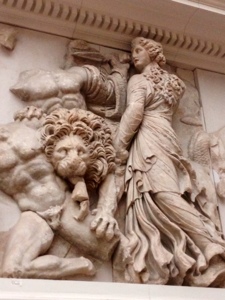
Oh My. Wow. Amazing. Astounding. Mind-blowing. Words simply don’t describe the glory of the Pergamon Altar. I had to sit down, it is that stunningly beautiful. The building was actual built just to house the Altar – and you can argue about moving antiquities out of situ all you want – this totally works.

20131025-180649.jpg

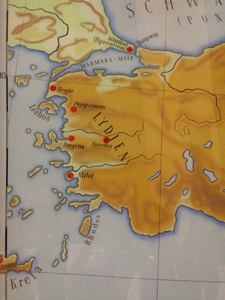
I’ve actually been to Ephesus, 180 km from Pergamon in Turkey, and one of the other 7 churches of Asia cited in the book of Revelations – and I have to tell you – seeing the Pergamon Altar was just as amazing – without the hours of travel, the heat, the crowds, and the challenges of visiting turkey. Plus it’s in a lot better condition.

http://en.wikipedia.org/wiki/Ephesus

20131025-180642.jpg

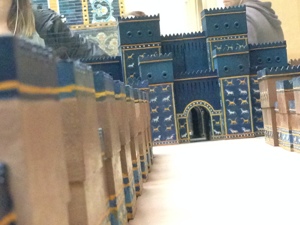
The extremely well done audio guide talks you through not only the altar itself – but through the models also presented, as well as giving you a brief over-view of the history of the find and the challenges of getting it to Berlin. Underneath the Altar in the back is a quick, but fascinating introduction to the challenges involved in piecing together the magnificent frieze that run around the altar. The entire thing – Altar, Frieze, description, Models, Museum – are simply breath-taking.

20131025-180656.jpg

20131025-180703.jpg

But that’s not all!

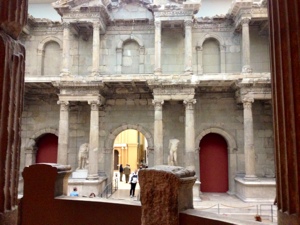
In the same building is the Market Gate of Miletus – along with one of the best preserved large Roman mosaics I’ve ever seen. You literally walk through a narrow door from the Pergamon Altar to the Gate. At 50 feet tall – the marble gate quite literally towers above your head – impossible to take in at one glance.

20131025-180710.jpg

After admiring this feet of ancient engineering – you proceed to the ultimate expression of Ancient Building Technique – the Istar Gate.

20131025-180718.jpg

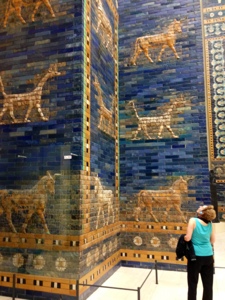
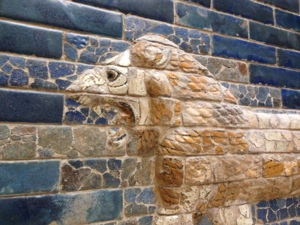
Jaw droppingly beautiful – It accomplishes exactly the desired result – admiration for the King that could commission such magnificence to be built-in Babylon. It is impossible to face this gate without feeling the awe and fear that anyone coming into this city must have known. You literally are surprised when there are no camels, no bells, no procession.

20131025-180725.jpg

20131025-180733.jpg

After these 3 uniquely huge and marvelously well-preserved examples of ancient art, it wouldn’t even matter if the next door was the exit. You’d have gotten your money worth.

But of course – there is still more. There’s a copy of the Stela of Hammurabi, a huge part of the walls of the Caliph’s Palace of Mshatta, and finally the Aleppo Room. The processional way of Babylon, the huge carved half beast half men that guard the entrances to palaces in the ancient world, and even the elaborately beautiful jewelry takes a bad second place to these incredible finds.

Did I tell you I love Berlin yet? Well I do.

Best History Museum Ever!


Ok – it’s an odd fascination – but I actually enjoy History Museums – particularly if they are well done. They always tell you something about the culture of the country – or at least about what the government thinks is important to know.

Given the outlines of Current German history – Loved Napoleon, Hated Napoleon, Wanted a Democracy, Didn’t want a Democracy, Started World War I, Lost World War I, Had a Democracy that actually elected Hitler, Started World War II, Lost World War II, Got Divided, Got United, and now has a Democracy – well – the history museum in Berlin was bound to be interesting.

Particularly in comparison to say – Canada.

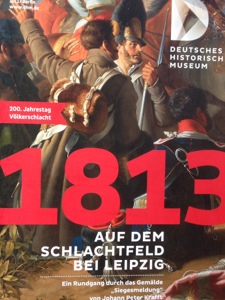
So we coughed up the big bucks – thank goodness for my Student Card – I was 1/2 price – and immediately started with the special exhibit on Leipzig 1813. Given that we’d just been there re-enacting the battle – seeing what the curators at the Deutsches Historisches Museum had to say was bound to be interesting. And it was. The exhibit – clearly taking the German point of view, started with a very famous painting showing the victors of the battle – the King of Prussia (Germany), Emperor of Austria and the Emperor of Russia – getting news of the victory. From there – the curators decided what to show – and what not to show.

The exhibit started with guns, wagon wheels and cannons – the tools of war. It also featured the skelton of a horse – found in a mass grave at the battle field site. From there it went into a brief history of Napoleon, from the point of view of his opponents. His errors are pointed out – and while mention of the Code Civil is made, the point is also made that the application of the Code was hardly even. Yes, feudal estates were broken up – but often they were just handed over to his relatives. And while his emphasis on promotion thru ability rather than family position was mentioned, it was also pointed out that his opponents learned the same lesson, and applied much of the same strategy by the end of the war. A lot of attention was focused on the forced draft in France – and the ‘volunteer’ armies of his opponents. Certainly the history they showed, and the history we thought we knew were quite different.

And as I’ve mentioned before – that’s what makes going to history museums in other countries so fascinating – there is always more than one point of view.

The exhibit ended with a short video about the re-enactment of the battle of Leipzig in 2012 – and in many ways – this was the most striking section. Instead of 6000 re-enactors – there were about 600 – and instead of using a portion of the actual battle field – they used the small field that we’d used to assemble just the french troops. Oh what a difference a year makes.

I left the exhibt amazed at the organization required to put on the re-enactment I had just participated in. It was incredible.

From that special exhibit, we worked our way over to the general section of the history museum, admiring the architecture as we went. The museum is huge – and we opted to skip most of it, and focus just on the sections that interested us most – 1778 onwards. The section for 1778 to 1816 – which covered the battles against Napoleon featured some wonderful pieces of art – including a painting of Napoleon in his corination robes – and most impressively – his hat, sword, and stirrups – left in his carriage at Waterloo in 1815 when he excaped after the disaster to Paris. Cool.

From there we read with great interest – and some surprise – the German perspective on the lead-up to World War I, the elation followed by the depression of the results of that war, and then the negative feelings about the treaty of Versaile. In the German history – it is that treaty more than anything else that brought about the conditions that allowed Hitler and his minons to appeal to such a wide audience. The museum contains a significant section effectively appologizing for the treatment of the Jews, the Roma, and the handicapped. There is no attempt to sugar coat that truth. The run-up to World War II is covered in great detail, as is what was happening in Germany during the war. After the war, the division is described, and the museum ends history in 2000 – 10 years after the fall of the Wall and the re-unification of Germany.

This is an outstanding muesum. Not one that you want to zip thru – but one that you want to slowly see – hear – experience. There are English signs in most sections, but getting the audio guide is well worth the small expense. The descriptions are absolutely reviting. We effectively got ‘kicked’ out by the closing bells.

Great Museum. Definitely a must go!

20131025-103006.jpg