Egypt and Jordan – Day 19 – Feb 20, 2026


Jarash – Amman’s hidden surprise!

I’ve already explained that we are amazed at how lovely Jordan is – there is little rubbish in Amman – a city of close to 5 million in a country of about 11.5 million (as of 2025). The city and capital of Jordan looks quite modern to my eyes, even though some sections are actually quite old.

In our bus rides around – we saw none of the disaster look and feel of sections of Cario – and in the most modern areas – it’s truly up to date. We even visited a grocery store in a mall – both of which would have impressed even the most spoiled of tourists.

Our first stop is a minor one – Heshemite Plaza – a 2000 year old Roman Theatre that seats 6000. On the sides they have added two tiny musums – not at the level of the GEM for sure – but what can best be described as ‘a good effort’. Rather stiff maniquins wearing traditional clothing – and sporting the red and white shemagh – so clearly associated today with Jordan and the Bedouin. The Theatre was rebuilt starting in 1947 (the earthquake around 700 AD did a number on all the Roman buildings). Mostly the orignal blocks were used. Unlike a lot of the Momuments in Egypt – the Roman carved stones were less likely to be reused to make a private house – too big, too heavy, and there are too many hills! This is just a short stop – the real Jewel is coming.

Jerash is truly incredible. Depending on how you translate from the Arabic – signs will say Jerash or Jarash – but it’s super cool either way.

In Roman Times (say 130 AD) – 30,000 people called Jerash home. In comparison – 1 million people called Rome home at the same time. But this city is in the middle of a desert!

It was so well known that the Roman Emperor Hadrian visited in 129-130 AD. This visit was such a big deal at the time that they built a 70 foot high three section Arch for him to use to enter the city. The ruts from the Chariots can still be seen in the stones. Is that cool or what?

But Hadrian was the only famous visitor. More modern visitors include Prince William (visited in 2018) and Catherine, Princess of Wales (who visited as a child in 1980). Even Andrea Bocelli performed here. It is a very special place.

We begin our tour by entering thru the Hadrian Gate, just one of the many entrances to the Ancient City almost all of which have been perserved for the future.

Osama explains that Jerash is the oldest and best perserved Roman City in the world. It is a gigantic momument to the building ability of the ancient Romans, and the fact that it is so well preserved, and that the restorations that have been done have been done so well combine to make it remarkable.

You can – with a bit of imagination – think you are walking in an ancient Roman City. There’s a hypodrome – where they staged horse races. You walk past the hypodrome, past dozen of shops, and thru another gate to the city. Futher in we are told that there is a theatre where they put on plays – and currently gets used for concerts and festiveles.

But first we must cross the Perfectly Oval grand forum – massive by any standards – a gathering place surrounded by Ionic Columns right at the foot of the stair case leading up to the giant Temple to Zeus. Suprisingly most of the columns surrounding the Oval are standing – and even the floor of the oval sports Roman Paving. Just close your eyes – You are in a 130 AD Roman City.

There is a paved Roman Road that leads from the Magnificant Temple of Zeus to the other end of the city with it’s Gate. Victor and I keep comparing this 2000 year old road with the roads in Quebec. Pretty similar condition actually.

The Romans knew how to build to last. I wish Quebec did.

Along the road – lined with massive Corinthium columns on both sides are church after church, and shop after shop. Periodically there are even stone manholes in the center of the road, created to deal with water run-off. Some shops are two floors high – with the supports for the 2nd floor easily seen. Most of the churches have been identified but not reconstruted yet. The columns on either side of the road were definitely connected because they have found and replaced some of those header stones.

Osama tells us that they are slowing down archological digs here to perserve some of the sites for future teams when technology has changed.

They know for sure that the Roman’s had running water – there are the very well preserved remains of a Nymphorum with spouting Dolphin heads. And they have also found a water mill that Osama says might have been used to grind grain.

In the center of the road – at the main part of town – the columns are significantly larger – letting folks know they have reached the Temple of Artemis. It sits right above the Nymphorum.

Rather than climb the steps to the entrance to the Temple – which go past a garden dug in the middle of the staircase – we opt to go on to see the Civic Complex – a huge Theatre with vomitoriums, wonderful cool sections of access points, and of course seating for thousands.

Osama says that’s how they know the number of people living here – by the number of seats! Everyone had to attend the important meetings apparently.

We continue exploring (Osama points out where the baths are – but says they are part of a future project), and then take the high road up past the Entrance to the Temple of Artemis. This is called the Archological Park – filled with stones all labeled as to where they were found – and awaiting someone to figure out how to put the pieces together.

Occasionally we think we hear bagpipe music – but Osama says – nah – that’s the wind.

Hmm – I know bagpipes when I hear them.

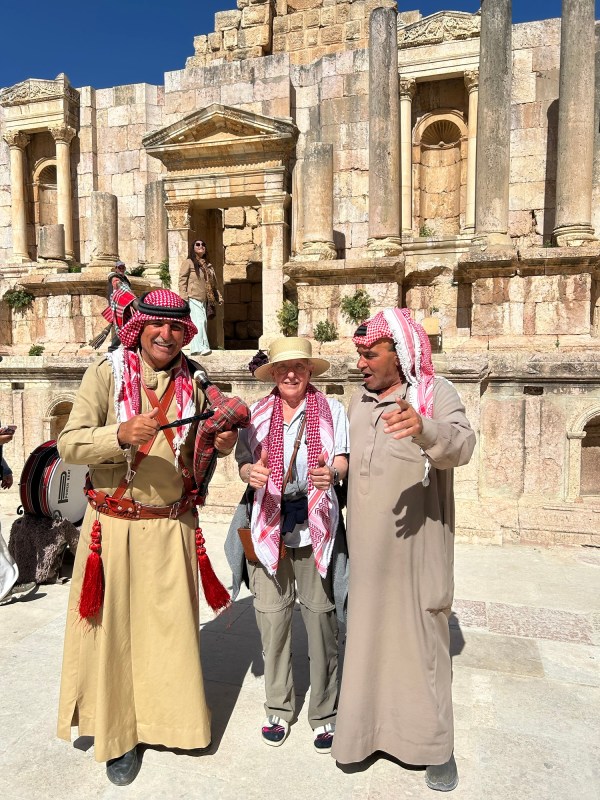
Eventually we enter an almost fully reconstructed theatre with excellent acoustics – and sure enough, there’s a Bedouin playing Bagpipes accompanied by a drummer. And he’s pretty good. We sit and enjoy the alfreso concert. At the end, Osama gets him to play the National Athem of Jordan. We all stand of course – and clap madly.

What a comletely magnificant way to end our Egypt and Jordan Adventure.

Quick visit to the ‘Museum’ – highlight is a video talking about the efforts made to reconstruct parts – and then lunch.

These late lunches are tough on me I have to say!

I mostly eat the Inside (pieces of roasted chicken) and the condiments.

Then it’s back to the hotel. Osama explains how we can get to proper grocery store – and we are in a cab heading there within minutes. The hotel staff explain that this driver is one of their regulars – and we should tell him when to pick us up to get us back to the hotel. Deal!

The mall is actually walking distance from the hotel – but there are two hills in the way. Amman is very very hilly!

But it is so modern – it takes our breathe away. If you told me I was in a major US city, I’d have believed. you.

The grocery store was perfect. We slowly cruised up and down every aisle – admiring the packaging, looking at the spices – and generally having a wonderful time. There is a lovely young gentleman manning a section that serves out portions of nuts and spices – we spend quite a bit of time there!

Eventually – it’s time for our ride back to the hotel, and then our Farewell Dinner.

Is anyone surprised that we have to get suitcases out at 1:00 AM. Sheesh.

Tomorrow (Feb 21) is going to be a very long day – turns out to be 28 hours before we are safely in Miami tucked into our bed.

What a wonderful adventure this has been.

Flash Forward – Feb 28 – It is very alarming to hear that Jordan has closed their airspace, and taken down two missles headed their way today. I just hope all our new friends in Jordan are ok – stuck as they are between Isreal and Iran. Not a safe place to be today or probably for quite some time. Not what Jordan needed at all.

Signing off to go back to reading the news about what the US and Iran are up to.

Thanks for reading my Blog. The Soup Lady
Egypt and Jordan – Day 17 – Feb 18, 2026


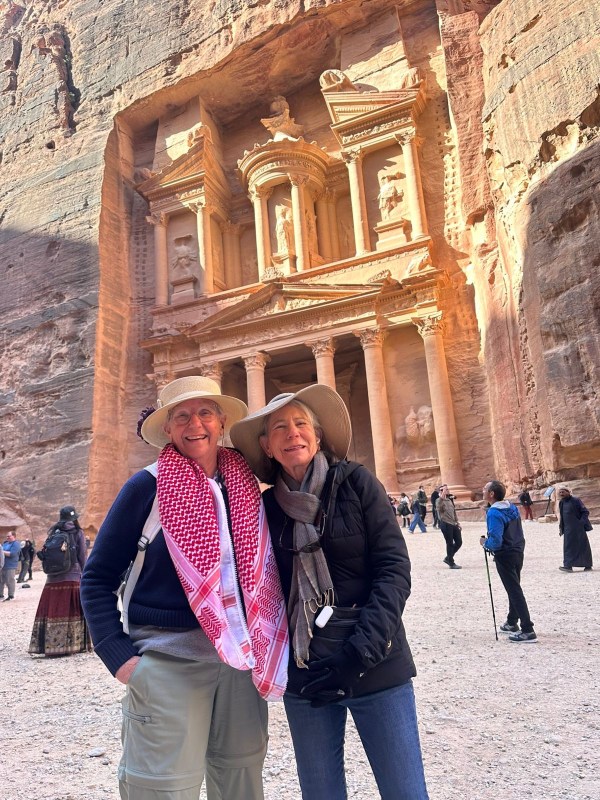
Petra! I can’t believe it. I’ve been dreaming of going to Petra forever – long before Indiana Jones made the Treasury famous in the Movie.

And now, finally – I’m going to do it! I’m completely excited, thrilled, and a bit nervous about the walk. But hey – I climbed into and up the Great Pyramid – I can do anything.

Unfortunately, Victor wakes up feeling very poorly and tells me that he’s rolling over and going back to sleep. I tell him – it’s Petra! You sure. He’s sure. So I go down to the lobby and explain to Osama that Victor’s not coming. He insists on calling up to the room to explain that Victor can take the cart option – but Victor says no – but thanks. He’s going back to sleep.

We walk across the road, Osama explains the layout of the Park – and then tells us that he plans on doing the walk very slowly, timing it so we get to the Treasury when the sun hits the face perfectly. I’m relieved. A nice slow walk – that I can do.

There are other options of course – some folks jog down as fast as possible. Other folks take a cart. And there’s even a horse riding option. Osama makes sure that no one wants the other options – and that folks know that it’s really easy to just do the carts back in case they get tired.

I’m not sure at this point that I realized that the Treasury isn’t actually in ‘Petra’ the city. It’s part of the Petra Momument of course – but it’s 1/2 way to the city. You must walk another mile and 1/2 to get to the city itself – and that’s where we’re having lunch. So basically it’s 3 miles down and 3 miles back from our lunch stop.

Completely innocently – I follow the leaders down the gravel, but relatively flat path past vendors (1 dinar – just 1 dinar), past folks hustling for horseback rides (want ride – horse ride), and past incredible views. Then we arrive at the entrance to The Siq – the canyon of the moon as per Indiana Jones. There’s a flat part, some bathrooms – and about 12 Roman Reactors! They do a quick formation march – then stand at attention as we walk down into the Siq.

As promised, Osama takes it slowly. He points out the elaborate water system that provided the city with water from springs up in the surrounding mountains, the dams that are part of that watering system, and a place where there’s a carving, now very eroded of a Roman (based on the Toga he’s wearing) leading several Camels. Once pointed out – you can’t miss it.

The pass thru the red rock canyons – colored magnificantly by nature in Red, White, and Black – curves and winds. This was the way Camel teams – 100 camels long – would get into Petra. Their goal – as ours is now – was the city. It’s an Oasis in the middle of the desert – right on the crossing of numerous trade routes North, East, and West.

Pictures simply do not do it justice.

Nah – not good enough. It is absolutely the most amazing thing.

And it’s not just the Treasury – although that’s staggeringly beautiful. There is so much more. Some of it easy to get to, some of it a lot more challenging. For example – there’s the Monastery – so named because folks who originally lived in the Siq and knew no archology – didn’t realize it was a tomb. Ed and Todd galloped up and down the 900+ steps, and could easily have done more. Me – not a chance!

Compared to the Tombs and Temples of Egypt, the city of Petra is relatively young – only about 2300 years old, compared to 4000 to 5000 years for the Egyptian Monuments – but the beauty can’t be understated.

It was a popular spot for 270 years (170 BC to 106 AD) for Camel Carvans because it had water year round. And it had water year round in the middle of a desert with maybe 14” of rain a year because the Nabataeans – a Bedouin Tribe out of Saudi Arabia – were amazing water engineers. They managed to get so much water to flow year round into the city that the Romans when they took over the city actually built a Nymphaeum, a quite elaborate public fountain.

In addition to the basic 3 mile walk – from the Entrance to the Treasury and on to the city of Petra itself, I’m considering a slight detour. It’s an easier walk amoung the options – up to what are called the Royal Tombs – although there are no records of any Royal folks living here. Then my phone bings – I get a message from Victor to let me know he’s feeling a lot better.

Osama says – we’ll do lunch down here as planned – it’s a magnificant buffet of Egyptian delights, you will love it. Then I’ll go back, pick him up and take him down to the Treasury in a cart. Odessey has already paid for the ticket so it’s just the cost of the cart extra. Naturally – I’ll go with Osama – and that means everyone else is on their own after lunch.

Plan made – I let Victor know that Osama and I will pick him up at around 3:00 to go see the Treasury.

After a deliciou lunch I hoof it back up the path (yes – 3 MORE miles) from the city of Petra, past the Royal Tombs, Past the Treasury and up, up, up to the Monument exit. Meanwhile Osama gets everyone else organized and then probably runs up to the Exit. Sigh – Oh to be young again.

I stumble back into our hotel room at 2:15 – quite proud of myself if a bit sore, and when Osama calls us at 2:30 PM – he’s ready to head back down – both Victor and I are ready to go. We enter the park again, and thank goodness – this time we are taking a cart down to the Treasury. I’m not at all sure I had another 3 miles in me. Victor admires the carving, the colors of the rocks, and some of the additional carvings, and then we take a cart back up the hill.

In addition to the expected hustle of ‘ride my camel’ – we are treated to a wonderful display of tourists behaving badly. To take the cart back – you have to line up and wait your turn. On large group of about 8 tourists – with their guide – ignore the line and try to push their way ahead of folks – including Victor and I – who have been waiting our turn to get on a cart very politely. I’ve having none of that I tell you – so I explain to them – there’s a line – and they are NOT getting ahead of my husband’s trip back to the hotel. And they aren’t getting ahead of those people who were waiting with us – or that guy that was also lined up before they so rudely decided to stand on our right rather than wait their turn.

To applause from the other folks patiently waiting – we are seated in the next cart to make the journey back thru the canyon. On our way up – we spot at least 5 carts heading back down empty – I guess the word got to the Powers that Be that folks were getting unruly at the cart stop.

Victor goes back to our room to rest – I do the Petra Museum. It’s actually a lot larger than it looks and covers the entire history of this part of Jordan. As I enter the museum, I run into Andrea who tells me to be sure and see the introductory movie. It’s all about water – and how the Nabataeans ruled for 270 years because they understood how truly important it was!

Just FYI – (I had to look this up on a map) – Petra is in the middle South of Jordan – well below the end of the Dead Sea and about 1/2 way from the Dead Sea to the Red Sea. Definitely in the middle of the desert.

It’s easy to imagine 100 long camel carvans going up and down – destination Petra and water. The high period of Petra ended when the last of the Kings died without an heir and the Romans decided they would rule Petra.

Fortunately – they improved, not destroyed the carvings in the soft Limestone done by the Nabataeans. But they did force them to stop carving tombs, and eventually they were absorbed into the Roman culture. In the city of Petra there are huge Roman ruins including a giant Temple which had it’s own swimming pool and garden, a multi-story building, traditional entrance arches, and of course the Nymphaeum.

I suspect that the Siq even impressed the Romans as they didn’t really widen it – but left it as this magnificant entry way into another world.

Dinner is a group affair – more mezze for me – and we are fairly early to bed. Thank goodnes. My watch is very proud of me – I did over 24,000 steps – and I’m pretty well done in. I just hope Victor continues to feel better in the morning.

Signing off to pass out – the Soup Lady

Egypt and Jordan – Day 15 – Feb 16, 2026


8:00 AM and the noise level in Cairo is already quite unbelievable. I will admit however, that I am starting to get used to the noise, the people seeming to constantly be yelling at each other, the insane amount of traffic – and as we head out into the ‘country-side’ – the increasing use of donkeys and/or horses to pull carts.

We’ve even seen donkeys pulling carts containing Oxen.

These are not tourist attractions, these are farmers who have no other way of getting their goods to market. There is a level of poverty here that is quite challenging by western standards.

Yet again we are also stunned by the piles of garbage everywhere – and while I believe that Hussein believes it shows how little the population respects the government – we watched out the bus window while a police officer in a dress uniform standing near an oh so common police standpoint casually take a paper out of his pocket, wipe the front of his uniform, then lean down and clean his shoes. When he finished – we all watched as he tossed the paper onto the already dirty street.

I know myself that if there is no liter – I will careful put a trash wrapper in my pocket. I’ll even pick up a piece of litter if it is the only piece and find a garbage can. But with no garbage cans in sight, and a filty street – picking up one piece seems hopeless. So even I – while annoyed – won’t stop to clean. I’m guessing the population of Egypt must be feeling the same way – and there are millions of them! (and we actually never saw a public garbage can!)

Somehow, I think the issue is more a cultural disregard for property that is not mine. Maybe the inside of my home is clean, but I’ll guarentee that streets in your neighborhood are dirty, areas near fences layered in discarded boxes and crates, the sidewalks challenging to walk down, and if there is a unoccupied area – particularly a gully of any size, it is filled with garbage. And the mounds are often high.

Maybe there is a ‘nicer’ section of Cairo, but we have yet to see it. Unless it is a very clearly tourist area – it’s a mess. Have people no pride?

But clearly, I digress. We are headed for the Step Pyramid. Hussein tells us that this national monument area is his favorite and he can’t wait to share it with us.

If you are interested in the history of this pyramid – there is a lot of information in Google on it, and on the rest of this National Park – check it out. I’m going to just talk about the parts I found interesting.

But first – when we park the bus inside the Monument – I see something I haven’t seen before. A man sweeping garbage on the sand into a dust pan. And not just one. I spot at least 3 employees cleaning up here – and then I realize that there is no litter to be seen. What a contrast to the street in Cairo!

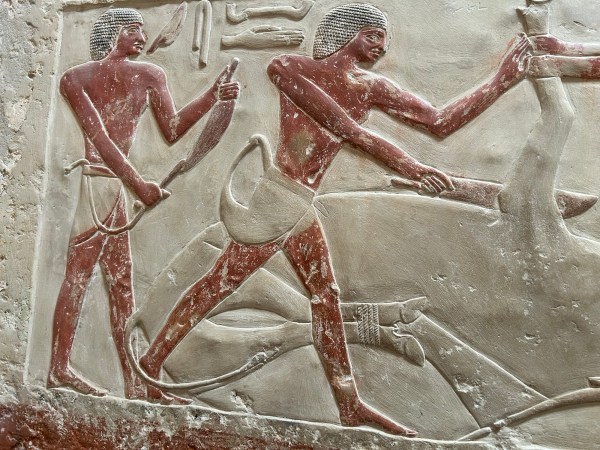
Our first stop is the tomb of Idut – one of Hussein’s favorites – and rightly so. Unlike the massive Temples of Luxor and Karnak, the tombs we visited in the Valley of the Kings, or even the smaller temples we visited by boat in the Nubian area of Upper Egypt – the hieroglyics in this tomb are not about the book of the dead, or even much about the young princess (probably the daughter of King Teti) that died. They are all about local activities from 4,340 years ago! Imagine that – it’s a picture book for kids on what common folks were doing in the fields, and the kind of products that the Princess might expect to get from the common folks in the afterlife.

There’s hunting, fishing, farming, and even tax payments shown. This tomb is stunningly different from anything we have seen before.

There are colored carvings of rivers filled with different kind of fish, with Fishermen pictured fishing with lines with multiple hooks and a fish caught on one of them. There are other fishermen using nets. The accounting scene looks like it could be drawn today – with the scribe having pencils held behind his ears as he records the days receipts. There are common folks shown bowing to the princess to show respect, and a lovely colored scene of a fisherman with his net avoiding a hippo to catch huge fish. Another hunter is trying to use his staff to spear something. There are farmers carrying different kinds of birds to the princess, some being held, some in a sack.

In another scene, cows are being coaxed across a stream by the simple technique of holding a calf by his legs from a boat. The calf is clearly calling out to his mother – and the herd in solidarity are following the mother across the river!

In another scene – the farmers are crossing the river in a boat while below them the hippos including a baby hippo are being pursued by a Crocodile.

In another scene – a commoner is shown carrying a hind quarter of a calf – complete with the leg and hoof. There is also a butchering scene with the cows legs tied together in the forground. Another carving shows a young ibex leading his owner towards the Princess – one assumes that the young ibex is a gift to her.

One imagines that over 4000 years ago – an artist was having a lot of fun drawing what he could see around him every day.

We then move on to see the oldest tomb found so far with paintings from the book of the Dead. It’s easy to get inside compared to the challenge of the Great Pyramid – just down a few steps and you are surrounded by extremely well preserved Hieroglypics giving all the instructions for the Ka – the soul of the dead person – on how to enter the afterlife! All over 4000 years old. And some of these pyramids even still have sections of the finer limestone in tact.

It is easy to understand why Hussein, as an Arcologist finds these tombs of greater interest than the more popular and famous Giza Momuments. They are truly stunning.

Finally we are going to visit the funeral complex of King Unas – also dating back 4500 years. He ruled long enough to have time to build a truly elaborate Complex – including a Hall of columns, a large courtyard with false fascades so when his Ka came to visit – it would feel at home. Think Disneyland – from one side they look like elaborate buildings, but from the back they are just 2 stones thick.

There is a lot of ongoing excavaations going on in this area – and it’s been a hot bed of exploration for over 100 years – so you can imagine how much there is to see. But while our time isn’t limited, our ability to cope with the heat and the crowds limits our desire to explore. We only check out the highlights. There are well over 100 pyramids in this area alone – many of them visible from a high view point.

Hussein explains that the architect for King Unas was very creative, but hedged his bets. So while the buildings are made of stone, they are made to look like they are made of logs in keeping with older techniques. And the Hall of Columns features Columns attached to walls – not free standing – to make sure they didn’t fall down. We end our visit with a walk thru the stunningly beautiful hall of columns – and reboard our bus.

What has made our trip to Egypt so interesting is the depth of knowledge that Hussein is willing/able to share with us. He clearly knows his stuff. And some of the most interesting ‘lectures’ are about how he views the current political and Economic Situation. It’s way more interesting than – “and on your right is the Great Pyramid”.

We have one more stop before we get lunch. There is a magnificant statude of Ramses II that was found on it’s side with his feet missing. It has been uncovered and left lying on his back so the magnificant carving work can be seen up close. And it is amazingly lovely. I’m particularly impressed by the carving of his nose, his lips, and the bracelet on his right arm.

My best part of this visit is not the statue – but the opportunity to drive thru different sections from Cairo. We pass farm land, and more interestingly – farm land that has been converted into private schools. Hussein points out that the farmers make more money selling the land – but the problem is that the students who go to this school aren’t local students – they couldn’t afford it. So the kids are bused in, and bused out.

He also says that the government has caught on to this, and recently has created a law that makes it much harder – but not impossible – for farmers to try to cash in on their arable land. But the farmers figured out that they could make their land ‘useless’ by simply not farming it for a couple of years. Then they go to government and get a certificate that says the land isn’t worth farming – and bang – they can sell it for development.

Soon we are back at the hotel. A quick clean-up and we have our farewell dinner.

Early tomorrow morning we have to get our suitcases into the hallway and our bodies to the lobby. 5 of us are leaving the tour – 16 of us are going on to Jordan.

Signing off to catch way too few hours of sleep – The Soup Lady.

Egypt and Jordan – Day 13 – Feb 15, 2026


The Pyramids – we are Going to see the Pyramids!

Finally – after 12 days in Egypt we are going to go where everyone who visits Egypt thinks of first – the Great Pyramid.

Hussein tells us that isn’t just one Pyramid in Egypt – there are over 185 of them. But the truly famous ones are of course the three Pyramids of the Khufu family. King Khufu who was buried in the Great Pyramid, his son and his grandson who were buried in the middle and smallest of the Giza Pyramids in their turns.

We’d been able to see them from the GEM (Great Egyptian Museum) – but this time we’re going to up close and personal.

On the ride from the Kempenski to the Pyramid Complex, Hussein explains that we all have tickets to climb inside the Great Pyramid to the place where King Khufu was buried, but it’s a challenging tour and our guides can not come with us.

First you climb up large blocks to the entrance to the Pyramid, craved by the Muslins who were certain there was treasure inside, and were I suspect sorely disappointed to discover that the tomb raiders had been there long, long, long before them. Then you walk thru a 2 way narrow stone tunnel to the staircase and go up a narrow staircase. Then you are at the first of 3 ramps that climb ever upward. It is 340 meters to the top of the ramps, the ceiling becoming increasingly lower until people must stoop or even crawl. And your reward? An empty Stone Rectangle with nothing inside. The worst part – you must reverse the journey to get back.

He continues to explain that folks have complained of back and thigh pain for 2 and 3 days after this experience.

Hmm – not sure that sounds like much fun.

But then I tell myself – I travel here for 24 hours on airplanes – and I’m going to admit to my friends and family that I didn’t go inside the Great Pyramid. Does that sound like me? I think not.

So – the bus drops us off, we gather near the foot of the Great Pyramid to be told a bit of it’s history, along with the fact that for over 3000 years it was the tallest man made structure in the world and is the last of the 7 great wonders of the ancient world still standing.

We walk the short distance up to the foot of the pyramid – and it is a lot larger from this perspective than it was from the GEM windows.

There is a crowd of people lined up climbing the big stones to the begining of the tunnel that marks the entrance to the Pyramid, and Hussein asks – ok – who is going to go inside.

Bravely, I raise my hand. I’m not even alone of our group to do this. This is highly reassuring. I’m not the only nut!

Naturally, I quickly fall the rear of our group – I’m easily going to be the slowest climber – but my first thought is to just do the tunnel – say I’ve been inside – and be done with it.

But in for a nickel, in for a pound. Of course I do the first tunnel, then I climb the stairs, and now I’m going up the first of the ramps. These are wooden ramps with wooden ‘steps’ going across at about 9” intervals. The ramps will get increasingly steep as we go higher, but at this point I don’t know that. This first ramp, which extends out of view above me looks very do-able.

So I start climbing. I bang my head on the ceiling from time to time – it is quite low and the height changes suddenly – hence the ‘bangs’ but I’m doing ok. What is most challenging is that folks are going down the same ramp, and the ramp is only about 2’ wide. Some folks slip by easily – but the guy going down sitting on his bum and taking up the entire 2’ does pose a climbing challenge.

First ramp completed – now I’m at a flat part about 2’ square (just enough to breathe and stretch) before I start the next part. A guard is stationed at this point, and his job is to encourage folks to keep moving! This time there is one ramp going up, and another ramp going down – so it’s much much faster. But the ceiling is getting lower – and I’m definitely having to stoop. It’s the stooping that slows you down.

This ramp ends, and the third and last ramp is now visible. We’re back to the 2’ wide 2 way ramp design, so I’m frequently forced to stop while someone passes me on their way down.

And this ramp is much much steeper, and the ceiling is quite a bit lower. I’ve figured out that my head is safer if I keep a hand raised over it, dragging my fingers along the ceiling. When my fingers find a down part – I duck a bit further.

340 meters upward – that’s about 340 yards or 1000 feet – I’m at a flat tunnel that is seriously small. This is where some folks crawl, but I’m ok walking with my back bent, hand above my head, and my knees stretching out straight ahead with each step.

At the end – as promised – the actual burial space of King Khufu. Hurrah – I made it! And I’m very proud of mysel.

But as promised – it’s an large empty space. I take a photo of a fan to prove I’ve been there, look around and stretch – and then start the long crouch back down.

I suppose if figures that if I’m polite on the way up, I’ll be polite on the way down – so bottom line – I’m slow. But I make it back down all the ramps, the stairs and thru the tunnels to daylight. The guards at the entrance greet us with “You’ve been born again” – which makes me chuckle.

I DID IT! I climbed to King Khufu’s burial Chamber. Yea Me!

We re-group, and get back on the bus to go to the Sphinx. This is actually easy to visit – although it’s finally getting a bit crowded and there’s a bottleneck where we have to squeeze thru a narrow doorway. But it’s totally worth it – it’s the Great Sphinx. I even spot the location where Detective Hercule Poirot sat at the being of Death on the Nile! If you’ve never seen it, or it’s been too long – the 1978 version is such a classic – Check it out.

Folks are posing as if they are kissing the Sphinx – if you stand on the high edge of the walkway and bend over – from the right angle it does look like you are exchanging kisses.

We walk back slowly, it’s the SPHINX! I’m so excited to finally come face to face with something so beautiful, so historic, so old!

Hussein gives us a bit of a talk about the Sphinx, then Victor takes the mike to explain that Napoleon definitely didn’t blow the nose off – there are written reports from years before he came to Egypt describing the Sphinx as having no nose.

Back to the bus, and it’s time for our camel rides. I can’t resist. I’ve climbed up inside the Great Pyramid – I can sit on a camel. And I now have the picture to prove it. I even got a ride – albeit very short. But enough to realize that a camel is a lot like a horse with a very awkward way of kneeling. First they put their front legs out and bend their knees toward the back. Then they bring down their back legs – with the knees bending towards the front. It makes for a bit of a pitch forward then backwards – which some folks in our group find surprising, but it’s quite fast.

The Camel Handler signals me to raise both my hands to frame the Great Pyramid behind me – and snaps my picture.

Very Cute!

And no – my camel did not spit at me, or behave in the last bit inappropriately. He was easy down for me to get on, easy up with me on his back, a bit of posting while he walked around, and then absolutely still when asked to stop by the driver so we could get the photos.

Next stop – the smaller of the Pyramids, where we walk around looking at the pits where the boats we saw in the GEM were discovered – and Hussein explains a bit more about how these momuments were built. They have found ruins of mud brick ramps in other places, so they are quite certain that the same method was used here. The most interesting – I didn’t know that – thing is that they discovered above the burial chamber of King Khufu a series of decreasing empty chambers ending in one that is triangular. They suspect that these were used to reduce the pressure on the burial chamber by redirecting the weight of the stones above it on all 4 sides. Neat.

Back to the bus, a drive along the highway linking the GEM to Cairo proper past the crowded and half empty appartment buildings, and crowds of folks pushing and shoving their way on the streets to a Fish Restaurant. It’s relatively new and actually interviewed Victor for a TV advertisement they were working on after each of us was served a whole grilled fish (a small sea bream we decide) with skewers of 3 grilled shrimp (head and tail on). I like the Mezze the best to be honest.

Then it’s back to the hotel – and I opt for a lovely afternoon on the roof terrace, hidden from the sun by a large umbrella – working on my blog of course.

For dinner we go back to the Taboula with Ed and Todd. We have a very very lovely time, the food is even better than last time. The host remembers us from the night before (I think it’s my hat with it’s purple flower – or maybe Victor’s destinctive sideburns and ponytail?) and greets us warmly. He suggests different dishes – although we insist that one of the main courses be the Beef with Pomegrante and Citrus Sauce. Dessert is 3 unique dishes – and I love everything. Best place we’ve eaten since we arrived in Egypt – for sure.

The walk home is past the security guards for the British and American Embassys again – and it still feels awkward.

Cairo just feels like a city in big trouble. So many men just standing around, not even talking in small groups, just standing around at all hours of the day and night. Hussein says unemployment is about 30% amoung younger men – which tallies with what we see. Although when I look up unemployment in Egypt – officially it’s at 6.5%. Hmmm – hard to believe.

Although they are doing the 3rd world thing of throwing people at problems, not equipment as we would in the 1st world. There are donkeys used to pull carts – not just one or two, but clearly the obvious choice. And while I don’t see the thousands of motorbikes that I did in Thailand and Vietnam – there are ‘common’ taxis.

These are white vans that pick up folks standing on the highways. Hand signals determine where the van with it’s load of riders is heading so the folks needing a ride can quickly determine if this van will work for them. And everyone – old and young, men and women – use these services. Apparently a ride is 1/2 an Egyptian pound. We see crowds of people just standing around waiting – literally blocking an entire lane of the highway on each side.

And I can see that the much advertised Metro to the GEM is very closed.

Signing off to go to bed – tomorrow is another busy day.

The Soup Lady

Egypt and Jordan – Day 12 – Feb 14, 2026


Another insanely early start day! That’s 2 in a row – tough on these old bones – but it is what I signed up for – so I’ll pull up my big girl pants and bravely head out into the dark.

Our destination is Cairo – and everything goes smoothly. Thank goodness for the Odyessy Folks – they really have this streamlined. We re-group at a completely unreasonable hour in the lobby, grab coffee or tea or hot water from the hotel staff who also had to get up early, grab our ‘to go’ breakfast bags – and board a bus for the 45 minute trip to the Luxor Airport.

The streets are empty – but the airport is packed. There are layers upon layers of security. First stop – we seperate into women’s and men’s lines – We are told to carry only our passports – Everything else goes thru the scanners. And then we walk thru a human scanner – and everyone gets a pat down. They even make us put our legs up on a block and they pat them down. There is a woman doing the patting on the ladies side, and a man for the man’s side.

Then we get to the check-in counter – wait in line to check-in, then we go to the security system (Men vs Women division and another full body pat down this one with shoes off), and finally we are at the gate level. All these checks – and we are only flying Domestic – Egypt Air from Luxor to Cairo.

The plane is packed, not an empty seat to be had. But at least we are all able to get on the plane. Hussein warned us that sometimes groups are bumped to later flights if they arrive late at the check-in counter. But we dodged that bullet.

Even so the flight is delayed, and we get a late start. No matter – Hussein has plans that he can flex to make sure we get to see everything we were told we’d see in Cairo.

The other option is the train from Luxor to Cairo – a distance of about 500 miles. But the train takes 13 hours! The train from Montreal to Toronto, a distance of 600 miles, takes a bit over 4 hours – and we’re screaming that this is extremely slow. Well – it’s not slow in comparison, that’s for sure.

Anyway – we have a quick flight and uneventful flight – and we land in Cairo. Our first experience with the Cairo Airport wasn’t great – but this time we are firmly in Hussein’s hands. His cheerful ‘Follow Me’ gets us out of security to baggage claim. There’s a heart stopping few moments when everyone elses luggage has arrived – and ours is MIA. But then the baggage conveyer begins to spin again – and out pop our Bags.

Whew.

We walk out of baggage claim to our bus without anyone asking if they can help us, and we are on our way to our first stop in Record Time. I’m impressed. There are clearly advantages to being with a well organized tour group like Odyessey!

The Citidel in Old Cairo was built in response to the Crusades – The rulers of Egypt wanted to defend themselves, but in fact the feared invasions never happened, and the Citidel was never used. It does remain today as the Egyptian reminder of the Crusades. In the courtyard of the Citidel is a Mosque built like Turkish Aga Sophia except they used Alebastor for the walls. Inside it is stunningly beautiful.

Right now it’s being refurbished, so while all visitors either cover their shoes or remove them, we were allowed in to get a better feel for the place. Among the planned refurmishments are new carpets, so the old carpets have been removed, giving the giagantic inside a clean and very relaxed feel. I’m also impressed by the view of Old Cairo from the Balcony that runs the entire width of the Mosque.

We take a short bus ride down to the ‘old Bazzar’ area of Cairo. It feels a lot like the Bazzar in Fez – except all the vendors are hawking tourist items. But the narrow alley ways and the tiny size of the shops definitely brings home that Bazzar feeling.

Some of us opt to shop, but Victor, Andrea, Ed, Todd and I opt for a different tour. Hussein takes us to see some of the more interesting aspects of “Old Cairo’. We walk past an entry way where the Threshold stone is has clearly been lifted from a Temple – it is covered in Hieroglypics. There a door way to a former Synogous – recognizable by the Jewish Star. There are butcher shops with butchers working on cutting Beef Quarters into smaller cuts of meat. I chat with a lovely Egyptian Family – Mother, Grandmother and two Daughters. Curled around the legs of the Grandmother – but finally willing to do high fives with me is the pride of the family – a young son!

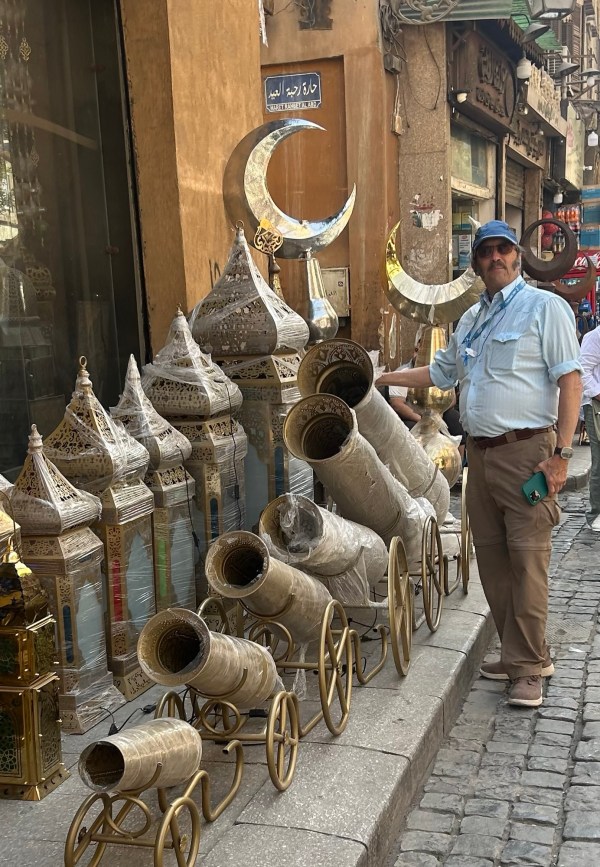
Other highlights – a shop making and selling Brass Cannons – in a variety of sizes – from large to really really large! I tell Victor – NO CANNONS!

There are also Tin shops making Hookahs in various sizes – including

Just as we are getting ready to leave – Andrea and I beg for a bathroom stop. Our security guard chats up one of the shop owners – and we are alowed to accend a very narrow spiral stone staircase 3 flights to a tiny bathroom. I don’t care – it’s clean and the guy who found us the toliet hands us some toliet paper!

Life is good!

Now we are driven to the Coptic area of Old Cairo. This area is actually buried underneath ‘New’ Cairo, and was built on top of Roman Ruins. So layer upon layer upon layer! So interesting. To get to the Coptic area, you actually walk down a rather steep staircase and under a bridge that carries pedestrians. There – much like Diagon Alley – is an under ground shopping street with small restaurants – a very large antique book store, and a Christian Nunnery (I spot a Nun!). There are two reasons we came down – a quick visit to the ‘Cavern’ where Jesus was hidden for from 3 months to 2 years – depending on who is telling you, and a magnificant old Synagogue that has been donated to the Egyptian Government during Nasser’s Nationalization of all things Jewish.

After taking over the Synagogue, the Egyptians discovered a hidden room filled with old records. In the records – it is recorded that Mamonidies once came here. It is unclear from the presentation we have what he might have been doing – research perhaps – but he was here! Amazing.

To say I’m impressed is an understatement. I know from being in England many times that history can be found buried in the ground, but this is a complete community that is still functional.

We then visit the Hanging Church – built over Roman Ruins that can actually be seen thru the floor boards, and get back on the Bus. For the first time today, I am feeling ‘crowded’. A high school group joins us in the church – and there isn’t even room to breathe. I’m out of here! (hey – first I admire the mosaics – then I run!)

Next stop – lunch and then back to the hotel for a well earned Nap.

We are ‘free’ for dinner, and Hussein suggests a Lebonese Restaurant called Taboula. It was on Victor’s – must try – list, so we are for sure going. Pam and Suzanne join us – and we get a shared meal for 4. There’s enough food for 6 – and it is easily the best meal we’ve enjoyed in Egypt. Superb cooking, great presentation – and one of the main courses – a Beef dish with a Pomegranate/Citris sauce blows us away. Victor asks how it was made or even just the name – but the maitre d’s lack of English and our lack of Arabic proves a stumbling block. He’s definitely looking it up when we get back to the hotel.

Dessert is also excellent – we decide that it’s a bread pudding made with pita – so a Pita Pudding!

The short walk back to the Kempenski takes us past the American and British Embassies. There is – not unexpectedly – a huge police presence. They are set up with Metal riot shields, Personnel Carriers, machine guns, and helmets with face shields every 25 yards – and clearly awake and on guard. I had wondered early about the relatively high number of police in the area of the hotel – now I know why. It’s definitely not about us!

The Kempenski is a warm and welcoming beacon and we gleefully say hi to the staff and make our way to our room.

Definitely bed time.

Signing off – the Soup Lady

Egypt and Jordan – Day 10 – Feb 12, 2026


Oh No! it’s another transfer day, although this one is by far the easiest. We just have to get off the ship and onto a bus for a short ride to our next hotel – the Steigenberger Nile Palace.

Of course it’s NEVER that simple in Egypt. The trick is that we can’t check in to the hotel under afternoon – and of course we have to check-out by 10:00 AM. But Odyessy doesn’t waste time. Hassein has planned a full agenda for us this morning.

So – suitcases outside by 7:30 – get breakfast and be ready in the lobby by 8:00.

I begining to think that Hassein has only two start times – insanely early and 8:00 AM!

Anyway – good travelers that we all are – we are ready at 8:00 to visit the Big Fish of all Temples in Egypt – Karnak. And it is huge. 60 acres in it’s entirety – and Hassein jokes that we shouldn’t worry – we are only visiting 59 of the acres.

Cute. Very Cute.

Even though it seems really early to me – Karnak is busy, busy, busy – and Hassein basically tells us – you haven’t seen anything yet. That and Follow Me are his ways of letting us know it’s time to move!

As we have come to expect from the bigger temples – there’s a ticket required – which Hassein hands us when we get to the automated ticket scanning booths. Inside the ‘Visitor Welcome Center’ there is a 3D structure of the original Temple – as best we can imagine it today. Hassein points out that what makes Karnak special is that every Pharoah from the Old, Middle and New Dynasties had a finger in the pie. Each created a part of the temple, or added a wall, or erected an Obelisk or two. And well meaning folks have tried to ‘save’ sections, sometimes helping out, sometimes with disasterous results.

The worst attempt was French – an well meaning gentleman was asked to just get rid of some of the salt build-up along one side of the Temple. The problem was that the Nile’s flood and drop cycle had left salt over time and the salt had created issues. His idea was to allow the Nile water’s to remove the salt – so he built channels to bring in the water and left it sit under the wall for 3 months.

The wall fell down.

What the fellow didn’t know was that the builders had put cedar wood pegs in the middle of the stone blocks to hold them in place. Adding humidity made the wood swell – and the stones were pushed apart. Just brilliant, right!

On the other hand – under the wall that came tumbling down were found the painted tiles from the temple of Akhenaten that I described in the last Blog. So in fact – in failure they gave Akhenaten eternal life!

Anyway – we spend a brief moment looking at the 3D model, and then it’s time to see the real thing. And it is HUGE. Sheesh. The main hall – famous for having the stone pushed down in the movie – Death on the Nile – is actually as mysterious and huge as the movie makes it seem. A dozen men couldn’t link arms and circle just one of the Columns and there are dozens.

The ‘shorter’ columns are topped with closed Lotus Flowers, and the larger columns in the center of main hall are carved as Open Lotus flowers. The roof was built to go up vertically on the inner set of closed Lotus Flower Columns and then over the open Lotus Flower Columns and then down vertically on the other side. In the Vertical spaces, are grids of windows – creating rays of light. The net effect is to have the rays of the Sun illuminating the Open Lotus Flowers!

So cool. Such a neat effect.

I get some lovely sun rise images over bits and pieces of the temple. There are some really striking parts to this temple – not least of which is the remainders of the ramp system that the builders and artists used to create a Wall. Basically they used mud bricks, built a ramp up to the final height, placing the blocks layer by layer as the ramp was being built.

Then the artists arrive and start carving the blocks from the top. As they finish, the ramp is destroyed and they can access the lower parts of the wall. To make sure the designs are carved in the right places – they used plumb lines to make straight vertical lines (ask your local painter) – and then other plumb lines to make horizontal lines. That makes a grid – and then the images are transfered into the grids.

I use exactly the same technique to copy a painting from a small sketch to a bigger piece of paper. Wow – who knew I was using a 5000 year old technique.

There are some lovely low Relief and high Relief images to admire – and of course the wonderful Obelisks of Hatshepsut. She married her Nephew, then made him marry her daughter, all to keep control of the throne and title of Pharoah in her hands. She ruled for 18 years – and when she died – her Nephew – who finally got to be Pharoah – tried to erase her name everywhere. Nice family – right.

Anyway – Hassein went to great effort to explain what we know and don’t know about the creation and placement of an Obelisk. Because they are needles pointing the way to Heaven for the souls – they are made of one huge piece of stone, carved out in the Quarry. He explains how they measured out the size, carved out parts including the pieces that would in the end make the Obelisk raised at one end and lower at the other. Then the carving would start. When that was finished, the rest of the stone that wasn’t Obelisk was removed and the obelisk put on a boat to take it to the Temple. It was moved into position, and then raised. There are images that have been found that detail carefully all the steps except the one key one – how did they raise the Obelisk into position? No one apparently knows!

We pose for a group photo in front of the Obelisk of Hatshepsut – Admire the magnificant carving of a young King Tut and then use our free time to wander (or go to the toilet!).

We then take the bus a very short distance to a place where they make and paint Papyrus. There’s an interesting demonstration of the technique – starting with the plant (a lot like bamboo), and showing how strips are laid in both horizontil and Vertical position to create after 5 to 10 days of drying – Papyrus. And based on what we’ve seen in the GEM – this stuff really lasts and lasts! It’s flexible and pliable, and with proper preparation – easy to paint. Lots of our fellow travelers happily do some shopping – but we’re trying to downsize – and honestly – nothing really grabs our attention.

Then it’s finally time for lunch – which Hassein tells us is his favorite meal of the trip. We are crossing the Nile by boat to eat at a framer’s home. I must admit I’m sceptical – but in fact – is really truly is his home. There’s a shady area in front of his door that they have put out tables and benches to seat the 21 of us – and a bread oven in the corner. The walls of the space are painted to remind the family of their 2 trips to Mecca – one by steamship, one by airplane.

14 people live in the house – it has 3 floors with maybe 12 rooms, and from what we can see – one sink, and one toilet. Sharing is caring.

The kitchen where the meal has been prepared is very very basic – but the meal is amazing. We start with a vegtable delicious soup (all veggies from their farm), followed by Chicken and Beef. The beef is so tender – it’s wonderful. Of course there’s Rice, Hummus and Tahini – and pita. No meal in Egypt is Pitaless!

They show us how to make a ‘pastry’ type of bread that they dip into Molasses for dessert (it’s yummy – and I’m a complete Klutz at rolling out the bread). The farmer – who speaks excellent English, although he appologizes first – answers all our questions, explains how big his family is – and also tells us that no one knows how old his mother actually is – because age doesn’t matter!

Then they take us inside the house so the Mother who is probably 1/2 my height – can show us how she spends every day grinding wheat using a grinder handed down to her from her mother. One of my fellow travelers tries it – and can make the grinder turn, but just barely. I wait till everyone else is outside to ask if I can try. I can’t even turn the top stone 1/2 way. And this tiny little lady can make it grind wheat.

Mona – if you read this – you know what I need to work on – sigh.

We then say our good-byes and get back on the boat to check-in finally at our hotel.

It’s the best one I might EVER have stayed at. Huge and beautiful. The rooms are stunning, tons of space, lots of lights and we have a giant balcony that overlooks the Nile. I sit on the Balcony working on my blog while Victor takes a nap.

In the late afternoon we are escorted to another Cotton House – where more of our group do more shopping. Victor buys a lovely Blue shirt of linen, and a cotton scarf he’s been hunting for. I chat with one of the very sweet sales girls.

When we get back to the hotel, we take a stroll around the swiming pool, various restarants and double lobby – at the lowest level we find a cute bar where some of our fellow travelers have gathered. We join them for drinks (delicous). I see one of the staff swinging a bucket of coals to get them to light up – and then put the coals into a tall, rather elborately decorated stand. Victor takes one looks and says – those are Hookahs – and lots of folks are smoking. Our waiter asks if we’d like to try one – but we all agree since we don’t smoke – it might not be a good idea to start with these!

When we get up to leave the waiter tells us that entertainment is starting – we should stay. But we all agree – we are done for the evening!

We settle for a simple dinner (I have a salad) at one of the hotel’s restaurants – and go back to bed. Naturally – tomorrow is another LONG day!

Signing off – The Soup Lady

Egypt and Jordan – Day 9 – Feb 11, 2026


Our assigned Visit time at the Edfu Temple is 5:45 AM – so clearly we are going to get an early start.

At least we don’t have to pack first. We just need to get up, get dressed, and get down to the lobby.

I’ll admit that I’m wondering why the rush. I never even heard of the Edfu Temple – and we don’t even have time to grab breakfast first.

Well – it turns out that there are several reasons for our very early start.

One – your group leader must pick a time to go to the temple – this is done to try to cut down on over-crowding. I will admit that it’s a great idea – but there are an awful lot of folks getting up really really early to check this place out.

Two – The Amwaj Livingstone needs to get on it’s way early to meet our designated time to get thru the locks at the first Cataract. The plan is for the boat to sail at 7:30 AM to make our assigned time at the locks, and we will actually get an easy morning and afternoon after we return from the Edfu Temple.

Three – this is a really really cool Temple. So suck it up lady – you are going.

Ok – now that I understand – I’m willing to go with the flow and get up and downstairs on time. 5:15 AM. You have to be kidding me.

It’s dark when we leave the ship – and yes – we’re not the first ship here either, we must cross thru 2 other ships on our way off. And Hassien has been warned that the ship might move. He’ll have to check when we get back.

There are scores of horses and buggys waiting to pick up guests from the different ‘floating hotels’ – but Odyessy has decided not to use the horse and carriages – we are told that they are worried about the way the horses are treated, so we board a bus to get to the Edfu Temple.

Along the way – Victor and I check out the horses – and we really don’t see signs of abuse. The horses actually look quite happy to be out at this early hour – and it is clear that they are well fed. I suspect the issues arise when a horse can no longer fulfil his carriage pulling job – but there’s no one to ask.

They do have sunshades for the horses – lots and lots of them are located near the temple. And most of the carriages have an alfalfa supply under the feet of the driver for ‘horse munching’ when it needs a fresh treat. I’m told that Alfalfa is a major crop here in Egypt, although I’m sure it’s not just for the horses in Edfu.

Surprisingly – despite the early hour – there are lots of folks at the temple, and Hassien tells us that we’re lucky it’s not very crowded. Right.

One advantage of our early start is that we get to watch the sun rise over the Temple of Edfu – a stunning sight. The colors of the sky here, well above the pollution further down stream are simply stunning.

Edfu is famous because it is very very large – and almost completely intact. It was saved because it got used by more than just the Egyptians. There’s evidence of it’s use by the Greeks and the Christians.

Unfortunately the Christians decided that some of the images were inappropriate – and ‘removed’ them by chiping away at the offending parts – generally the faces, arms and legs. Apparently looking at carved bodies distracted from serious worship. I think the priests might have been bored. But again – no one around to ask. Fortunately – the carved images were left intact in the Storerooms, so not surprisingly – Hassien hussles us in that direction.

His plan is simple – hit the highlights that will get seriously crowded first, then double back to see the larger parts of the temple when the crowds are less of an issue. And I can see his point. We get to take our time admiring the glorious carvings in the relatively tiny storerooms – and can still easily enjoy the large columned mid Temple and peacefully admire the huge front Courtyard. Good planning Hassien.

This is a temple built by Ramses II – and to make sure that no one repurposed it easily – He had his name carved in huge Hieroglyics – about 4 times the normal size and depth. This worked because his name is still visible all over the place!

Many of the carvings are in excellent condition (we are talking 4000 years) – and Hassien loves to point out the most interesting ones – like the one of the ‘sky’ bending over the world. She is portrayed with her feet on the ground, her torso bent to be the sky, and then her arms extending down back to the earth. We will see other examples of the sky lady – particularly in the Valley of the Kings! She is quite beautiful.

One of the prime locations is the central courtyard – huge with giagantic pillars on three sides creating a space for the worshipers to wait for the priests to bring out the golden statue of the God from the inner santurary. There is also a 18’ high statue of the Falcon God wearing the double crown of Egypt that is a focal point for folks to stand infront of and have a photo taken! Who can resist that option!

We are given about 20 minutes of free time to wander on our own – and I go back into the storeroom area – I love how the entrance is hidden to the far side of the santuary and then runs all the way behind it. So reminds of Catholic Churches I’ve been in where hidden behind the main altar is a series of smaller chapels.

I’m again impressed by the quality difference between the High Relief and the Low Relief carvings. Apparently Temples are carved, but Tombs are painted. Low Relief is more common and easier to create – High Relief is saved for the most ‘important’ images, and more commonly found in Lower Egypt. It’s the High Relief Carvings that look so alive to me, although even Low Relief ones carry more movement than the paintings, despite the coloring.

We re-group, and head back to our bus and our ship. As predicted – it has moved – and is now about 5 ships out from the shoreline. We count carefully – get on board – and as predicted – the ship sets sail for the locks. We definitely need to be there on time.

This gives us ample time to enjoy the scenery on the sides of the river (mostly green with the very occasional building), breakfast (yum), and then lunch (yum).

From my comfy seat on the Sundeck I can admire the scenery, chat with fellow Odyssey guests, meet some of the other folks traveling on our ship – and of course we compare notes on our different tours.

I’m very happy with Odyssey – Hassien has taken great care of us – and while the ships aren’t the newest on the river – I think they are quite lovely and the service is wonderful. I’m comfortable – what more can one ask?

I also contemplate the advantage of including the section on Lake Nasser. Because we started at Abu Simbel and then floated down to a series of oher smaller Nubian Temples – our visits seemed intimate and private. We rarely saw other folks, and got to spend as much time as we wanted in the temples. There were no glass panes to prevent us getting close to the carvings, few vendors trying to sell us random books/scarves/alabastor whatevers – and it felt like a private adventure.

Now that we are within spitting range of Luxor – for many tourists the end of the line – we are seeing the impact of so many people keen to have their chance to see the Temples. It’s a very very different feeling.

As we get close to Esna – we run into the predictable waiting line for our turn at the lock. So we join several other ships that have ‘parked’ by heading bow first into the shore of the Nile on the Eastern side – away from the town of Esna and upstream of the two sets of locks that provide passage over the first Cataract. Keeping the engine running, keeps the ship stationary – but we now become a target for vendors. They row out on boats and yell at folks on the sun deck to buy their wares.

Our group ignores them, but we have on board a large group of Japanese tourists who are completely intrigued.

The vendors hold up table cloths – shouting prices. If a buyer seems interested – the action intensifies. The men on the boats 40’ or more below us toss up table cloths in plastic bags – and the tourists put their money in the bag to toss it back! I think that generally there are two table cloths in each bag – the expectation being that one will be ‘bought’ and the other – with the money inside – will be tossed back to the vendor.

I must say – I’m not a fan of this kind of shopping – but the Japanese seem to love it – and a lot of table cloths end up being purchased!

Eventually – the ship’s ‘lock’ time comes – and we back off the shore. The vendors are disappointed to lose so many buyers – but thank goodness another ship arrives and they get distracted.

We head into the locks.

The first lock is really just a bottle neck. It’s the original lock, and it took an hour per ship. Now – it’s not in use – but because of the Catarat – every ship must be pulled thru manually before getting to the proper locks just a bit downstream. This makes us again a target for vendors – although they are not allowed too close to the lock itself. I did watch with great interest when one boat pulled infront of our ship. There was a man with his son inside, and the man put out his prayer rug, the son use the oars to orient the bow of the boat towards Mecca – and the man began to pray.

Hmm.

We are fairly quickly into the lake between the two locks (new and old). The new lock is actually a double lock – with room for 3 or 4 ‘floating hotels’ on each side. It takes about 20 minutes to close the doors hehind our ship, open the doors infront of the first ship in line – and allow the water to spill out – lowering the ships 8’ to the new level of the Nile. We then move out of the locks, and if there are ships going up stream, they motor in and the process is reversed.

So old timing – 1 per hour. New timing 6 per 20 minutes or 18 per hour. It’s probably still a bottle neck – but at least it’s not an insane bottleneck!

Next stop – Luxor.

First a word about the word Catarat. The white build up in eyes losing vision reminded the Egyptian Priets of the bubbling white water of the Nile when it hits the granite rocks in the Catarats. Hence the term – Catarats in the eyes! Hassien is just a fountain of information.

As soon as we tie up at Luxor – and the number of ‘floating hotels’ goes up drastically – we immediately re-group in the lobby – exit the ship – and head for a bus. We are going to be touring Luxor and then going to the Luxor Museum.

The program has planned for a total of 2 hours for both visits, but I think we go a bit slower. In any rate – there is plenty of time to both get a guided tour of the Luxor Temple, and to have private time to do a tiny bit of exploring on our own.

The Temple completely lives up to it’s hype. It’s amazing. Not nearly as huge as Karnak of course – it was built for a Queen not a King – but lovely. The carvings are glorious, the heights of the columns incredible, and the courtyards both inspiring and daunting. My ownly complaint – and it’s predictable – is the crowding. And I’m reminded again why I’m so glad we did Lake Nasser’s Nubian Temples first. I spend more time saying sorry and getting out of the way of other people than I do enjoying the beauty of the carvings.

The avenue of the Sphinxs is stunning – just the fact that the Egyptian government could commit and execute such a project, with a lot of help by foreign interests including USAid – is special. over a mile long, over 1000 platforms for Sphinxs – wow. Unfortunately they haven’t found most of the Sphinxs – but the planners carefully put the best ones into the best positions for Photos.

This avenue was used twice a year, when the statue of the God Orisis in the Karnak Temple went to visit his wife – Isis – in her temple at Luxor. There was a huge parade there – carrying the statue of the God. And then 10 days later – an equaly huge parade brought the God Orisis back to his own temple.

Next stop – the Luxor Museum. Hassien tells us that this is his favorite museum – to his mind better than the GEM – and I have to agree it is right up there.

His highlight are the two mummies on view, carefully displayed in very dark rooms and in glass ‘cases’ – to keep them intact. He is also intrigued by the pieces of painted tiles found under the collasping wall at the Temple of Karnak.

After the death of the Pharoah Aton – who tried to convert the Egyptians to mono-thesism – the next Pharoahs with the help of the priests who lost their jobs because of his actions tried to erase his memory. They buried these Tiles under the wall at Karnak. But when the wall was destroyed by accident in the mid 1800’s – the tiles were found and it was a gigantic jig-saw puzzle to put them back. The result is displayed along a huge long wall in the Luxor Museum. The result is – as so many things are here in Egypt – quite stunning.

But now it’s time to return to our ship – just walking distance from the Luxor Museum – dinner – and for Victor and I – Bed!

Tomorrow is another LONG day!

Signing off – the Soup Lady.

Egypt and Jordan – Day 3 – Feb 5, 2026


It’s another day in Cairo, and today we start our Odyssey Tour by meeting our guide and fellow travelers in the lobby of the Kempinski.

But first – breakfast. It’s just as overwhelming as it was yesterday – but this time I bravely ask the chefs to prepare me an Egyptian Version. They gleefully agree and are handing me plates with samples of all the ‘special’ things that they feel Egypt has to offer.

I do love their version of scambled eggs I will admit – add nuts to anything and you pretty much have me sold, but Ful Medames has me frankly unimpressed. Part of the issue – I said not spicy – and I’ll bet it is always served spicy. But it’s a very unappealing grey color. I kinda pretend to eat it, and then push it aside.

Now we go down to the lobby area and meet our guide – Hussain, and our 19 fellow travelers. They are mostly in the 60 to 79 age range = or as Victor refers to us – the White Haired Crowd. But they seem very nice. Hussain – our guide and fearless leader for the next 2 weeks is a Nubian Gentleman with a degree in Egyptology, and has actually worked 2 seasons as a archologist. He’s experienced, well spoken, extremely informatie – and a general delight.

This is going to be great.

We start with the standard ‘rules’. No polictics – there was a fist fight several months ago – they don’t want repeats. Don’t talk or even recognize the vendors. If you ignore them, they will ignore you. Be polite, be on time (he’s not waiting if you aren’t there), All delivered in a droll manner and with a smile. I like him!

We then board our 44 passenger bus. Given that we’re just 19 (21 if you include Hussian and our security guard), that makes for plenty of space.

As before – we are heading out to the GEM.

I ask Hussain about the frequent condos that have entire floors vacant – without even windows.

Hussain says that naturally there are lots of reasons – but bottom line – it’s money. If you want to put up a building – you need a permit. Permits are only good for one year.. So developers hop to it. and get the structure of the bilding up and running . They stop just sort of finishing the building! No foors, No ceilings, No windows, and tell the buyer – your job to finish. They have fulfilled the requirements of the Permit – their job is done.

And there are lots and lots of building like this –

As one of our fellow travellers quipped – well that explains the lack of ‘homelessness’.

After what feels like a much faster trip – avoid rush hour in Cairo folks – it’s not worth the travel time – we again arrive at the GEM.

And this time Hussain takes care of everything for us. We are given ‘Whispers’ – remote listening devices that allow us to hear what Hussim has to say – even if he Whispers. Since we must set them to a specific channel – I’m going to guess a version of an old fashioned walkie-talkie. Our channel for the entire trip will be #5!

What is astonding is the differences between what Hussain (remember – he’s a University trained Egyptogist and has experience doing digs) shows us and what we saw yesterday reveals the incredible depth of displays in this volumous space.

Again we start with a quick look at some of the materials before King Tut – focusing on reading the hieroglyphics. Hussain tells us that we define Civilization as an Organized society with a discernable leadership, a written language, and records. By this standard – as soon as the Egyptians had formalized hieroglyphics, they were civilized – and that happened almost 5000 years ago.

He shows us how to do a beginner’s read of hieroglyphics, then takes us to see some of the most interesting examples of why the Egyptians were considered Civilized so long before other communities. In the museum’s collection are examples of early writings that have now been ‘translated’ – and because the Egyptains loved to write on stone – are still readable. He also shows us perserved early versions of the Book of the Dead – the insanely complicated instructions that had to go with a corpse to the afterlife.

Unlike our first guide – Hussain is interested in convincing us of the depth and weath of Egypt. He also is concerned with some of the more conteversal aspects of the current regime. But more on that later.

We tour the museum slowly – but very differently today. So worth that extra day! I spot places that I didn’t ‘see’ yesterday and would like to spend more time at today because Hussain has promised us time to wander. The docents have done a wonderful job of identifing in both English and Arabic all the display cases – sometimes repeating a brief explanation 4 times (once on each side), but sometimes changing it up.

After our 2 hour guided tour – which includes a much more detailed description of what might have gone wrong with King Tut who died very young – and was buried with 365 Canes (clearly he had trouble walking) and a very detailed discussion of the relationship between the 4 gods – Osiris, Isis, Set and the 4th sister – Nephithys – it’s free time.

Victor finds a comfy place to sit – I go back to sections that were skipped on both tours. There are 3 (maybe more – I found 3) underground sections. One dedicated to the Valley of the Kings, one to what has been uncovered in the ‘artist’ colony that existed not far from the Valley of the Kings and housed all the folks and their families who had dedicated themselves to workiing on the tombs, and one focused on what has been done underwater near the former site of Alexandria.

The last was my favorite. They had video footage of the divers ‘discovering’ various items – mostly statue pieces and coins – and then the items were displayed for us to see. As a scuba diver who’s done some underwater ‘forging’ – this was super interesting.

They also had photos taken during the opening of King Tut’s tomb, a section devoted to explaining what happens during the 12 hours of night – including images of the various gates a soul must navigate on their way to the afterlife.

It’s a huge huge museum, and like all really big museums, there is lots to uncover. I barely make it on time back to our meeting place!

We all go for lunch at Zooba – and this time are served a feast of Egyptian flavors and foods. Beware the Egyptian appetizers – it’s easy to eat your fill of beets, sausages, and humus – not leaving room for the main courses of grilled chicken (I do LOVE their grilled chicken), fava bean and cheese vegetarian dishes, and of course deserts. Today it was a truly delicious rice pudding.

Hussain now takes us over to see the full sized ship that carried King Korfu to the great Pyramid and was then unassembled and stored near by for his use in the afterlife. I’m am again impressed. Not only with the ship which is remarkable intact after 4000 years – but the incredible design of the building built to house it.

Hussain also points out some Paprus that is growing at the museum. I didn’t actually realize it was a plant much like bamboo! Cool.

We have definitely walked our feet off today – but we still need to get back to the hotel.

Because buses are higher than cars, on the return trip we drive very close to the appartment buildings we’ve been passing. Hussain explains that these appartment buildings were painted by the government when it was realized that the road visitors must travel from the ‘fancy hotel district near the Nile’ and the museum would pass this way.

We also see ‘farms’ on the roofs of several of the buildings. Once you know to look for them – they were highly visible from our elevated positon. We say several chicken farms of course – but also sheep herds, and goat herds. I’m consumed with wondering how they take them down the elevators!

Back at the hotel we get a brief period to relax – then we meet for a welcome ‘drink’ (I’m drinking only soda water – this place is dry!) – and then we go over to one of the popular islands in the Nile for dinner. Again the appetizers (Mezze) are delicious. This time we have the Egyptian version of Samosas, Fried Beef buns, and course Pita. The main course – Grilled Chicken! I’m a happy camper.

Back to the hotel and bed. We must have our luggage outside by 1:30 AM – and we must be in the lobby by 2:00 AM sharp as we are flying tomorrow to Ashwan!

Signing off to get packing – and trying to grab some sleep – The Soup Lady

Egypt and Jordan – Day 2 – Feb 4, 2026


It’s a new day – and I’m straving! Clearly the airport and airplane food wasn’t sufficient – and I’m thinking Breakfast!

So Victor and I get up – and get going. First stop – Breakfast at the Kempinski Nile – and What a breakfast it is!

I’m totally blown away. And it’s not like I haven’t enjoyed some pretty impressive breakfasts in my life – but this one – wow. And it was included in our reservation. Color me very very happy.

Naturally – my first stop is coffee – but you are not allowed to get your own – oh no – there are two coffee waiters and it is their job to get my coffee.

Ok – Latte would be perfect – and they smile, nod, and disappear, returning quickly with a small but completely perfect Latte. Yum.

Meanwhile, I’m investing the breakfast options. There are several different service areas. First I see the fruit juices – fresh squeezed Mango, Guava, Orange and a fourth choice that I can’t remember.

2nd section – the fruit station – some fruits I recognize, like grapefruit and oranges, others I think look familiar – like dates, and a lot of fruits that I’ve honestly never seen before. I try something white – and I’m no wiser. On this section there are also a lot of round fruits – green, white, pink, red – but my bravery only goes so far. I’ll skip them for now. Also on the fruit station are the meats and cheeses. So many options.

3rd section – the Honey Comb and raw honey selection! Wow – My camera is out immediately. That’s the largest Honey Comb I’ve ever seen!

4th section – the Bread choices. I’d say I recognize maybe 4 or 5 of the options – the rest are mysteries. Not quite pastries, but they look to be sweet. I’m sure at least 3 different options were in the donut family, but the ones that appeal to me the most are decorated with sesame seeds – both white and black. They are in different shapes – round and cresent variations, and I gleefully grab a round one with black seeds. Then I turn around and realize there’s another station behind me with cereals like oatmeal (delicious) and Fool (fava beans I’m told – but not green – more of a grey). There are toppings for the hot cereals – standards like nuts, but other options I really don’t recognize.

And there’s an omlet station! Now that looks familiar – and delicious.

Since it’s my first breakfast here – and I’m not sure how my stomach is going to react to gastronomical challenges – I opt to go safe. We are here for 3 nights – I’ll be braver tomorrow!

After my delicious breakfast, we take a hired car to the GEM. I’d bought us tour tickets for 10:00, and based on last nights travel adventure – I’m leaving lots of time to get to the Museum. Ahmad is quite friendly – the car is a mini-van – even though it’s just the two of us.

The plan is that the car is ours for the day – and we trade phone numbers. I’m to message Ahmad when we’re ready to head back to the hotel.

After info exchange – we head to the GEM. This time it’s both daylight, and not rush hour – although the traffic is still quite insane. We can see more and more appartment buildings – and I point out to Victor how many appear to have deserted floors. Not only do the floor appear vacant – they often have no windows, and the ones we can see inside have no finishing inside either. We spend the ride trying to guess what causes this – I suggest that maybe when you move out you take the windows with you, Victor thinks that maybe something has happened and the owners have never moved in at all. I decide to definitely ask when we meet our guide tomorrow.

From one of the many multi-lane highways in Cairo, Ahmad rounds a corner – and there is the GEM. It’s over 500,000 ft of exibit space making it one of the largest museums in the world. The entire thing is done on a massive scale – in keeping with the massive size of the objects on display.

I’d pre-bought tickets – and despite my language concerns – folks generally speak English – and everyone is super helpful. It’s the massive size that is the most daunting.

We find how to get earphone sets for our tour – and join our guide. She’s obviously highly experienced, and after a bried info proceeds to guide us thru the top exhibit in a 2 hour tour. About 1 hour of the tour is devoted to King Tut – all 5000+ of the object discovered in his tomb are on display. And the rest of the tour is spent pointing out the highlights of the exhibits related to other Kings.

The grandeur simply can not be described in words. Nor can words describe the crowding. Our guide estimates that there are more than 5000 visitors today – a relatively standard week-day load. I’m betting that 1/2 of them were in the King Tut Galleries. Good thing are are 6 of them, right?

The center part of the musuem is an open air atrium that runs the full height of the building. To reach the main exhibit areas – all located on the top level, on the left side of the Atrium – you can opt to take an upward moving sidewalk, or climb stairs. Or guide takes the walkway – and talks to us about what she’s seeing as we move slowly up past the Egyptain timeline. Everything is on a simply gigantic scale. Even the moving sidewalk is split into 5 parts!

King Tut is clearly the highlight of our first tour – and our guide makes sure that we play attention to what she thinks are the highlights of that collection. So yes we get time with the all gold funeral mask, she points out dagger with the iron blade – created hundreds of years before iron was created, and most importantly – talks about the 8 layers of Sarcophgus.

I hadn’t appreciated the sheer size of the outer 4 Wooden Boxes that were nested, one inside the next. They are quite literally room sized – and decorated with gold that has been engraved with glorious Designs – including of course – Eyes of Horus.

But even more stunning are the inner coffins (he had 4). From Gold covered carved wood to solid gold – they are beautiful. And in absolutely perfect condition.

It’s the condition of the items – all 4000 years old – that of course makes them most remarkable.

After the tour – Victor and I decide to try the Multi-Reality show on the creation of the pyramids – from simple dug graves, to the humble ‘bread’ momunent – thru the step Pyramid to the Great Pyramid that is visible from the ‘Pyramid Viewing Gallery’. It’s cute – but not a must see.

The real must see is the Boat of King Korfu. Discovered fairly recently, it was used to transport the body of the King to Giza, then disassempbled and carefully placed into a boat shaped pit dug to one side of the Great Pyramid. After the discovery, the boat was treated like a jig-saw puzzle and re-assembled.

It is massive – over 150 feet long – and intact. Over 4000 years old – Organic – and beautifully preserved.

We grab lunch at Zooba – an upscale Egyptian Fast Food Restaurant in the GEM and very highly rated. Yum.

Then we contact Ahmed to let him know we’re ready to head out. As we leave – we realize they are closing the GEM for some dignatary – and said VIP is arriving right now! Yikes. I ask who is coming – and find out that it is the wife of the Turkish President who has come to chat the Egypitan Leader.

We quickly regroup with Ahmad and head out – we are lucky and manage to escape the parking area secuirty detail right before the VIP shows up. Whew.

The trip back to the hotel is much easier than the trip to the GEM. Victor and I are totally wiped out – we’ve done a lot of walking and a lot of traveling in the last 2 days – and we need some down time.

The roof of the Kempinski is the perfect hideout. There’s a heated swimming pool, nice tables, a bar and food service team, and a magnificant view over the Nile. We relax, chat, blog, and wind-down. Tomorrow is another long day.

Signing off over-looking tourist boats on the Nile – the Soup Lady

Day 6 at the Art Retreat – Meow Wolf and an evening Art walk


After the rain and wind of yesterday, today dawns bright and sunny and warm. The amount of rain yesterday goes a long way towards explaining why there are so many eroded sections of land. When it rains in Santa Fe – it pours HARD. Great lighting and thunder effects too.

It’s Friday and to be honest – I only know because I looked at the calendar on my iphone. The time here has been distorted – periods of extreme focus while painting or visiting serious museums or Georgia O’Keeffe’s home – or times of relaxing and chatting. It seems that every day I learn something new about the BadAss ladies who are here on Retreat with me. I’m reminding of peeling onions – layers and layers…

Today is a ‘free’ day – Cat has chosen to spend the day at 1000 Waves – a local Spa (she’s getting a body massage, a foot massage, and enjoying the pools and hot tubs), and Dee, Carrie, Char and I have opted to visit Meow Woof. I can’t for the life of me remember what Xan and Tabetha have planned (painting I’m assuming), and of course Carol is flying home.

Meow Woof – this is an art installation that was created 8 years ago here in Santa Fe, and has now grown into a multi-city adventure. The original is housed in an abandoned bowling alley – offers free parking – and self-describes as an immersive Art/Fantasy/Mystery Adventure.

I’m so excited to go that I opt to arrive at opening time in order to explore by myself and see everything. I know that the Intrepid Traveler is nodding her head madly at this sentence. Yup – I need time to do a museum/art installation at my snail pace. I read everything.

Passing thru the ‘entrance’ portal where you are warned that bad behaviour will get you removed. To be sure you understand the importance of behaving properly – there’s a list of sins that are considered bad. You are also warned that cameras are in fact watching you!

But unlike most art installations – Touching is strongly encouraged – and in fact if you don’t touch – you won’t figure out what is going on. This is definitely a place where the occasional hand wash is a good idea.

Bottom line – touch but don’t run, don’t damage stuff, and don’t make it hard for others to enjoy.

Ok – past the entrance you walk into the front yard of a two story home – complete with a lovely front porch with rocker, a mail box, and curtains in the windows. It’s evening, it’s peaceful – maybe too peaceful – and the stars are out. To the left is a shed/workshop that begs to be investigated, but I decide to explore the house first.

Front entrance – check. Small office to the left, living room to the right, dining room straight ahead with the kitchen beyond. There’s also a lovely curving staircase leading up to the 2nd floor. The living room features a comfy sofa with an ipad showing videos released by one of the members of the family – a self styled life guru. There’s also a fireplace, a TV showing home videos of the family, and some marketing materials. There’s a diary, newspapers spread around, and other details that all create both an atmosphere and a very real physical presence.

Taking my time, I start reading all the available materials, watching the videos that show in time delay fashion the startling amazing success of the life style guru and then move sequentially thru his huge success, his rapid fall from grace, and his hope for the future that seems oddly focused on a young nephew. All of this sets up the mystery. Where has the family gone? Why is the house stuck in an old Bowling Alley? Why do other travelers pop in and out of odd places – angled doors hidden under the staircase, entrances thru the fireplace, normal looking closets that lead into other places? What is going on here?

And why is there a code for a safe I can’t see? Why are there videos of an old gentleman showing off his ‘Transducer’ and talking about a 500 year old Hamster?

I’m not going to ruin the story in this blog – that would be totally unfair – but trust me – if you aren’t dragging kids who just want to run thru touching things – this place has details upon details to explore! And the most detail – the slowest part – is inside the house.

Bathroom cabinets hide worm holes, Pictures on the walls swing open in odd ways, Clothes and jewelry fill baskets and drawers, floor creak and turn on videos. Even mirrors might suddenly come ‘alive’.

But the largest physical part is ‘beyond’ the house – in another dimension that has suddenly become linked with the house.

There are portals to those other dimension hidden everywhere – inside the fridge, inside the washing machine, beyond the workshop, past the clothes in the closet, behind a bookcase, inside a picture frame. Don’t take anything at face value…

My favorite spaces were the ones that encouraged me to dance – and there were three rooms that not everyone even found – let alone spent enough time in to understand what was going on.

The first was a laser harp set-up – floor to very high ceiling laser lights that when interrupted by moving your hands thru them (think plucking the strings) played music that made me dance around as the strings of light responded to my motions.

The second was a light show controlled by pressing on buttons scattered all around the room.

The third was a room with a desk. If you sat at the desk, a light/sound video began to play – explaining the story, why things were as they were and what had happened. I’m going to guess that I might have been one of the few folks that sat thru the entire explanation! At least I never saw anyone else sitting there in the 4-5 hours I was in the exhibit.

Other rooms feature a futuristic travel agent explaining the advantages of various vacation destinations… And you can even Visit those destinations! The workshop is also a place for exploration, as is the Cake and Candy rooms, the Black and White Room, and even just the walkways that connect the levels and the rooms.

Thank goodness there are places to sit and rest and watch. These tired legs needed those breaks from the action.

In the marketing they say – over 75 rooms – and I believe them. By about 2:00 I thought I’d visited everything, only to finally bump into Carrie, Char and Dee! And then together we found even more rooms.

I particularly liked sitting in the bus that has been thrust between dimensions – resulting in the front of the bus pointing towards the sky with the driver’s seat 25’ over your head- and the ‘passenger seat’ in the bus being on the ground floor sharply leaning backwards to complete the illusion – and the feeling of flying thru space.

Bottom line – I loved Meow Woof! What a smashing idea.

Around 5:00 we head out to rejoin the rest of our fellow ‘retreaters’. We first went to Canyon Road – very upscale art galleries to visit – some closed, some open – all very very expensive. Then we moved on to downtown Santa Fe where they were having a fiesta. It was fun walking around, but too noisy for most of us and very crowded. So we opted to try a New Mexico ‘Mexican’ Restaurant where we ate a lovely slow and pleasantly quiet dinner.

Back to the ranch – and you know who went gratefully to bed! I do love my room at the ranch – it’s my own personal space – and after all the intensity of the day – just the perfect place to relax. So ice cream and down time and bed.

Signing off

Leslie