Egypt and Jordan – Day 19 – Feb 20, 2026


Jarash – Amman’s hidden surprise!

I’ve already explained that we are amazed at how lovely Jordan is – there is little rubbish in Amman – a city of close to 5 million in a country of about 11.5 million (as of 2025). The city and capital of Jordan looks quite modern to my eyes, even though some sections are actually quite old.

In our bus rides around – we saw none of the disaster look and feel of sections of Cario – and in the most modern areas – it’s truly up to date. We even visited a grocery store in a mall – both of which would have impressed even the most spoiled of tourists.

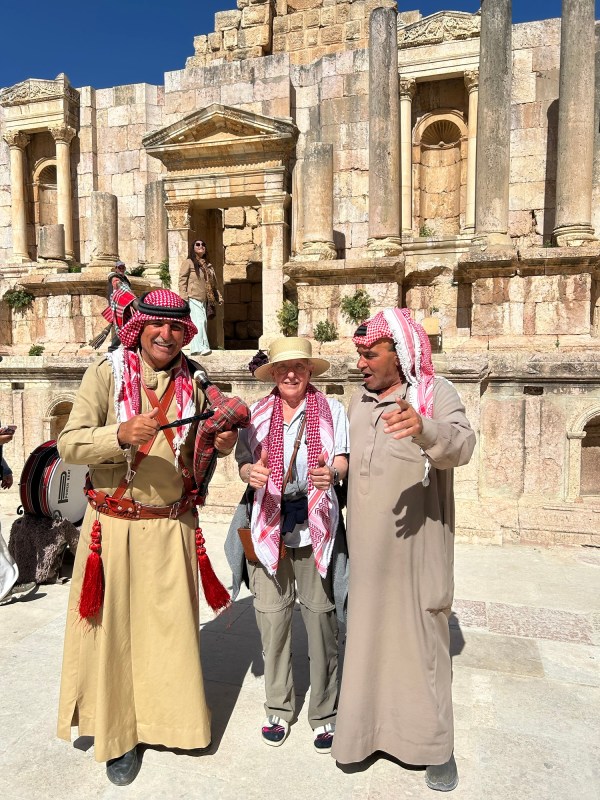
Our first stop is a minor one – Heshemite Plaza – a 2000 year old Roman Theatre that seats 6000. On the sides they have added two tiny musums – not at the level of the GEM for sure – but what can best be described as ‘a good effort’. Rather stiff maniquins wearing traditional clothing – and sporting the red and white shemagh – so clearly associated today with Jordan and the Bedouin. The Theatre was rebuilt starting in 1947 (the earthquake around 700 AD did a number on all the Roman buildings). Mostly the orignal blocks were used. Unlike a lot of the Momuments in Egypt – the Roman carved stones were less likely to be reused to make a private house – too big, too heavy, and there are too many hills! This is just a short stop – the real Jewel is coming.

Jerash is truly incredible. Depending on how you translate from the Arabic – signs will say Jerash or Jarash – but it’s super cool either way.

In Roman Times (say 130 AD) – 30,000 people called Jerash home. In comparison – 1 million people called Rome home at the same time. But this city is in the middle of a desert!

It was so well known that the Roman Emperor Hadrian visited in 129-130 AD. This visit was such a big deal at the time that they built a 70 foot high three section Arch for him to use to enter the city. The ruts from the Chariots can still be seen in the stones. Is that cool or what?

But Hadrian was the only famous visitor. More modern visitors include Prince William (visited in 2018) and Catherine, Princess of Wales (who visited as a child in 1980). Even Andrea Bocelli performed here. It is a very special place.

We begin our tour by entering thru the Hadrian Gate, just one of the many entrances to the Ancient City almost all of which have been perserved for the future.

Osama explains that Jerash is the oldest and best perserved Roman City in the world. It is a gigantic momument to the building ability of the ancient Romans, and the fact that it is so well preserved, and that the restorations that have been done have been done so well combine to make it remarkable.

You can – with a bit of imagination – think you are walking in an ancient Roman City. There’s a hypodrome – where they staged horse races. You walk past the hypodrome, past dozen of shops, and thru another gate to the city. Futher in we are told that there is a theatre where they put on plays – and currently gets used for concerts and festiveles.

But first we must cross the Perfectly Oval grand forum – massive by any standards – a gathering place surrounded by Ionic Columns right at the foot of the stair case leading up to the giant Temple to Zeus. Suprisingly most of the columns surrounding the Oval are standing – and even the floor of the oval sports Roman Paving. Just close your eyes – You are in a 130 AD Roman City.

There is a paved Roman Road that leads from the Magnificant Temple of Zeus to the other end of the city with it’s Gate. Victor and I keep comparing this 2000 year old road with the roads in Quebec. Pretty similar condition actually.

The Romans knew how to build to last. I wish Quebec did.

Along the road – lined with massive Corinthium columns on both sides are church after church, and shop after shop. Periodically there are even stone manholes in the center of the road, created to deal with water run-off. Some shops are two floors high – with the supports for the 2nd floor easily seen. Most of the churches have been identified but not reconstruted yet. The columns on either side of the road were definitely connected because they have found and replaced some of those header stones.

Osama tells us that they are slowing down archological digs here to perserve some of the sites for future teams when technology has changed.

They know for sure that the Roman’s had running water – there are the very well preserved remains of a Nymphorum with spouting Dolphin heads. And they have also found a water mill that Osama says might have been used to grind grain.

In the center of the road – at the main part of town – the columns are significantly larger – letting folks know they have reached the Temple of Artemis. It sits right above the Nymphorum.

Rather than climb the steps to the entrance to the Temple – which go past a garden dug in the middle of the staircase – we opt to go on to see the Civic Complex – a huge Theatre with vomitoriums, wonderful cool sections of access points, and of course seating for thousands.

Osama says that’s how they know the number of people living here – by the number of seats! Everyone had to attend the important meetings apparently.

We continue exploring (Osama points out where the baths are – but says they are part of a future project), and then take the high road up past the Entrance to the Temple of Artemis. This is called the Archological Park – filled with stones all labeled as to where they were found – and awaiting someone to figure out how to put the pieces together.

Occasionally we think we hear bagpipe music – but Osama says – nah – that’s the wind.

Hmm – I know bagpipes when I hear them.

Eventually we enter an almost fully reconstructed theatre with excellent acoustics – and sure enough, there’s a Bedouin playing Bagpipes accompanied by a drummer. And he’s pretty good. We sit and enjoy the alfreso concert. At the end, Osama gets him to play the National Athem of Jordan. We all stand of course – and clap madly.

What a comletely magnificant way to end our Egypt and Jordan Adventure.

Quick visit to the ‘Museum’ – highlight is a video talking about the efforts made to reconstruct parts – and then lunch.

These late lunches are tough on me I have to say!

I mostly eat the Inside (pieces of roasted chicken) and the condiments.

Then it’s back to the hotel. Osama explains how we can get to proper grocery store – and we are in a cab heading there within minutes. The hotel staff explain that this driver is one of their regulars – and we should tell him when to pick us up to get us back to the hotel. Deal!

The mall is actually walking distance from the hotel – but there are two hills in the way. Amman is very very hilly!

But it is so modern – it takes our breathe away. If you told me I was in a major US city, I’d have believed. you.

The grocery store was perfect. We slowly cruised up and down every aisle – admiring the packaging, looking at the spices – and generally having a wonderful time. There is a lovely young gentleman manning a section that serves out portions of nuts and spices – we spend quite a bit of time there!

Eventually – it’s time for our ride back to the hotel, and then our Farewell Dinner.

Is anyone surprised that we have to get suitcases out at 1:00 AM. Sheesh.

Tomorrow (Feb 21) is going to be a very long day – turns out to be 28 hours before we are safely in Miami tucked into our bed.

What a wonderful adventure this has been.

Flash Forward – Feb 28 – It is very alarming to hear that Jordan has closed their airspace, and taken down two missles headed their way today. I just hope all our new friends in Jordan are ok – stuck as they are between Isreal and Iran. Not a safe place to be today or probably for quite some time. Not what Jordan needed at all.

Signing off to go back to reading the news about what the US and Iran are up to.

Thanks for reading my Blog. The Soup Lady
Egypt and Jordan – Day 18- Feb 19, 2026


Well yesterday was Amazing – between the Treasury, the Royal Tombs and the insanely beautiful Siq – Petra was clearly worth the trip.

But now we’re heading out. Again it’s an early start – but since I managed to look at the map, and realize how far we are down South in Jordan – I’m not surprised. It’s early because we have a very LONG way to go.

But first an aside. We all know that Moses spent 40 years wandering the desert, but unfortuately – he didn’t leave a map of his journey. So there are countless places in Jordan that assure tourists that “Moses Slept Here”.

In fact – the town that we spent the night is in is called Wadi Musa – Valley of Moses. And there are apparently endless number of towns with similar names – the idea is that this is where Moses struck the stone that got him in so much trouble – he was supposed to ‘Speak’ to it – not ‘Hit’ it!

Osama tells us that while we could visit some of these towns – it’s rather fruitless – there’s no evidence to suggest exactly where this happened – but we are very sure where Moses went up the mountain to get his peak at the Promised Land before he died – and that is Mount Nebo.

Osama told us the first day that he rates toliet stops – from 1 to 5 stars, with 6 stars reserved for the really over the top options. And we have a 5 star version at the halfway point of our trip North to Mount Nebo.

It turns out that this is exactly the same place we stopped on the way from the airport to Petra – and it does deserve the 5 star label. Lovely bathroom. But more importantly to me – it also has really really good Coffee.

Victor and I managed not to get coffee before the bus pulled out of Wadi Musa – and I’m feeling the need for some caffine – and this lovely bathroom/Coffee Shop fits the bill. Yum.

Not surprisingly but reminding me strongly of those gift shops in Disney World that you have to walk thru when you exit a ride – to get to the toilets from the front door you have to walk the sales option guantlet.

The trick – don’t touch anything. If you even stroke a rug, or finger a gold plated dish, or pick-up a figurine – a salesman will appear like a geni out of a lamp. It’s Jordan, not Egypt – so they are very polite – but very present. You touched – you must want to buy. So moral – don’t touch. Walk straight to the toliet (and it is 5 stars – which means it’s clean, there is a seat on the toilet, the flush works – and – the best part – there’s toliet paper. And they don’t even charge!), do what you need to do – and walk straight back out.

I had to detour for my coffee – but that didn’t set off the sales team. It’s when I touched a lambs fur coat wondering who would wear such a thing here in Jordan – where in the dead of winter it gets down to say 70 degrees – or maybe even a frightening – don’t let the kids out – 50 degrees. Sigh – I touched – and had to tell the very cute, very pleasant salesman – I just wondered why anyone would buy such a thing.

Of course I led with “I’m sorry” – I am Canadian after all.

Back on the luxury bus – we continue to drive North – admiring the numerous small and mid-sized businesses along the way. They look modern, and busy. What a change from Egypt where the only ‘businesses’ we saw were run by the Military. I looked it up – apparently 75% of the GNP of Egypt is generated by Military related businesses – leaving the middle class in Egypt without work. Officially Egypt has a 6.1% unemployement rate – but that doesn’t seem correct when you see the number of men just hanging around. In Jordan – we haven’t seen unemployed men just ‘hanging’ – everyone – including the omni-present vendors – seems gainfully and in many cases rather joyfully employed. It’s a huge and obvious difference between the two countries. That and the garbage. Almost none in Jordan, and the garbage is piled deep in Egypt. But back to the bus ride.

Osama shows us how to put the red and white shemagh. This is a large square piece of cloth with a distinctive pattern and often seen with tassels on the corners. It is generally worn wrapped around the head and sometimes held in place by a black cord. It is considered a national symbol of Jordan, representing pride, heritage, and the Bedouin culture. Osama goes on to tell us that it is extremely popular in Jordan because King Hussein wore it, as does his son (the current King) and his grandson (the future king). Odessey bought one for each of us – and lots of us are sporting it today. I bet that’s why the lesson – we really had no idea how to tie it. I continue to wear it as a scarf. The last thing I want is a large cotton cloth wrapped around my head. How can this be cooler?

As we get closer to Amman, the traffic gets a bit more intense – and we start passing sheep and goat herders minding their flocks. Some are flocks are small, some flocks are a tad larger – but all the animals look very healthy – and there is lots of greenery for them to eat. Osama explains that Northern Jordan gets anywhere from 14” to 24” of rain a year – a very good thing since the only other sources of water are natural springs. Further North Jordan borders the Jordan River and of course the Dead Sea – but neither is a really good souce of fresh water. They rely on those springs and the rain.

On the top of all the houses and appartment buildings in Amman are white tanks for water. Once a week for 2 hours everyone gets their share of water from the springs and it is piped directly into those tanks. Then each home must ration the water for the week. If they run out – they will need to buy water (expensive) – or do without.

Osama is very proud of his country – and shares with us their medical success story. They have a free public heath system for all Jordanians – but there is a private health system that caters to folks from the other Gulf States. He thinks their medical system is 4 stars – and says – yes you might have to wait 30 minutes to see a Doctor – but the care is very good.

The compares incredibly favorably with what we learned of the Egyptian medical system where much much longer waits are the norm. And honestly – the difference in the appearance of the hospitals is remarkable. In Egypt they are older buildings with hundreds of folks standing around outside – simply waiting. In Jordan, the hospitals – public or private, are modern – and we never saw any waiting lines.

After our 4 hour ride – we arrive and Mount Nebo. Fortunately, we don’t have to climb it like 100+ year old Moses did. The bus drives us up and we are in a huge parking lot (I think they are expecting lots of visitors). There is a tiny museum, and then we are in the courtyard of a beautiful church. Osama takes us around the side – and there – directly across from the entrance to the church is the view of the Promised Land. It’s not terribly clear today – but we can easily see the top of the Dead Sea, and beyond it the hills and valleys of Isreal.

The symbol of this place is a staff with a serpent coiled around it – the universal sign of healing – and indeed my Doctor’s buttons (1812 Regency Period) feature exactly the same coiled snake.

Inside the Basilica of Moses there is a fabulous mosaic that was saved from the destruction of all images during the Iconoclasm in 754. The priest got word of what was happening to all the mosaics and painted icons and got the brilliant idea to save this mosaic by covering it up with sand and then having another mosaic with just simple patterns put on top.

Then folks seemed to have forgotten that the priest had made this happen – and the mosaic remained hidden until work was done on the church floor in the 1800’s.

Imagine their surprise!

The mosaic is simply stunningly beautiful. It tells the story of what life was like before and after the birth of Jesus. Before Jesus, man hunted animals freely – you can see the blood from a Lion being speared. Then there is a gap indicating the birth of Jesus, and the Mosaic afterwards shows a very different world. Animals and Man live in peace under the trees of peace – the Pomegrante and the Olive tree. There is even a very detailed image of two men, one white, one black. Independently they are both leading animals, a camel, a horse, an Ostrich. Osama uses that image to explain that he thinks there is room for everyone in the world.

Then he takes us to a place that actually makes Mosaics today. We go into the Mosaic’s workroom where 8 folks are seated carefully putting tiny stones one by one into a frame that will become the desired image.

Our host explains the technique. You start with the drawing of the finished design reversed onto a piece of cloth. The cloth is put into a frame that hold the cloth stiffly and the artist creates the design by using tweezers to pick up each stone, dip it into a paste of water and flour that is sticky, and then places the stone. Repeat again and again and again. It can take several months to create a really large, very small stone design like a tree of life, or only a hour to create a smaller design using larger stones. The stones are all Granite, gotten from folks who make kitchen counters and the like – left over pieces work just fine. Before the artists start, the large stones are cut into thin strips with a stone saw, and then the artists creates the smaller pieces using the same cutting tool I used when I was doing Stained Glass.

When the piece is done – you are looking at the back of the Mosaic, and it’s very bumpy since the pieces aren’t even close to exactly the same size. But that helps make the finished piece last. The next step has someone taking the finished art, spreading a really good glue layer on a proper frame, and then carefully flipping the art so the ‘top’ lines up within the frame.

Wait until the glue dries, then carefully remove the cloth by adding water to disolve the sticky layer. You reveal the Mosaic – right side up this time!

Our host explains that this workshop and the rug making workshop are all part of buisnesses started in Jordan by Queen Noor with Foreign help, primarly USAid. They are extremely proud of their connection to the US – and display the brand IDs of some of their sponsors. Because of their relationship with DHL – they can even provide free shipping. This is important because rugs and tables are very heavy!

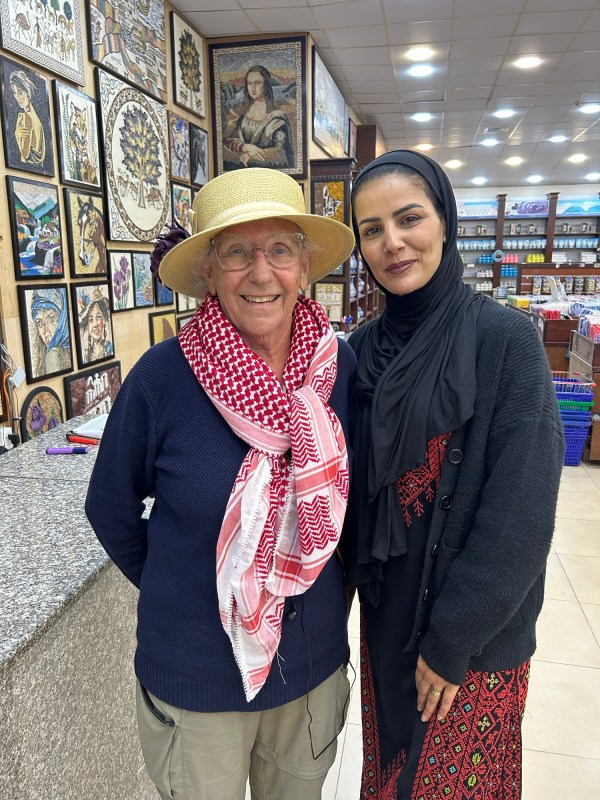
Now we are led into their sales room. If you show any interest at all – a lovely sales person is quickly glued to your side. They work on commission of course – and we were quite taken with the young woman (single mother, 2 kids) who wants to help us pick something to send home.

Yeah – we folded. Come visit us in NOTL if you want to see what we bought.

We leave the shop – and finally enter Amman proper. It’s the capital of Jordan, and a much smaller city. But it is also a very very lovely city cascading as it does over 7 hills. I actually think that number is wrong – it’s more like 14 or more hills – but Osama defends their use of 7 by saying is a lucky number – like the 7 hills of Rome. So just let it go.

We are staying in a lovely Hyatt for 2 nights – and tonight we are on our own for dinner. There are options in the city and in the hotel – but Victor is still feeling under the weather, and I’m not exploring on my own – so we opt to just eat a quick dinner in the hotel lounge (steak sandwhich – I’m so happy).

Tonight is the first night of Ramadan. Osama explained this on our bus ride as well. The muslims follow the lunar calendar with no corrections – so Ramadan moves about 10 days a year. The start of Ramadan is determined by when the head Iman of each country sees the Cresent Moon – and it was overcast just a bit around the part of the sky where the moon would appear the first night we were in Jordan, so Ramadan didn’t start. It did start in Egypt and Saudi Arabia because their Imans could see the cresent moon. Jordan’s Iman only saw the Cresent moon the night before – so today was the first day of Ramadan.

When we drove thru the city of Amman – I saw crowds of men buying what appeared to be pancakes from bakeries. I asked Osama and he confirmed my guess – these pancakes are special for Ramadan. Naturally – I want to try some.

He’s going to see what he can do tomorrow. He’s also going to try to get Victor and I into a proper grocery store. We love walking the aisles of a grocery store – so I’ve definitely got my hopes up for tomorrow.

Tonight it’s that Steak Sandwich and bed. How can riding all day in a bus tired you out so much? Mystery to me.

Signing off – the Soup Lady