Egypt and Jordan – Day 11 – Feb 13, 2026


A Balloon Ride over the west bank of Luxor – To Go or Not to Go?.

Hussien starts off the ‘sales’ pitch by telling us that the Balloon Ride is expensive, and that there are 32 people in the basket with you – plus of course the Pilot. And you must get up super early to get to the launch site. And it’s possible that the Balloons won’t fly because the wind is wrong, or there’s too much sand in the air.

Given that Cairo is under a Sand Storm watch – We do hesitate for a second – but then Hussien continues by telling us that it is unbelievably good.

To go or Not to go? But I loved my balloon ride in Turkey – so we decide – Ok – we’re going.

Turns out that 15 of the 21 of us opt in – so we will make up 1/2 of the basket. That sounds a bit better – but I’m still wondering about crowding. Well – we will see.

The alarm rings, we dress warmly (I don’t know WHY I listen to Egyptians complaining about the temperature. They are wearing faux fur coats and I’m in short sleeves and shorts – and find it warm). But maybe it’s colder 300’ above Luxor.

We all pile into a large van – and head out. The city is very quiet – there are folks around, but the real action hasn’t started yet, thank goodness. So traffic is light, very very light by Cairo standards for sure.

In the pre-dawn, we cross over the Nile, and quickly find ourselves in a van parking lot! There must be over 100 white ‘tourist’ vans jockeying for parking locations, but our driver knows exactly were to go – so we’re parking right acoss from 2 balloons spread out on the sand. The first of these is ‘Our’ Balloon.

Most folks opt to stay in the van, but I’m way to curious to do that. So out I hop to check out the action. There are ‘coffee’ shops along the side away from the balloons – and probably 100 balloons laid out on the sand, ready to start the process as soon as they get the ok to fly!

I walk over to our balloon. The basket is on it’s side – and there are 3 Giant Fans on the right and left side of the basket. The basket is huge – figures if 33 people are going to be inside. And the size of the balloon is equally huge. Way larger than the balloons I ‘flew’ in Turkey for sure. The width of the opening is larger than the basket – and the balloon itself stretches at least 100’ off.

I am totally surprised when a voice from inside the basket say – hi! A face peeks out of a foothole in the basket – and I ask – who are you? Maybe a better way might have been to say hi back – I’m Leslie – Who are you. But never mind – too late to fix mistakes.

He explains he’s part of the crew! I then realize that what I’d taken to be an empty set of steps is now the resting place for 4 other guys – and they are taking out drums to entertain themselves before the balloon gets launched. I’m chatting with them when suddenly folks are running past me in all directions – sprinting to their assigned Balloons. The ‘GO’ signal has sounded.

Everyone has his assigned job. Guys man each of the Giant fans, and 3 other guys open up the mouth of the Giant Balloon. The fans fill the balloon with air – slowly at first, then increasingly effective as more and more of the silk gets filled. The guys walking around inside the balloon straighten folds, push out the sides, and then check that things are going correctly.

The pilot arrives – walks the interior of the Balloon – just like a pilot inspecting his airplane, and then he signals to the crew that the fire will be starting. A huge flame erupts from the center of the basket – hot air is driven into the air filled balloon, and it starts slowly to rise up.

What seems like a slow process accelerates as the Balloon fills, and starts to float over our heads. Suddenly there’s a tap on my arm – Andrea has joined me to watch. Victor, Andrea and I decide to share a section of the huge basket. Over the noise of the flame – the pilot explains that there are 9 sections – one for him and 4 on each side. 4 people max can go in each basket section – but one group will be 3. We opt to be 3.

That settled we wait for a few moments as the crew pushes the basket up right and readies the basket for us to clamber in. The sides are high – to my chest for sure – so no falling out! I watch how other folks get into their sections – and the teams bring a step stool up so we can get a start on the height. But to get down off the rim, we have to drop down 3.5 feet. I do a horse descent – super glad for that training – and suddenly everyone is in the basket. We are instructed on the landing position – bend your knees hard, duck your head, put your hands on the cords on the side of the basket and DON’T move until the pilot gives the all clear.

The crew has stopped holding the fans – and are now circling the basket holding it down while the Pilot get’s the engines ready to take us up. The air in the balloon has to be heated before the crew can let go – but there’s an exciting minute or so while the crew puts all their weight into keeping the balloon on the ground.

The pilot signals the crew to let go – and we wave goodbye! Suddenly we are flying.

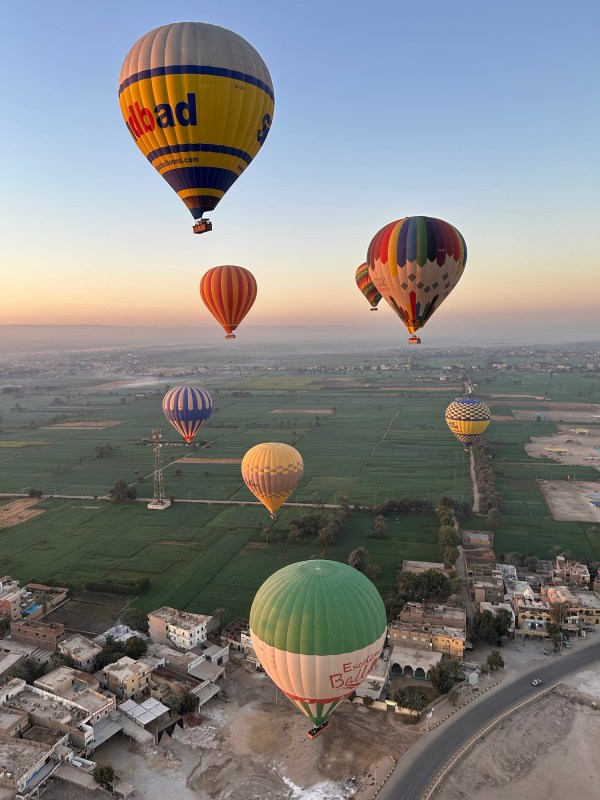
Our balloon rises quickly – and now that I’m not paniced – I take a look around. There are over 100 balloons flying – We are in the middle of the pack – but 2nd to go up. The balloons were laid out in such a way as to keep enough space between the balloons to avoid collisions. I’m guessing they also control ‘lift-off’ time to stagger the balloons further.

The ride up is actually quiet and the view is amazing. We are looking towards the hills that seperate Luxor from the Valley of the Kings and the Valley of the Queens and the pilot explains that we definitely don’t want to go over those hills – There’s no easy place to land. And we aren’t allowed to cross the Nile for exactly the same reason. It would be really hard to find a landing space for one of these huge balloons in Luxor City.

So we are hoping to drift North towards Cairo where there is a good place to land the balloons.

But right now – he’s going to spin the balloon and the basket so we can all get a Pano picture of the sunrise over Luxor. Insanely beautiful. I’m so happy.

We drift over towns on the west bank of the Nile – Victor loves the view of the roof tops – it’s HO scale! I’m just enjoying the breeze, the feeling of flying, and the thrill of being up so high.

My heart is definitely racing! This is so beautiful. Much better than the balloon ride in Turkey!

Folks in another basket ask our Pilot how much training he has – and after quiping that this is his first try – admits that to be a Pilot you must do 3 years of training and get something like 1000 hours of experience before you can take up a balloon on your own – let alone with guests.

He then starts explaining about landing – reminds us of the landing position – and then shows us where it is safest to bring the balloon down. Only then does he also explain that it’s almost impossible to hit a good spot – so we need to be prepared to stay in the landing position till his all clear.

Our 90 minute flight is almost over – and to say it has flown by is an understatement! Wonderful.

We start to decend – and while several of the balloons are already down in the right place, we decend a bit quicker than our Pilot planned – and we are going to be landing in a rougher area than he likes. He cautions us again about the landing position – and then asks us to assume it!

We are only 20 feet above the sand and rock – and the crew has driven around to be directly below us with the truck parked safely to the side. As we decend – the crew grabs the basket and tugs it into a flatter part of the landing area.

Then once again they put all their weight into holding us down. The balloon as a different idea and makes a quick dash for the sky – but loses the battle and falls gentle to the ground.

Now most of the crew stop hanging onto the basket and switch jobs. The silk of the balloon can not be torn – so they have somehow spread a large mat on the rocks and sand where we have landed and pull the lower part of the balloon onto that mat. There is still a bit of air in the upper part of the balloon so they team up to fold and twist the lower part of the balloon, safely protected by the mat, and pull it forward into a fold. Pull, twist, fold, Pull, twist, fold – repeat until the balloon has been emptied of all the air – and safely carried onto a truck.

Next it’s our turn. The crew circles around the basket helping folks out of their sections. We were the last section in – so we’re the last section out. And it’s not like getting out of bed, but it’s easier than getting up from the ground without using your hands! Victor waits until both Andrea and I are safely out of the basket and in the hands of the crew before climbing out himself.

Now we must board a flat bed truck to be taken back to our van. Remember we were last out … well – everyone else is already sitting in the truck bed – we have to squeeze in. This is made more interesting by the fact that the side of the flat bed has to be raised to hold us all in. Us and 29 of our closest friends cuddle up on the bed of the truck with some members of the crew. Other crew members sit on top of the truck Cab!

It’s about a 5 minute drive – 30 minute walk – to where the vans are waiting. We get off the truck bed, into to the Van – and all of us cheer! We’ve done it – and it was super fun.

My heart is racing the entire ride back to the hotel for a quick breakfast. Surprisingly there’s an Egyptian Gal with a Chef’s badge working the omlet station! I’m so surprised – it’s one of the few women I’ve seen working since we got to Egypt. We start to chat and I tell her that my daughter and my granddaughter are also chefs! She asks about what they do – and without mention the animal – I explain that Adrienne used to butcher animals and use the meat to make sausages and that Anais is a running a bar and the head Mix-ologist. She says – say hello to them from a Chef in Egypt!

So Hello Adrienne and Anais from Chef Yasmine!

Now we regroup for the moments this tour has been working towards – visiting the tombs of the Valley of the Kings and the tombs in the Valley of the Queens.

Hussein explains that there are 32 tombs in ‘good’ condition in the valley of the Kings, but only 5 are open to visits each day. They rotate which of the 5 will be open – but always include one of the ‘Super Stars’! And he thinks 2 of the 5 of the ones open today are amazing!

But first we are starting with the place that King (Queen) Hapshepsut had built to be mummified. Imagine – this was built for just 40 days of use! And every Pharoah had one. Despite the efforts of her nephew to remove her name from the lists of Pharoahs, this survived quite intact – and was an amazing place to visit.

The outside is more amazing than the inside – but still – pretty cool. On the ground floor on the left side of the building (a 3 story hehemoth with a huge entrance staircase) are some well preserved carvings celebrating the Expedition to Punt – still with some of the original 4000 year old coloring). This is one of the few military victories for Hatshepsut – doesn’t it surprise you that she believed in compromise over the sword? We check those out, climb the steps up to the actually Temple, and then Hussein explains that because so many tourists visit these temples – as of 6 years ago – the government banned all guides from entering.

It was determined that having the guides in with their tour groups delayed folks from quickly leaving the inner chambers – and I have to admit that most folks move a lot faster when someone isn’t trying to get them to see a particular carving.

Hussein outlines the ‘top’ things to watch for – including the stunning blue sky with stars in the Santuary. I recognize and gleefully photograph the image celebrating the fact that this Pharoah ruled both upper and lower Egypt. It’s clearly Horus and Set holding ropes that knot around the spine (for stability) to the lungs. I particularly love the fact that in this rendition the feet of the Gods are so vividly pushing down on the lungs to get more pressure on the knot.

There are frequent occurances of the Lives Life slogan.

Unlike the paintings on the bottom floor – the carvings in the Santurary are High Relief and very well done. Given that her nephew tried to erase her – it’s a miracle that her Mortuary Temple survived.

I meet an Egyptian family wearing of all things – Disney attire! They pose for a picture with me – what fun!

Next stop – the Valley of the Kings. First stop Tomb of Ramses IV – and as Hussein predicted – it’s extraordinary.

One of my concerns has always been that the Valley of the Kings – because of the massive amount of tourists that visit it – will disappoint. I’m pleased to report that I was wrong. The carvings are truly magnificant – from the Book of the Dead carved into the walls to help the Pharoah’s Ka find it’s way to heaven to the stars on the ceiling to full color (4000 years old people) images of his attendance in different colored robes, to the magnificant ceiling – still highly colored.

I can’t read the Hieroglics – but I can admire them.

After all of Hussein’s efforts – I do recognize the symbol for Ra giving Life to the Pharoah!

The way into the tomb is fairly straight – and easy – and again guides are not allowed in so the stream of folks moves fairly quickly. Yet again I run into another Egyptian Family – also touring the tombs with their 1 year old son. Did I get a picture – of course!

Hussian challenged us to find the image of the sky – a woman bending at her hips and shoulders to protect the land. Her legs are firmly planted on the land, her hips to shoulder are the sky, and from the shoulders her arms reach back down to the earth. It’s a very powerful way of seeing the world.

There are also full colored carving of the Pharoah taking the boat thru the night to reach heaven. Not surprisingly – the carved boat looks very much like the one found near King Korfu at the GEM.

Hussein also challenged us to keep our eyes out for snakes – a re-occuring theme in tombs of this period. There are good and bad snakes of course – the good ones protect the Pharoah, the bad ones provide challenges he must overcome to get to Heaven.

One last challenge – see if you can find the ‘good’ people and the ‘bad’ people. The ‘good’ people are shown walking upright to greet their God, the ‘bad’ people are shown upside down, and sometimes headless on their way to Egyptian hell.

Our next tomb is the one created for the sons of Rameses II. Given that he had close to 50 sons – there were lots of folks to celebrate – and the tomb is fairly large.

We pause for a photo of the plaque showing where the tomb of King Tut Ankh Amun was found – they charge extra to enter the tomb ($20 US) – and Hussein warns us that it is small, crowded and empty. There are not even any carvings because he died so young.

We also get to visit the Tomb of Rameses VI – originally intended for Rameses V but quickly repurposed for Rameses VI. Like the one for Rameses IV – it’s covered with paintings – but the carvings at the top level are much less impressive and have been damaged. You have to continue walking downwards to get to the ‘good stuff’.

I particularly liked the carving showing Rameses VI on his throne and suplicants coming to him up a staircase. They represent the different tribes he had conquored! Again its the richness of the blue and yellow colors that is most surprising. How can artifical colors, created by chemist 4000 years ago have lasted so long?

In this tomb I easily find the upside down folks heading for their punishment – They are actually carved in Low Relief right below their more fortunately fellows heading to heaven!

This tomb goes on and on – as it spirals downward – the colors are better preserved and the carvings become High Relief – clearly the artists started at the lowest level.

Hussein explains that when the 40 days required to mummify the body was finished – all work immediately stopped on that Pharoah’s tomb, the body was sealed inside and the artists moved on to the tomb of the next Pharoah.

My favorite image in this tomb – just for the use of color – shows the Pharoah on his chair holding blue and white colored staffs crossed, a red sash that is tied and flows down to the hem of his robe, and an offering of a Lotus Flower.

At the lowest levels – this tomb is insanely beautifully decorated – and at the very lowest level there is the final burial chamber – with it’s images of the sky as a woman bent over the earth to protect it.

The colors and carvings at this level are breathtaking.

Without Hussein’s guidence I can only guess at the meanings – but I easily find the snakes – both good and bad, and the details are just wonderful.

We then visit the tomb of Rameses III – I do love the crocodile details and take a close up image of the Pharoah (identified by the snake shown on his forehead ready to spit posion at his enemies offering smoking incense to a God. I am reminded yet again that High Relief makes a huge difference!

There is also a surprising image of a large block of stone sliding down a ramp. Is this a hint at building techniques?

Did I mention the other Egyptian family I met who had brought their 2 year old son to view the tombs. Friday is a day off for Egyptians – which explains why today I’m meeting Egyptians among the hoards of Foreign Tourists!

We get back on the bus – and Hussein has a treat for us – the Egyptian version of Lays Potato chips! Yum!

We move on the Valley of the Queens – where we are offered access to two tombs. One has been severly damaged by water coming in over the years from the Nile, but the 2nd one is my personal favorite.

Unlike most tombs which just celebrate a Pharoah and at best have interesting scenes of the conquests marching towards the Pharoah with their hands tied behind their backs – this one has a very loving story to tell.

The Prince buried here was the Pharoah’s favorite and his death was a shock. So the images on the walls of the tomb show the father first telling his Queen that he will return and the son is shown walking behind the grieving couple. The young prince is identified by his side hairlock and the Ostrich feather he proudly carries. In another scene his father introduces him to the Gods, and in the last scene – the father is seen leaving the tomb with his son among the Gods.

I’m emotional just writing about this story. It is told so clearly and so beautifully.

Like the best of the tombs in the Valley of the Kings – the carvings are high relief, the colors brilliant and the story told well.

Our last tomb is the least impressive – although it is much more famous – it’s the tomb of Titi. Unfortunately the damage by the water seeping in and out of the tomb has destroyed the colors and made the carving hard to see. Because they are so damaged, glass panels have been placed over them – making them hard to see and a challenge to photograph.

We board our bus and head back to the hotel for a mixed grill lunch and an afternoon of leisure. Victor and I grab a nap – then try to take a walk outside. We manage to go in the wrong direction – so we quickly run out of anywhere to walk.

We are approached by two different gentlemen – who say that they remember seeing us at breakfast in the hotel.

Fortunately – Hussein had mentioned that this had become the newest ‘come-on’ – so we know to ignore them. But isn’t that funny – twice – about 5 minutes apart.

We return to the hotel, eat dinner – and go to bed. Later tonight (like 1:30 AM) we have to wake up, pack our bags, and check-out. We fly to Cairo at about 4:30 AM and definitely can’t be late.

Signing off for a few hours of rest – The Soup Lady

Egypt and Jordan – Day 10 – Feb 12, 2026


Oh No! it’s another transfer day, although this one is by far the easiest. We just have to get off the ship and onto a bus for a short ride to our next hotel – the Steigenberger Nile Palace.

Of course it’s NEVER that simple in Egypt. The trick is that we can’t check in to the hotel under afternoon – and of course we have to check-out by 10:00 AM. But Odyessy doesn’t waste time. Hassein has planned a full agenda for us this morning.

So – suitcases outside by 7:30 – get breakfast and be ready in the lobby by 8:00.

I begining to think that Hassein has only two start times – insanely early and 8:00 AM!

Anyway – good travelers that we all are – we are ready at 8:00 to visit the Big Fish of all Temples in Egypt – Karnak. And it is huge. 60 acres in it’s entirety – and Hassein jokes that we shouldn’t worry – we are only visiting 59 of the acres.

Cute. Very Cute.

Even though it seems really early to me – Karnak is busy, busy, busy – and Hassein basically tells us – you haven’t seen anything yet. That and Follow Me are his ways of letting us know it’s time to move!

As we have come to expect from the bigger temples – there’s a ticket required – which Hassein hands us when we get to the automated ticket scanning booths. Inside the ‘Visitor Welcome Center’ there is a 3D structure of the original Temple – as best we can imagine it today. Hassein points out that what makes Karnak special is that every Pharoah from the Old, Middle and New Dynasties had a finger in the pie. Each created a part of the temple, or added a wall, or erected an Obelisk or two. And well meaning folks have tried to ‘save’ sections, sometimes helping out, sometimes with disasterous results.

The worst attempt was French – an well meaning gentleman was asked to just get rid of some of the salt build-up along one side of the Temple. The problem was that the Nile’s flood and drop cycle had left salt over time and the salt had created issues. His idea was to allow the Nile water’s to remove the salt – so he built channels to bring in the water and left it sit under the wall for 3 months.

The wall fell down.

What the fellow didn’t know was that the builders had put cedar wood pegs in the middle of the stone blocks to hold them in place. Adding humidity made the wood swell – and the stones were pushed apart. Just brilliant, right!

On the other hand – under the wall that came tumbling down were found the painted tiles from the temple of Akhenaten that I described in the last Blog. So in fact – in failure they gave Akhenaten eternal life!

Anyway – we spend a brief moment looking at the 3D model, and then it’s time to see the real thing. And it is HUGE. Sheesh. The main hall – famous for having the stone pushed down in the movie – Death on the Nile – is actually as mysterious and huge as the movie makes it seem. A dozen men couldn’t link arms and circle just one of the Columns and there are dozens.

The ‘shorter’ columns are topped with closed Lotus Flowers, and the larger columns in the center of main hall are carved as Open Lotus flowers. The roof was built to go up vertically on the inner set of closed Lotus Flower Columns and then over the open Lotus Flower Columns and then down vertically on the other side. In the Vertical spaces, are grids of windows – creating rays of light. The net effect is to have the rays of the Sun illuminating the Open Lotus Flowers!

So cool. Such a neat effect.

I get some lovely sun rise images over bits and pieces of the temple. There are some really striking parts to this temple – not least of which is the remainders of the ramp system that the builders and artists used to create a Wall. Basically they used mud bricks, built a ramp up to the final height, placing the blocks layer by layer as the ramp was being built.

Then the artists arrive and start carving the blocks from the top. As they finish, the ramp is destroyed and they can access the lower parts of the wall. To make sure the designs are carved in the right places – they used plumb lines to make straight vertical lines (ask your local painter) – and then other plumb lines to make horizontal lines. That makes a grid – and then the images are transfered into the grids.

I use exactly the same technique to copy a painting from a small sketch to a bigger piece of paper. Wow – who knew I was using a 5000 year old technique.

There are some lovely low Relief and high Relief images to admire – and of course the wonderful Obelisks of Hatshepsut. She married her Nephew, then made him marry her daughter, all to keep control of the throne and title of Pharoah in her hands. She ruled for 18 years – and when she died – her Nephew – who finally got to be Pharoah – tried to erase her name everywhere. Nice family – right.

Anyway – Hassein went to great effort to explain what we know and don’t know about the creation and placement of an Obelisk. Because they are needles pointing the way to Heaven for the souls – they are made of one huge piece of stone, carved out in the Quarry. He explains how they measured out the size, carved out parts including the pieces that would in the end make the Obelisk raised at one end and lower at the other. Then the carving would start. When that was finished, the rest of the stone that wasn’t Obelisk was removed and the obelisk put on a boat to take it to the Temple. It was moved into position, and then raised. There are images that have been found that detail carefully all the steps except the one key one – how did they raise the Obelisk into position? No one apparently knows!

We pose for a group photo in front of the Obelisk of Hatshepsut – Admire the magnificant carving of a young King Tut and then use our free time to wander (or go to the toilet!).

We then take the bus a very short distance to a place where they make and paint Papyrus. There’s an interesting demonstration of the technique – starting with the plant (a lot like bamboo), and showing how strips are laid in both horizontil and Vertical position to create after 5 to 10 days of drying – Papyrus. And based on what we’ve seen in the GEM – this stuff really lasts and lasts! It’s flexible and pliable, and with proper preparation – easy to paint. Lots of our fellow travelers happily do some shopping – but we’re trying to downsize – and honestly – nothing really grabs our attention.

Then it’s finally time for lunch – which Hassein tells us is his favorite meal of the trip. We are crossing the Nile by boat to eat at a framer’s home. I must admit I’m sceptical – but in fact – is really truly is his home. There’s a shady area in front of his door that they have put out tables and benches to seat the 21 of us – and a bread oven in the corner. The walls of the space are painted to remind the family of their 2 trips to Mecca – one by steamship, one by airplane.

14 people live in the house – it has 3 floors with maybe 12 rooms, and from what we can see – one sink, and one toilet. Sharing is caring.

The kitchen where the meal has been prepared is very very basic – but the meal is amazing. We start with a vegtable delicious soup (all veggies from their farm), followed by Chicken and Beef. The beef is so tender – it’s wonderful. Of course there’s Rice, Hummus and Tahini – and pita. No meal in Egypt is Pitaless!

They show us how to make a ‘pastry’ type of bread that they dip into Molasses for dessert (it’s yummy – and I’m a complete Klutz at rolling out the bread). The farmer – who speaks excellent English, although he appologizes first – answers all our questions, explains how big his family is – and also tells us that no one knows how old his mother actually is – because age doesn’t matter!

Then they take us inside the house so the Mother who is probably 1/2 my height – can show us how she spends every day grinding wheat using a grinder handed down to her from her mother. One of my fellow travelers tries it – and can make the grinder turn, but just barely. I wait till everyone else is outside to ask if I can try. I can’t even turn the top stone 1/2 way. And this tiny little lady can make it grind wheat.

Mona – if you read this – you know what I need to work on – sigh.

We then say our good-byes and get back on the boat to check-in finally at our hotel.

It’s the best one I might EVER have stayed at. Huge and beautiful. The rooms are stunning, tons of space, lots of lights and we have a giant balcony that overlooks the Nile. I sit on the Balcony working on my blog while Victor takes a nap.

In the late afternoon we are escorted to another Cotton House – where more of our group do more shopping. Victor buys a lovely Blue shirt of linen, and a cotton scarf he’s been hunting for. I chat with one of the very sweet sales girls.

When we get back to the hotel, we take a stroll around the swiming pool, various restarants and double lobby – at the lowest level we find a cute bar where some of our fellow travelers have gathered. We join them for drinks (delicous). I see one of the staff swinging a bucket of coals to get them to light up – and then put the coals into a tall, rather elborately decorated stand. Victor takes one looks and says – those are Hookahs – and lots of folks are smoking. Our waiter asks if we’d like to try one – but we all agree since we don’t smoke – it might not be a good idea to start with these!

When we get up to leave the waiter tells us that entertainment is starting – we should stay. But we all agree – we are done for the evening!

We settle for a simple dinner (I have a salad) at one of the hotel’s restaurants – and go back to bed. Naturally – tomorrow is another LONG day!

Signing off – The Soup Lady

Egypt and Jordan – Day 9 – Feb 11, 2026


Our assigned Visit time at the Edfu Temple is 5:45 AM – so clearly we are going to get an early start.

At least we don’t have to pack first. We just need to get up, get dressed, and get down to the lobby.

I’ll admit that I’m wondering why the rush. I never even heard of the Edfu Temple – and we don’t even have time to grab breakfast first.

Well – it turns out that there are several reasons for our very early start.

One – your group leader must pick a time to go to the temple – this is done to try to cut down on over-crowding. I will admit that it’s a great idea – but there are an awful lot of folks getting up really really early to check this place out.

Two – The Amwaj Livingstone needs to get on it’s way early to meet our designated time to get thru the locks at the first Cataract. The plan is for the boat to sail at 7:30 AM to make our assigned time at the locks, and we will actually get an easy morning and afternoon after we return from the Edfu Temple.

Three – this is a really really cool Temple. So suck it up lady – you are going.

Ok – now that I understand – I’m willing to go with the flow and get up and downstairs on time. 5:15 AM. You have to be kidding me.

It’s dark when we leave the ship – and yes – we’re not the first ship here either, we must cross thru 2 other ships on our way off. And Hassien has been warned that the ship might move. He’ll have to check when we get back.

There are scores of horses and buggys waiting to pick up guests from the different ‘floating hotels’ – but Odyessy has decided not to use the horse and carriages – we are told that they are worried about the way the horses are treated, so we board a bus to get to the Edfu Temple.

Along the way – Victor and I check out the horses – and we really don’t see signs of abuse. The horses actually look quite happy to be out at this early hour – and it is clear that they are well fed. I suspect the issues arise when a horse can no longer fulfil his carriage pulling job – but there’s no one to ask.

They do have sunshades for the horses – lots and lots of them are located near the temple. And most of the carriages have an alfalfa supply under the feet of the driver for ‘horse munching’ when it needs a fresh treat. I’m told that Alfalfa is a major crop here in Egypt, although I’m sure it’s not just for the horses in Edfu.

Surprisingly – despite the early hour – there are lots of folks at the temple, and Hassien tells us that we’re lucky it’s not very crowded. Right.

One advantage of our early start is that we get to watch the sun rise over the Temple of Edfu – a stunning sight. The colors of the sky here, well above the pollution further down stream are simply stunning.

Edfu is famous because it is very very large – and almost completely intact. It was saved because it got used by more than just the Egyptians. There’s evidence of it’s use by the Greeks and the Christians.

Unfortunately the Christians decided that some of the images were inappropriate – and ‘removed’ them by chiping away at the offending parts – generally the faces, arms and legs. Apparently looking at carved bodies distracted from serious worship. I think the priests might have been bored. But again – no one around to ask. Fortunately – the carved images were left intact in the Storerooms, so not surprisingly – Hassien hussles us in that direction.

His plan is simple – hit the highlights that will get seriously crowded first, then double back to see the larger parts of the temple when the crowds are less of an issue. And I can see his point. We get to take our time admiring the glorious carvings in the relatively tiny storerooms – and can still easily enjoy the large columned mid Temple and peacefully admire the huge front Courtyard. Good planning Hassien.

This is a temple built by Ramses II – and to make sure that no one repurposed it easily – He had his name carved in huge Hieroglyics – about 4 times the normal size and depth. This worked because his name is still visible all over the place!

Many of the carvings are in excellent condition (we are talking 4000 years) – and Hassien loves to point out the most interesting ones – like the one of the ‘sky’ bending over the world. She is portrayed with her feet on the ground, her torso bent to be the sky, and then her arms extending down back to the earth. We will see other examples of the sky lady – particularly in the Valley of the Kings! She is quite beautiful.

One of the prime locations is the central courtyard – huge with giagantic pillars on three sides creating a space for the worshipers to wait for the priests to bring out the golden statue of the God from the inner santurary. There is also a 18’ high statue of the Falcon God wearing the double crown of Egypt that is a focal point for folks to stand infront of and have a photo taken! Who can resist that option!

We are given about 20 minutes of free time to wander on our own – and I go back into the storeroom area – I love how the entrance is hidden to the far side of the santuary and then runs all the way behind it. So reminds of Catholic Churches I’ve been in where hidden behind the main altar is a series of smaller chapels.

I’m again impressed by the quality difference between the High Relief and the Low Relief carvings. Apparently Temples are carved, but Tombs are painted. Low Relief is more common and easier to create – High Relief is saved for the most ‘important’ images, and more commonly found in Lower Egypt. It’s the High Relief Carvings that look so alive to me, although even Low Relief ones carry more movement than the paintings, despite the coloring.

We re-group, and head back to our bus and our ship. As predicted – it has moved – and is now about 5 ships out from the shoreline. We count carefully – get on board – and as predicted – the ship sets sail for the locks. We definitely need to be there on time.

This gives us ample time to enjoy the scenery on the sides of the river (mostly green with the very occasional building), breakfast (yum), and then lunch (yum).

From my comfy seat on the Sundeck I can admire the scenery, chat with fellow Odyssey guests, meet some of the other folks traveling on our ship – and of course we compare notes on our different tours.

I’m very happy with Odyssey – Hassien has taken great care of us – and while the ships aren’t the newest on the river – I think they are quite lovely and the service is wonderful. I’m comfortable – what more can one ask?

I also contemplate the advantage of including the section on Lake Nasser. Because we started at Abu Simbel and then floated down to a series of oher smaller Nubian Temples – our visits seemed intimate and private. We rarely saw other folks, and got to spend as much time as we wanted in the temples. There were no glass panes to prevent us getting close to the carvings, few vendors trying to sell us random books/scarves/alabastor whatevers – and it felt like a private adventure.

Now that we are within spitting range of Luxor – for many tourists the end of the line – we are seeing the impact of so many people keen to have their chance to see the Temples. It’s a very very different feeling.

As we get close to Esna – we run into the predictable waiting line for our turn at the lock. So we join several other ships that have ‘parked’ by heading bow first into the shore of the Nile on the Eastern side – away from the town of Esna and upstream of the two sets of locks that provide passage over the first Cataract. Keeping the engine running, keeps the ship stationary – but we now become a target for vendors. They row out on boats and yell at folks on the sun deck to buy their wares.

Our group ignores them, but we have on board a large group of Japanese tourists who are completely intrigued.

The vendors hold up table cloths – shouting prices. If a buyer seems interested – the action intensifies. The men on the boats 40’ or more below us toss up table cloths in plastic bags – and the tourists put their money in the bag to toss it back! I think that generally there are two table cloths in each bag – the expectation being that one will be ‘bought’ and the other – with the money inside – will be tossed back to the vendor.

I must say – I’m not a fan of this kind of shopping – but the Japanese seem to love it – and a lot of table cloths end up being purchased!

Eventually – the ship’s ‘lock’ time comes – and we back off the shore. The vendors are disappointed to lose so many buyers – but thank goodness another ship arrives and they get distracted.

We head into the locks.

The first lock is really just a bottle neck. It’s the original lock, and it took an hour per ship. Now – it’s not in use – but because of the Catarat – every ship must be pulled thru manually before getting to the proper locks just a bit downstream. This makes us again a target for vendors – although they are not allowed too close to the lock itself. I did watch with great interest when one boat pulled infront of our ship. There was a man with his son inside, and the man put out his prayer rug, the son use the oars to orient the bow of the boat towards Mecca – and the man began to pray.

Hmm.

We are fairly quickly into the lake between the two locks (new and old). The new lock is actually a double lock – with room for 3 or 4 ‘floating hotels’ on each side. It takes about 20 minutes to close the doors hehind our ship, open the doors infront of the first ship in line – and allow the water to spill out – lowering the ships 8’ to the new level of the Nile. We then move out of the locks, and if there are ships going up stream, they motor in and the process is reversed.

So old timing – 1 per hour. New timing 6 per 20 minutes or 18 per hour. It’s probably still a bottle neck – but at least it’s not an insane bottleneck!

Next stop – Luxor.

First a word about the word Catarat. The white build up in eyes losing vision reminded the Egyptian Priets of the bubbling white water of the Nile when it hits the granite rocks in the Catarats. Hence the term – Catarats in the eyes! Hassien is just a fountain of information.

As soon as we tie up at Luxor – and the number of ‘floating hotels’ goes up drastically – we immediately re-group in the lobby – exit the ship – and head for a bus. We are going to be touring Luxor and then going to the Luxor Museum.

The program has planned for a total of 2 hours for both visits, but I think we go a bit slower. In any rate – there is plenty of time to both get a guided tour of the Luxor Temple, and to have private time to do a tiny bit of exploring on our own.

The Temple completely lives up to it’s hype. It’s amazing. Not nearly as huge as Karnak of course – it was built for a Queen not a King – but lovely. The carvings are glorious, the heights of the columns incredible, and the courtyards both inspiring and daunting. My ownly complaint – and it’s predictable – is the crowding. And I’m reminded again why I’m so glad we did Lake Nasser’s Nubian Temples first. I spend more time saying sorry and getting out of the way of other people than I do enjoying the beauty of the carvings.

The avenue of the Sphinxs is stunning – just the fact that the Egyptian government could commit and execute such a project, with a lot of help by foreign interests including USAid – is special. over a mile long, over 1000 platforms for Sphinxs – wow. Unfortunately they haven’t found most of the Sphinxs – but the planners carefully put the best ones into the best positions for Photos.

This avenue was used twice a year, when the statue of the God Orisis in the Karnak Temple went to visit his wife – Isis – in her temple at Luxor. There was a huge parade there – carrying the statue of the God. And then 10 days later – an equaly huge parade brought the God Orisis back to his own temple.

Next stop – the Luxor Museum. Hassien tells us that this is his favorite museum – to his mind better than the GEM – and I have to agree it is right up there.

His highlight are the two mummies on view, carefully displayed in very dark rooms and in glass ‘cases’ – to keep them intact. He is also intrigued by the pieces of painted tiles found under the collasping wall at the Temple of Karnak.

After the death of the Pharoah Aton – who tried to convert the Egyptians to mono-thesism – the next Pharoahs with the help of the priests who lost their jobs because of his actions tried to erase his memory. They buried these Tiles under the wall at Karnak. But when the wall was destroyed by accident in the mid 1800’s – the tiles were found and it was a gigantic jig-saw puzzle to put them back. The result is displayed along a huge long wall in the Luxor Museum. The result is – as so many things are here in Egypt – quite stunning.

But now it’s time to return to our ship – just walking distance from the Luxor Museum – dinner – and for Victor and I – Bed!

Tomorrow is another LONG day!

Signing off – the Soup Lady.