Bistro 1843 – crazy location, awesome food


Who’d a thunk it? A crazily great place to eat on Ile Bizzard. I mean – I thought ile Bizzard was just about the golf courses – not about food.

But there I was – guests of a friend of ours who positively loves great food – and bring your own wine places. He’s clearly an ‘oeniphile’ – that’s someone who knows a ton about wine – with over 1000 bottles in his cellar – and he knows his food too.

So joining him somewhere new to you – but not to him – is definitely going to be good. And this was very very good.

The owners/chef are a bright young – completely bi-lingual couple – who just 6 months ago had their first child. The wife (Sara-Ann) is the hostess, waitress, and general friendly soul, while the husband (Karik) does the cooking – and great cooking it is. Meanwhile the baby is upstairs – with her night-nanny. Turns out the 2nd floor of the historic homestead turned gourmet restaurant is where they live. Talk about a seriously easy comute.

The restaurant has been open for 4.5 years – which just says that sometimes I’m incredibly slow at learning about new places. Our friends have eaten there dozens of times – and were greeted warmly by the hostess – who in addition to providing outstanding service – gifted us with an extra dessert. Given that our meal extended over 3 hours – and she locked up behind us – I’m pretty sure that extra dessert was our reward for last of the night!

Rumor has it that you must make reservations a month in advance – and our friends admit to thinking they have scored if they can get a reserveration with just a week’s notice – yes it’s that good, and that popular.

But I know you are waiting to hear about the food.

The menu is quite limited – as would be expected of a place with just 30 seats, and one chef in the kitchen. The Table d’hote – which just means off the menu – all the meals come with a soup or sald and dessert – had 3 offerings – of which 2 were outstanding. My friends adored their steak – one served with a bernaise sauce – made up to order since it wasn’t supposed to be served that way, and the other had the steak with the reduction of bacon and maple. Yummy. I positivied adored my meal – a completely yummy piece of cod served with figs. My husband’s lamb offering wasn’t quite as good as ours – so sorry dear.

The soup d’jour was a sweet potato ginger concuction that was a tad heavy on the giner – but not so heavy that my husband didn’t lick the bowl.

For entrees, following our friend’s suggestion – we ordered the scallops in curry. Oh my – that was easily the best dish of the evening.

Desserts were also excellent – well presented, and elegant. I tried the walnut tart – packed with walnuts and served with home-made ice cream. My husband had a blueberry upside down cake which he finished with joy. The free dessert i mentioned earlier was the flourless chocolate cake – heavy on cocolate and served with a maple ice cream that I loved.

So – good food, good wine, good friends – comfortable chairs, pleasant surroundings – and the feeling of being in a home – not a high turn over restaurant.

Great meals are made of this.

Bistro 1843 on Urbanspoon

Fluff – but fun fluff! St. Leonard Chronicles at Centaur Theatre


Sold out houses – night after night – says something about this fun to watch, and slightly heart warming play about an evening with an Italian extended family in St. Leonard. And it’s been extended to December. You have time to get tickets and join the crowd singing it’s praises!

There’s the young couple, their parents, and the mother of the mother of the husband – aka: Grannie. They are sitting around a dinning room table – behind them is a view into the kitchen that they can not see – being family. The direction alone deserves kudos. Roy Surette has managed to imagineer a small room with walls that yet is open to the theatre seating. You get completely the fact that this is not a huge home – in fact it’s a duplex/triplex – the young couple have renters that they manage below and above. By setting the kitchen above and behind the table, it is very easy to keep your eye on the action there – and yet build up unseen walls separating that action from what is happening in front.

The story unfolds as a string of conversations – starting with the Grannie who regales – for the hundredth time – her family with the story of what happened when she arrived in Canada.

Keeping with the Italian tradition – of course she and her young husband stayed with cousins they had never meet – living in a walk up served with an outdoor curving staircase. And of course the husband slips with the trunk half way up the stairs. Equally predictable are the reactions of the non-italian neighbors – Go home Wop! Maudit Italians!

Listening to the banter, laughter, and tall tales being told – you get a good idea of what life for this kind of extended family must be like.

There is a story of sorts – the kids are trying to make their lives better, the parents see any changes as change for the worse, and the old lady drinks wine and nods off from time to time.

I won’t ruin the play by revealing more of the story – but bottom line – the acting is terrific, the play itself a wonderful effort, and naturally the production values at Centaur is fabulous.

Join the troops – see the play. Everyone deserves an easy night out!

2 Star Michelin Restaurants – Seriously – are they worth the price?


Hard to say actually. We only ate at two 2-star restaurants this trip – the fabulous Atelier in Munich has only 1 star.

The first was the Essigbratlein in Nuremberg, the 2nd was the Fischers Fritz in Berlin. Both are seriously expensive, very elegant, service intensive restaurants – both are clearly intended to offer ‘blow-you-away’ food at prices that will dent your pocketbook.

First – the Essigbratlein. Nuremberg is not Berlin, and one wouldn’t expect either Berlin prices, nor Berlin quality – and you’d be exactly right. The meal at the Essigbratlein – a tiny 10 table hole-in-the-wall located within spitting distance of the Nuremberg Castle – was good – heavy on veggies (unusual in restaurants of this type) – and generous with the wine. But the courses blur together in my memory – delicious why we enjoyed them, but except for the Brussel sprouts with mandarin – not worth blogging about. The one exception were the Brussel sprouts. Not a vegetable I would quickly assume I would enjoy – and in this case – I’d be very wrong. This was a stunning dish. Light, flavorful, full of texture – completely delicious.

And I must compliment the restaurant on the wine service. Traditionally – I don’t order the wine pairing – it’s a lot of money for a lot of alcohol I simply can’t drink. But at the Essigbratlein they went ahead and poured me a sipping portion of each wine served at the table. I could taste, enjoy – and they didn’t charge us. Cool.

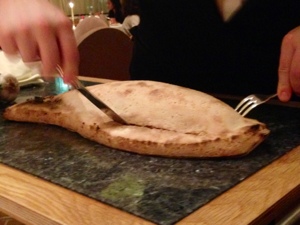
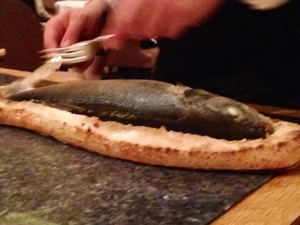
Second – the Fischers Fritz. This is a much larger restaurant – more servers, more tables, more space. And located as it is in the Regency Hotel in Berlin, I’m going to guess a much much larger kitchen. The result is as should be expected – a superior experience. Highlights included the Sea Bass in Sel (an entire fish cooked in a flour/salt pastry shell so that the juices are sealed in), and the Cheese Course.

20131025-233806.jpg

20131025-233813.jpg

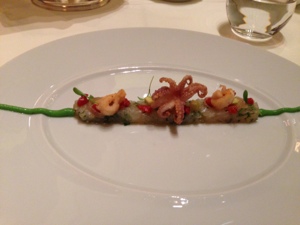
I adore a cheese trolley – and their trolley was outstanding. On the other hand – they did not accompany the cheese with as many treats as did the Atelier in Munich – so I can only give them a B+ for that course. I also loved the first appetizer – a tartare of sea bass with avocado and quickly fried mini-octopus.

20131025-233758.jpg

Wonderful texture, delightful favors, plus it looked great. Unfortunately – the desert was a disaster – I think the Fishers Fritz needs a pastry chef – bad! The ‘franchise’ on the other hand were delightful tiny bites of chocolate truffles, jellies, and treats. They were as good as the desert was bad.

I must admit that while the Fischers Fritz was the better of the two, the Atelier in Munich trumped them both. Oh well – you never know if you never try!

Best History Museum Ever!


Ok – it’s an odd fascination – but I actually enjoy History Museums – particularly if they are well done. They always tell you something about the culture of the country – or at least about what the government thinks is important to know.

Given the outlines of Current German history – Loved Napoleon, Hated Napoleon, Wanted a Democracy, Didn’t want a Democracy, Started World War I, Lost World War I, Had a Democracy that actually elected Hitler, Started World War II, Lost World War II, Got Divided, Got United, and now has a Democracy – well – the history museum in Berlin was bound to be interesting.

Particularly in comparison to say – Canada.

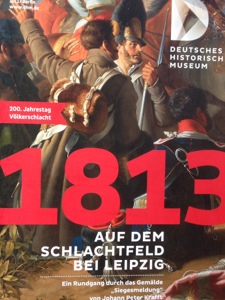
So we coughed up the big bucks – thank goodness for my Student Card – I was 1/2 price – and immediately started with the special exhibit on Leipzig 1813. Given that we’d just been there re-enacting the battle – seeing what the curators at the Deutsches Historisches Museum had to say was bound to be interesting. And it was. The exhibit – clearly taking the German point of view, started with a very famous painting showing the victors of the battle – the King of Prussia (Germany), Emperor of Austria and the Emperor of Russia – getting news of the victory. From there – the curators decided what to show – and what not to show.

The exhibit started with guns, wagon wheels and cannons – the tools of war. It also featured the skelton of a horse – found in a mass grave at the battle field site. From there it went into a brief history of Napoleon, from the point of view of his opponents. His errors are pointed out – and while mention of the Code Civil is made, the point is also made that the application of the Code was hardly even. Yes, feudal estates were broken up – but often they were just handed over to his relatives. And while his emphasis on promotion thru ability rather than family position was mentioned, it was also pointed out that his opponents learned the same lesson, and applied much of the same strategy by the end of the war. A lot of attention was focused on the forced draft in France – and the ‘volunteer’ armies of his opponents. Certainly the history they showed, and the history we thought we knew were quite different.

And as I’ve mentioned before – that’s what makes going to history museums in other countries so fascinating – there is always more than one point of view.

The exhibit ended with a short video about the re-enactment of the battle of Leipzig in 2012 – and in many ways – this was the most striking section. Instead of 6000 re-enactors – there were about 600 – and instead of using a portion of the actual battle field – they used the small field that we’d used to assemble just the french troops. Oh what a difference a year makes.

I left the exhibt amazed at the organization required to put on the re-enactment I had just participated in. It was incredible.

From that special exhibit, we worked our way over to the general section of the history museum, admiring the architecture as we went. The museum is huge – and we opted to skip most of it, and focus just on the sections that interested us most – 1778 onwards. The section for 1778 to 1816 – which covered the battles against Napoleon featured some wonderful pieces of art – including a painting of Napoleon in his corination robes – and most impressively – his hat, sword, and stirrups – left in his carriage at Waterloo in 1815 when he excaped after the disaster to Paris. Cool.

From there we read with great interest – and some surprise – the German perspective on the lead-up to World War I, the elation followed by the depression of the results of that war, and then the negative feelings about the treaty of Versaile. In the German history – it is that treaty more than anything else that brought about the conditions that allowed Hitler and his minons to appeal to such a wide audience. The museum contains a significant section effectively appologizing for the treatment of the Jews, the Roma, and the handicapped. There is no attempt to sugar coat that truth. The run-up to World War II is covered in great detail, as is what was happening in Germany during the war. After the war, the division is described, and the museum ends history in 2000 – 10 years after the fall of the Wall and the re-unification of Germany.

This is an outstanding muesum. Not one that you want to zip thru – but one that you want to slowly see – hear – experience. There are English signs in most sections, but getting the audio guide is well worth the small expense. The descriptions are absolutely reviting. We effectively got ‘kicked’ out by the closing bells.

Great Museum. Definitely a must go!

20131025-103006.jpg

Pilgrimage Churches – What are they, and Why bother going out of the way to see them?


We’ve seen 2 pilgrimage churches so far – both spectacular – when leads me to wonder 3 things – why were they built, how do you find them in the guide books, and why bother going?

Which leads right into a fourth thing I’ve wondered about – is it worth renting a car in Europe.

Starting with the fourth thing first – why rent a car? In the cities – a car is the last thing you want. What you want is a hotel within walking distance of everything – and baring that – a good public transit system. The challenges of finding a place to leave a car are absolutely mindboggling. Car parks are few and far between – aided and abetted by the authorities – which at least in Switzerland have decided that no new parking spots will be built-in Zürich. You build a new building with 100 spots underground for cars – you’d better find 100 other spots to get rid of. sheesh.

So – no point having a car unless you are trying to tour the countryside or visiting towns way outside the beaten path. And since we had decided to tour and part of our touring required some pretty out-of-the-way places – we needed a car. So seeing pilgrimage churches became a possibility.

So how to find them. I’ll be honest – Regine (our friend in Zürich – who really ought to consider a career as travel guide) suggested both. And thus we visited them. But there must be another way. I did find Vierzehnheiligen in Bad Staffelstein in Fodor – with a star (Fodor choice). And once I knew to look for it – even the Insight Guide has a picture. So it’s there – if you know about it. The 2nd pilgrimage church – which honestly I thought even more impressive is called the Wies Church – it’s well documented on the internet – and knowing the name – I found it in Fodor – labeled “Off the Beaten path” – with which I must agree. So – maybe the best thing is to rely on the ‘you’ve really got to see this’ network!

20131021-231727.jpg

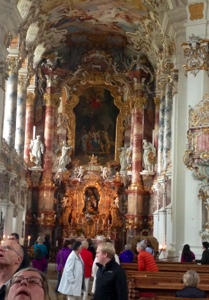
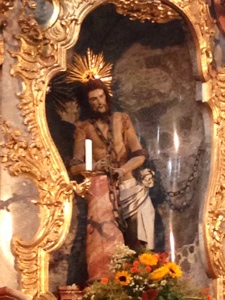
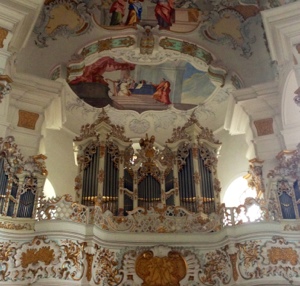
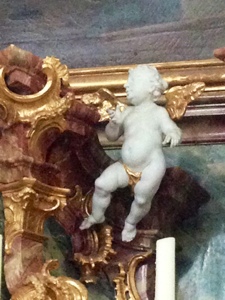
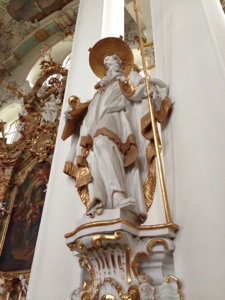
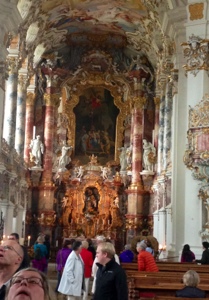
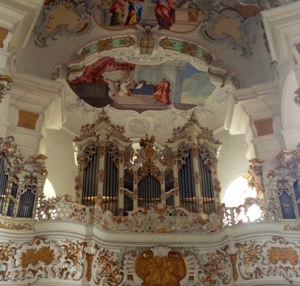
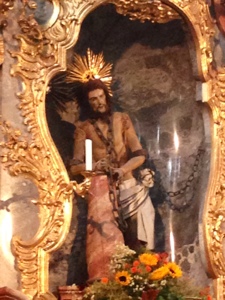
The Wies Church – located rather conveniently between Neuswanstein Castle and Linderhof Castle – is just there. Middle of nowhere. Not near a town, or even a decent highway. It was built in 1745 because a local woman claimed that she saw the wooden figure of Christ crying in 1739. Said Figure of Christ is enshrined in the altar (Fodor described it as a painting – I thought it was a craved statue)- clearly visible to all who visit the church. But it’s the church that will blow you away. It is a glorious love affair with Rocco – abounding with cupids, light, white statues of saints, prophets, or even just unknown heroes tipped in gold, and a mystery that still resonates. Did the painting indeed cry? We will never know – but the fact remains that the church is well worth visiting.

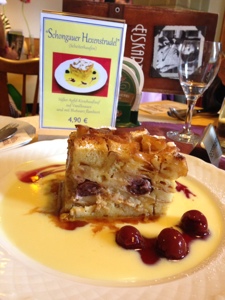
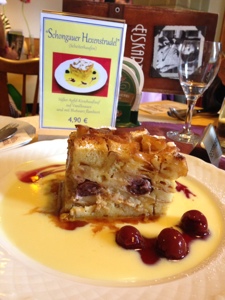
Even better – dessert at the guesthouse/restaurant right opposite the church entrance. My Hexenstrudel (witch’s strudel?) was amazing.

20131021-231814.jpg

Picture note: All the pictures below are from the Wies Church – but trust me – seen one cupid, seen them all. The differences are the structure of the church – and the reason it got built!

Vierzehnheiligen near the tiny town of Bad Staffelstein is actually a lot easier to find. It’s located just 40 km from Bamburg – which in itself is a delight. So this church clearly gets a lot more visitors – so many that starting Saturday afternoon and all day Sunday – all visitors must park at least 1/2 mile away from the church.

But again – oh so worth the trouble!

The first time you see the church is actually from the main road – it is situated on a fairly high hillside – and is clearly something remarkable.

Because we went on a Tuesday, and fairly late in the day as well, the road, the parking lots, and the church were relatively empty. Even better – a group was getting a tour of the organ loft – and had brought with them someone to play the organ – so as we gazed in wonder at the glorious architecture – we were surrounded by magnificent music. They sure knew something about acoustics in those days.

This pilgrimage church was built to celebrate the vision of a Shepard, who in 1445 apparently saw 14 saints along with Christ – striding along the hilltop. The church was built between 1743 and 1772 – in true over the top Rocco style. The shape of the church is exremely unusual. It’s almost completely round – and huge. So large that the main part is called “Gods Ballroom”. Smack in the center, and neatly dividing the church in two, is the altar – decorated of course with cupids, saints, heroes, and images of Mary. White, Gold, sunlight, and over-the-top carvings make the entire church seem to dance. No photo’s allowed – so we just got to look, stare, and wonder at the energy and money spent to build something so out-of-the-way!

Unlike the Wies Church, vendors selling religious (and not so religious) souvenirs line one side of the entrance way. Kinda tacky. But on the other side of the church is a former monetary that has partly been turned into a visitors center. All in German, but at least there is some attempt to document and explain the architecture.

Bottom line – they wouldn’t be pilgrimage churches if they weren’t worth visiting. So go. Enjoy. And say I sent you!

20131021-231738.jpg

20131021-231748.jpg

20131021-231756.jpg

20131021-231805.jpg

The Madness Continues – Another stunning castle, another wasted 3 years


Ludwig II continued… Or where he really lived…

Ludwig never lived in Neuschwanstein. He did spend some time overseeing the construction work from the Gate House. So where was he living while his dream castle was being built?

Linderhof Castle – our stop after a quick visit to the glorious pilgrimage Church at Wies.

20131017-001212.jpg

You can read all about it – and its miraculous statue of Christ here:

http://en.wikipedia.org/wiki/Wieskirche

20131017-001220.jpg

20131017-001228.jpg

The Church boggles the mind – it’s a whirlwind of Rocco madness. If you’ve seen one cherub – you’ve seen a hundred. After our walk thru, and hungry for lunch, we popped into the restaurant just opposite the door to the church. Surprisingly yummy – I opted for dessert – HexenStrudel – and I had the best meal! Oh it delcious. Color me content if there a nice sweet cake to enjoy.

20131017-001238.jpg

Tummy happy – it’s on to the Linderhof.

Linderhof Castle is located in an isolated area – a short distance as the crow flies from the drop dead splendor fo Neuschwanstein – but if the crow is driving a gear shift car – it’s an hour on curvy country roads. Worth the trip though – this is a wonderful castle to see – made more interesting by the fact that Ludwig II actually lived here in almost absolute isolation for the last 3 years of his life.

20131017-001246.jpg

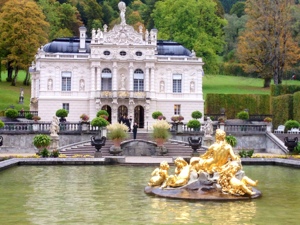
Linderhof, unlike Neuschwanstein, is located on rolling grounds that lend themselves nicely to some serious landscape gardening. Opposite the front door is a large pool – with a highly decorative and very attractive fountain that ‘erupts’ every 15 minutes. Ludwig II had been to the worlds fair in Paris (1867) – and had seen Versailles – so he decorated Linderhof to honor the Sun King – Louis XV. It’s filled with gifts given Ludwig from various monarch, and planned so that Ludwig could live here without seeing his servants.

For example – his dining room features a table that sinks into the kitchen so it can be set and served – then ropes pulled to raise the table in front of the king. No servants to ignore. Perfect.

Like Neuschwanstein, you must take a guided tour. Unlike Neuschwanstein, the out-of-the-way location and less dramatic appearance keeps the crowds away. In our tour group there were just 7 people – the guide, us (English), our friends (German), and a couple of Russians. So our guide handed out printed books to our friends and the Russians – and gave us the best tour ever. She showed us hidden cabinets and staircases that the servants used to hide from Ludwig. She pointed out details on paintings and explained Ludwig II’s fascination with the Sun King and his mistresses. And most importantly – made sure we knew to go visit the ‘Venus Grotto’.

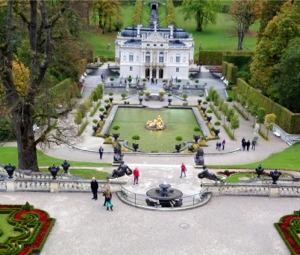
Following her directions, we wandered into the extensive gardens, admired the arbors and various planting – including the magnificent waterfall system framed to perfection by the windows of Ludwig II bedroom. You can see it behind the Castle in the picture taken from the top of the landscaped buildings in front of the castle.

20131017-001305.jpg

Eventually we make it to the Venus Grotto – and again must wait for a tour group. Well worth the wait I have to tell you! Ludwig II was enraptured by Richard Wagner’s operas – and the fact that scene painters not architects were asked to design Neuswanstein is well know. Less well-known is that he had the same person design for him a personal grotto. The place is huge – completely artificial of course – with a oversided rough shaped pool and a swan boat for the king to relax in while singers and the chorus performed Wagner’s operas from ‘shore’. All for an audience of exactly one. The hight of extravagance – a 25′ waterfall that turns on and off on command.

Futher foolishness – while at the Worlds Fair in 1867, Ludwig saw the Moroccan exhibit – and bought it! It now sits proudly in the garden of Linderhof.

Magnificat decor, beautiful furniture, and a fascinating back history. The Linderhof is worth driving out-of-the-way for.

Ludwig II – Never envy the life of the rich and bored!


In 1868, at age 18, Ludwig II became the king of Bavaria. But the times they were a-changing! He could never be an absolute ruler as he wished – instead he had to tread a very careful path around Bismark – a task for which he was apparently ill prepared. The result – a war that ended badly, and a rank of king only in name.

But he had money – and nothing really to do. So he retreated into a life of fairy tales and Wagner inspired Grand gestures. Friendless at the end, but surrounded by servants – his cause of death in 1886 remains a mystery – although the ill minded might wonder about his uncle, who became regent upon Ludwig II death and ruled for quite some time.

Sad life aside – Ludwig II wanted to build things – things that people would remember. And build he certainly did. We visited only 2 of his 8 palaces, one of which I’ll chat about today – the other tomorrow.

20131016-232925.jpg

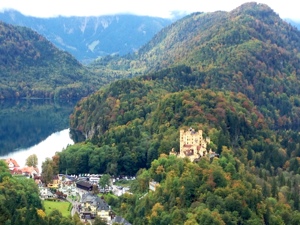
We also saw a third (Hohenschwangau) from a distance. That was more than enough to get the general idea- this was a king that loved the ornate, the over-the-top, the extreme. And he had the money to make it happen.

20131016-232851.jpg

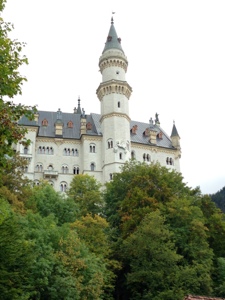
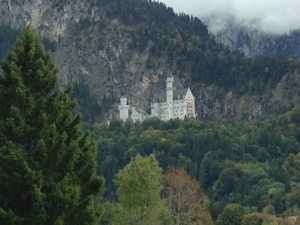
Neuschwanstein Castle is the stuff of picture books and Disney fairy tale fame. It’s not hard to imagine that Disney used Neuschwanstein as his model for Cinderella’s castle – even the guide books admit that this is one of the most famous buildings in the world.

But Ludwig II only spent about 8 nights here – by all accounts he visited during the multi-year construction, but there were never any parties, any balls, any sparkling lights and magnificently dressed people – not in reality. But on the walls – Ludwig fished his wish. Heros of Wagner Operas are everywhere – proud, glorious, and for many – insane. The tour (it’s required that you take a tour – no self touring) needs to be reserved ahead – but if you are aware of that – the reservation is free, and the time you will save is counted in multiple hours. We walked in, walked up to the booth, paid and left. Others were less lucky – and dealt with snaky lines that looped and curled. Don’t do that – reserve your tour!

Just a note – I don’t think you actually reserve a time – just a date. I’m not sure – but I typed in 11:00 as my desired time – and when we arrived – our tour ticket was 11:30. Not completely sure how that happened – I wasn’t the one who paid for the tickets. On the other hand – since we had 2 German speakers and 2 English speakers – they may have decided the only good choice was the tour with audio guides!

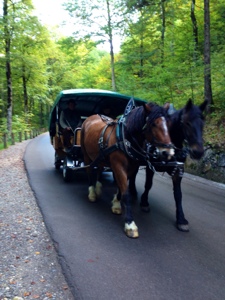
Anyway – cars are not allowed on the access road – only horse-drawn carriages and people walking.

20131016-232819.jpg

Shuttle buses take a completely different route. We thought we’d take the carriages – realized that the line was seriously long – and opted to walk. Good thing. No carriages passed us on the entire walk up. And it was a very easy walk, along a paved road through a forest. About 3/4 of the way up is the ‘carriage’ stop – and from there the views just get better and better.

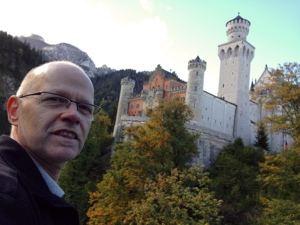
It’s a completely beautiful castle. No wonder it’s one of the top tourist spots in Germany. I get it. Totally get it!

20131016-232808.jpg

We had plenty of time to wander around the outside and take pictures – if the tour starts at 11:30 – it’s going to start at 11:30. This is Germany you know. There are normally so many tourists – they have a loading now – and a pre-loading line. And still the wait without reservations can be hours. Part of the reason – it’s not that horribly expensive. Combine relatively inexpensive with seriously famous and you have a winner.

I carefully read the tripadvisor reviews before hand – and while the advice to get reservations is a winner – along with the advice to come early – the occasional complaint about the number of rooms you can see is completely unfounded. The issue isn’t the number of rooms you visit – it’s the number of rooms that were completed! And the rooms are huge. confiding that Ludwig was effectively hermit – it makes the castle even more amazing.

Ludwig II had two floors completely done when he fled here in an attempt to escape the government representatives who were coming to put him in an insane asylum. But those 2 floors are wonderful. The life-size murals telling the legends that Wagner immortalized in his opera are simply stunning.

The only sad thing is the speed that you must move thru in order to stay with your group. I actually ended up with the group after mine – caught between locked doors. No matter – that guide just waved a smile and continued on with their explanations.

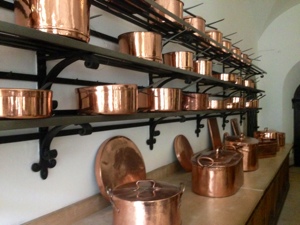
You are not allowed to take pictures inside (they want to sell those postcards) – but you can take pictures in the kitchen. Got to love copper pans, eh?

20131016-232902.jpg

One of the best parts of the tour is one not often mentioned in the reviews. After you tour the castle, you end up at the restaurant. Decent prices, and standard German food awaits there. But across the hall is a stellar exhibit – a video subtitled in at least 3 languages that shows using animated sequences the history of the building of the castle. it shows the original medieval forts that determined the shape of the foundation, it showed the castle being built step by step – and most importantly it showed what was on the original plans, but never brought to fruition.

Ludwig had planned on a Knight’s bath – effectively a private hot tub just for him. He’d also imagined a huge secondary terrace and overview on the Western side of the castle – the one overlooking his childhood home, the Schloss Hohenschwanagau. That’s the castle we saw from a distance, but never visited.

20131016-232830.jpg

After seeing the castle and watching the video, I was so impressed by the beauty of the paintings – not to mention the gold and gilt and ornamentation – I actually bought a story book that summarized the legends emblazoned on the walls.

Bottom line – worth the trip!

3 Museums – One Day – Don’t do it!


Only the foolish would try for 3 world class museums in one day – well color me foolish!

One of the big reasons I stopped doing group tours was the rush rush wait kind of thing. The tour leader would have a huge long list of things that we must see that day – and his job was to carol the rest of us into going along – regardless of what we’d miss along the way.

So I wasn’t too keen to discover that we were going to attempt the same crazy stunt – but without a tour leader! In Munich – there are 4 major museums – all art museums – within about 1 minute walk of each other. Alte Pinakothek, Neue Pinakothek, the Museum of Modern Art and the Brandhorst. We’d picked the 2 Pinakotheks and the Museum of Modern art as our targets of the day – and got a good start, arriving at the front of door of the Alte Pinakothek at about 9:30. Unfortunately – it doesn’t open till 10:00. Sigh.

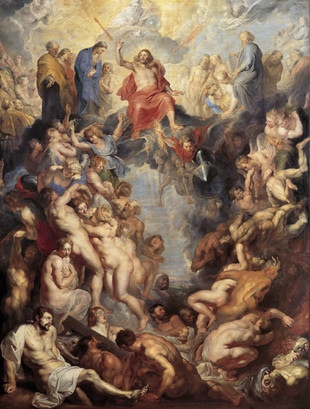
I’m not keen on sitting or standing around in the cold and wet – under any circumstances – so naturally we opted to stroll the neighborhood. Which put us back at the Alte Pinakothek at about 10:15. So much for that early start. Bathroom, ticket purchase, ear phone instructions – and we’re off. The Alte Pinakothek was built by Ludwig I around 1800 for one purpose and one purpose only – to house the most amazing painting by Rubens you’ve every seen. It’s huge – its stunning – and its in a room filled with other examples of his (Peter Paul Rubens) work. I loved that part of the museum the absolute best. There were seats, the explanations were interesting, and the art incredible. There is something so emotional about the works – you can feel the tensions of the damned and glee of the demons without even understanding the story.

20131014-000220.jpg

Also on display are a group of Rembrandt’s. The best to my mind is his rendition of the story of Jacob and Issac on the mountain. Jacob has bent back the neck of his favorite son in preparation for the sacrifice – and is literally saved by the bell. Stunningly beautiful.

There were lots of other paintings to gauk at of course – but the work of those 2 artists is reason enough to go to Munich!

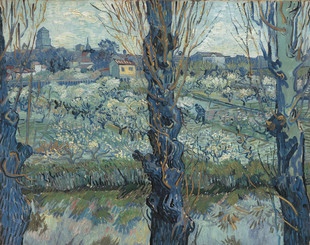
Next up – a smuggled in lunch and the Neue Pinoteck. This museum was set up by Ludwig II – and takes up where the other leaves off – starting around 1810 or so. The highlight here are the two Vincent Van Gogh paintings. The sunflower series is known world-wide, it’s iconic – and here is one of them – close enough to touch if the museum guards turn their backs. There is also one of his from the late Arles period – gay to look at quickly, emotionally depressed and isolated you feel as you identify the details – the water separating the viewer from safety and warmth, the lone peasant hunched against a cold wind only he can see. Glorious.

20131014-000457.jpg

Third – there’s the Modern Art Museum. We scored free tickets – not sure how that happened – got our ear phone sets and started to Explore. This gigantic space (are all Modern Art Museums huge?) is sub-divided into 5 sections – A special exhibit with art collected by one gentleman – Theo Wormland – consisting of mostly Max Ernst and Rene Magritte paintings, there’s the collection of the museum, there was another special exhibit of prints by Andy Warhol, there is the ‘Architecture’ Space, and final there is the Museum of Design. Each could stand on its own – as a group they are overwhelming and exhausting. Wouldn’t miss seeing it – but boy was I tried afterwards.

My clear favorites – some of the drawings – simple lines, yet so much emotion. I loved the collection called Dream Scapes. While Max Ernst’s work leaves you feeling depressed and unhappy – I have always loved the work of Magritte and Dali. What leaves you stunned is the thought that this one man would have the foresight to invest in this art when all the rest of the world thought these artists were completely crazy.

At closing time we drag ourselves out – we have dinner reservations at 7:00 (check out my review of the Atelier – it was dynamite) – but before that we must pay homage to the tomb of Josephine’s son from her first marriage and Napoleon’s Step-son – Eugene de Beauharnais. He’s buried in the Church of St. Michael – and we arrive just as services begin. Organ playing, lights on – beautiful. After the service ends, we check out the tomb. Victor is quite disappointed – they’ve dressed Eugene in a toga. Whatever for – he was in charge of the Chasseurs à Cheval of the Imperial Guard – surely a Chasseur uniform would have been better? But if it’s your tomb – you can do what you want.

We walk quietly back towards the restaurant – I’m thinking about my cold wet feet – Vic is still mad that Eugene is wearing a toga for all eternity.

12 Surprising Things about Munich


1: Escalators can go both ways – and they stop when no one is using them. This is so cool. You walk up to an escalator that isn’t working (reminds me of Concordia – for those in the know) – and when your foot hits the bottom pad – it starts. Like Magic. And it can be a foot race – winner hits the pad first! If it’s the person going down – then either you take the stairs – or wait till the escalator stops!

2. Outdoor cafes provide blankets on their chairs. Is that not the smartest thing? You can use the blanket as a seat – or drap it over your shoulders. Upscale cafes go for the fux fur look – exactly what you’d expect of course!

3. The city controls where Cafe’s can put their chairs – in a very subtle way. On the sidewalk outside of every food supply house are carefully painted, very subtle white circles. These paint splotches mark the limit of chairs and tables. You don’t have to put out any chairs – but if you do – don’t put them past that invisible line.

4. There are a lot types of BMW’s and Audi’s then we see in North America. I’m not just talking about the smaller cars – I mean options are different. The most suprising difference, and one I can’t figure out for the life of me – BMW owners can choose to not put the version of the car on the car. IE: you can’t tell a 350 from a 750 by the label. Odd, eh?

5. Bread can be beautiful. There are zillions of bakeries in Munich, so the competition must be fierce beyond belief. The solution – make yourself unique – and it helps if your bread looks pretty. Bow’s on pretzels, Gnomes in shop windows, Wedding cakes made from loaves of bread. If the imagination can think of it – the shop keepers will try it!

6. Grocery stores aren’t all the same. In Montreal, and most other cities in North America that I’ve visited, if you go into a Metro, a Piggy Wiggly, a Grand Union, a Price Chopper, or an IGA – the layout will look different – but the contents will be mostly the same. The same brands, the same sizes, the same selection – and sometimes even the same layouts. Some of the more unique Grocery Stores – Trader Joe’s say – make their mark by being unique and different – but those are few and far between. In Munich – all the grocery stores I walked into, even if the ‘brand’ was the same – had different layouts, different selections, different products. Amazing.

7. There are easily at least 15 different sizes/shapes/brands of Advent calendars. Not all stores have their Christmas goods on display – but in the ones that have gone Noel – the selection of Advent calendars simply blew me away. I don’t think I’m making out of Germany with out at least one.

8. The sidewalks are a lot cleaner than I remember. The last time I was in Germany there was dog poo all over the sidewalks – you literally couldn’t walk with your head up – it was head down and feet dodging all the time. That has totally changed. The sidewalks are completely clean. How neat is that.

9. Beware the Munich bike riders. Unlike Montreal, where bike lanes are carved out of streets – resulting in less room for cars – In Munich, the huge sidewalks have been subdivided clearly by lanes for bikes. And there are lots of bikes. And they go fast. And if you walk on the sidewalk and stray into their space – it’s not pretty. I’ve dodged the bullet several times – and Vic is getting very good at pulling me out-of-the-way of speeding bikes. The nice thing – the bike riders don’t yell at you – they might run you down – but they would be smiling while they did it!

10. The cheapest food is around the HautBanHof – that’s the main train station. Well, it might not be totally the cheapest – but the turn over is so fast – it’s clearly the freshest. Yum.

11: You have to pay to go to the bathroom. In one place – they actually had turnstiles set-up. Put in a Euro – or no pee-pee for you! At least they gave you a coupon good for .5 Euro off your next cup of coffee. Sort of feeding the system don’t you think. Even if they havent gone ‘mechanical’ – toilets almost always have a lady with her omnipresent tip plate. Often they use a coin to knock on the plate to remind you that it’s not there for food. In one toilet, there was even a conductor – she told you which stall to use, and walked in before you to wipe the seat – and hold her hand out for money.

12: Even king size beds have separate duvets – This has to be the oddest thing. You walk into a hotel room – there’s a king size bed. But on top are 2 duvets – one for him, one for her. It’s like having 2 sleeping bags on a king size air mattress. You only think you are sleeping together. But they are warm and cozy – and it’s so cold – I’ll settle for warm on cozy. In one hotel – I actually used 2 duvets!

Deutsches Museum in Munich – less than the sum of it’s parts


Don’t get me wrong – the biggest ‘Technology’ and ‘Science’ Museum in Germany is well worth visiting – it’s just that the parts are so large – it’s hard to focus.

The Deutsches Museum is all about ‘size matters’. Unlike most museums that are content with models, or electronic aids – this Museum wants the real thing. So there’s a life-size section of a Lufthansa Passenger jet showing the typical 2 – 4 – 2 seating- with the luggage containers below. There’s a real U-boat – the last of its kind, saved from destruction in 1919 by the founder of the museum, and sliced open so visitors can see the insides – from stem to stern. There are full-sized water wheels, running of course – even a full-sized sail boat used for fishing off the North Atlantic sea. At one point, you walk into the staterooms and then onto the deck of a cross Atlantic steamer – circa 1950.

It would be impossible to list all the stuff crammed into the museum – let alone see it all. But I did have one favorite part – and it’s wasn’t even on the must see sections!

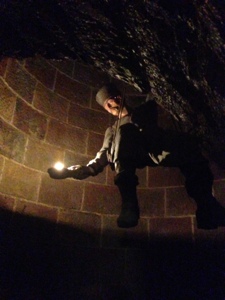
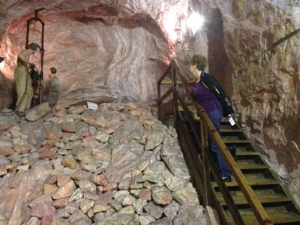
To me the highlight of the museum was the Mining section. Why – because they devoted basically 1/2 the basement to full-sized, walk thru, mines. Dark, dripping with water, dirt or wooden floored as appropriate – these ‘mines’ felt like the real thing. And since I’ve been in the real thing several times – I feel justified in saying that.

20131008-231348.jpg

To trace the changes in mining technology over the past 200 years – they have created mines worked by hand, complete with miners using lamps to claw coal from the earth. Exit that mine – and you are in a salt mine – with life-sized miners using pick-axes to cut salt ‘cubes’ from the walls. Walk a bit further, and you are in more mechanized times – horse-drawn sleds, tracks running beneath your feet, electric lights. Just a bit further – and you are face to face with gigantic mining machines with bits larger than a human. This is a truly impressive bit of display work – it would be hard to leave without a feeling of pity for anyone who would have to earn their living under the earth!

20131008-231400.jpg

Another truly fascinating section dealt with nano-technologies. This section used the very latest in museum technologies – you passed your hand over an object – and in German and English the object was explained in quite significant detail. Neat technology – but not the best at conveying information. Because you had to pick what to learn about – it was easy to by-pass important things, and get intrigued by something less critical. Basically a confusing exhibit – but very cool technology.

Another exhibit that couldn’t help but admire – but have to admit that the designers went so far – and then dropped the ball – was in the Pharmaceutical section. There you see a picture of a naked woman (this is Europe – no clothing, no problems), are forced to focus on her eye, from there to a piece of skin above her eye, and from there to a skin cell. You then turn right – and actually enter the cell – blown up 10000 times to make room for probably 30 visitors at once. So far – so cool – but then the designers ran out of ideas. Once in the cell – it’s back to basic explanation – mostly in German. Oh well. I did like that one section of floor looked like cell wall – I think the entire floor should have been made like that – it would have been far more impressive.

There’s also a model train layout – huge of course – HO scale – that is ‘animated’ 3 times a day. When animated, the cameras on the front of the trains are turned on – and you see the scene from the perspective of the engineer. A very neat effect.

Under the – scare the wits out of people heading – they have a huge exhibit on static electricity – which ends with a house bursting into flames from a lightning strike. Very noisy – but not something I haven’t seen before.

The very highly reviewed Physics section has every mechanical advantage demonstration tool I’ve ever seen – very hands on – very fun – but limited explanations. I was left thinking that kids probably press the buttons – pull the levers – and roll the balls – and then walk out – none the wiser.

Bottom line – Do go. It’s way cool to see the full-sized planes, boats, power tools, printing presses, telephone exchanges, even an old IBM 360 – the computer I learned to program on in 1966. Be sure to visit the Mining section – you’ll have to hike down stairs quite a bit – and then gradually work your way up thru the various exhibits – but it’s truly amazing. Don’t be surprised at the lack of English – some sections are well labeled, others have nary a word of English. And Don’t expect an audio guide. You will be disappointed. But I’d rate the Mining section alone a must see in Munich. I’ve never seen anything better anywhere – and that includes really coal and silver mines!