Egypt and Jordan – Day 11 – Feb 13, 2026


A Balloon Ride over the west bank of Luxor – To Go or Not to Go?.

Hussien starts off the ‘sales’ pitch by telling us that the Balloon Ride is expensive, and that there are 32 people in the basket with you – plus of course the Pilot. And you must get up super early to get to the launch site. And it’s possible that the Balloons won’t fly because the wind is wrong, or there’s too much sand in the air.

Given that Cairo is under a Sand Storm watch – We do hesitate for a second – but then Hussien continues by telling us that it is unbelievably good.

To go or Not to go? But I loved my balloon ride in Turkey – so we decide – Ok – we’re going.

Turns out that 15 of the 21 of us opt in – so we will make up 1/2 of the basket. That sounds a bit better – but I’m still wondering about crowding. Well – we will see.

The alarm rings, we dress warmly (I don’t know WHY I listen to Egyptians complaining about the temperature. They are wearing faux fur coats and I’m in short sleeves and shorts – and find it warm). But maybe it’s colder 300’ above Luxor.

We all pile into a large van – and head out. The city is very quiet – there are folks around, but the real action hasn’t started yet, thank goodness. So traffic is light, very very light by Cairo standards for sure.

In the pre-dawn, we cross over the Nile, and quickly find ourselves in a van parking lot! There must be over 100 white ‘tourist’ vans jockeying for parking locations, but our driver knows exactly were to go – so we’re parking right acoss from 2 balloons spread out on the sand. The first of these is ‘Our’ Balloon.

Most folks opt to stay in the van, but I’m way to curious to do that. So out I hop to check out the action. There are ‘coffee’ shops along the side away from the balloons – and probably 100 balloons laid out on the sand, ready to start the process as soon as they get the ok to fly!

I walk over to our balloon. The basket is on it’s side – and there are 3 Giant Fans on the right and left side of the basket. The basket is huge – figures if 33 people are going to be inside. And the size of the balloon is equally huge. Way larger than the balloons I ‘flew’ in Turkey for sure. The width of the opening is larger than the basket – and the balloon itself stretches at least 100’ off.

I am totally surprised when a voice from inside the basket say – hi! A face peeks out of a foothole in the basket – and I ask – who are you? Maybe a better way might have been to say hi back – I’m Leslie – Who are you. But never mind – too late to fix mistakes.

He explains he’s part of the crew! I then realize that what I’d taken to be an empty set of steps is now the resting place for 4 other guys – and they are taking out drums to entertain themselves before the balloon gets launched. I’m chatting with them when suddenly folks are running past me in all directions – sprinting to their assigned Balloons. The ‘GO’ signal has sounded.

Everyone has his assigned job. Guys man each of the Giant fans, and 3 other guys open up the mouth of the Giant Balloon. The fans fill the balloon with air – slowly at first, then increasingly effective as more and more of the silk gets filled. The guys walking around inside the balloon straighten folds, push out the sides, and then check that things are going correctly.

The pilot arrives – walks the interior of the Balloon – just like a pilot inspecting his airplane, and then he signals to the crew that the fire will be starting. A huge flame erupts from the center of the basket – hot air is driven into the air filled balloon, and it starts slowly to rise up.

What seems like a slow process accelerates as the Balloon fills, and starts to float over our heads. Suddenly there’s a tap on my arm – Andrea has joined me to watch. Victor, Andrea and I decide to share a section of the huge basket. Over the noise of the flame – the pilot explains that there are 9 sections – one for him and 4 on each side. 4 people max can go in each basket section – but one group will be 3. We opt to be 3.

That settled we wait for a few moments as the crew pushes the basket up right and readies the basket for us to clamber in. The sides are high – to my chest for sure – so no falling out! I watch how other folks get into their sections – and the teams bring a step stool up so we can get a start on the height. But to get down off the rim, we have to drop down 3.5 feet. I do a horse descent – super glad for that training – and suddenly everyone is in the basket. We are instructed on the landing position – bend your knees hard, duck your head, put your hands on the cords on the side of the basket and DON’T move until the pilot gives the all clear.

The crew has stopped holding the fans – and are now circling the basket holding it down while the Pilot get’s the engines ready to take us up. The air in the balloon has to be heated before the crew can let go – but there’s an exciting minute or so while the crew puts all their weight into keeping the balloon on the ground.

The pilot signals the crew to let go – and we wave goodbye! Suddenly we are flying.

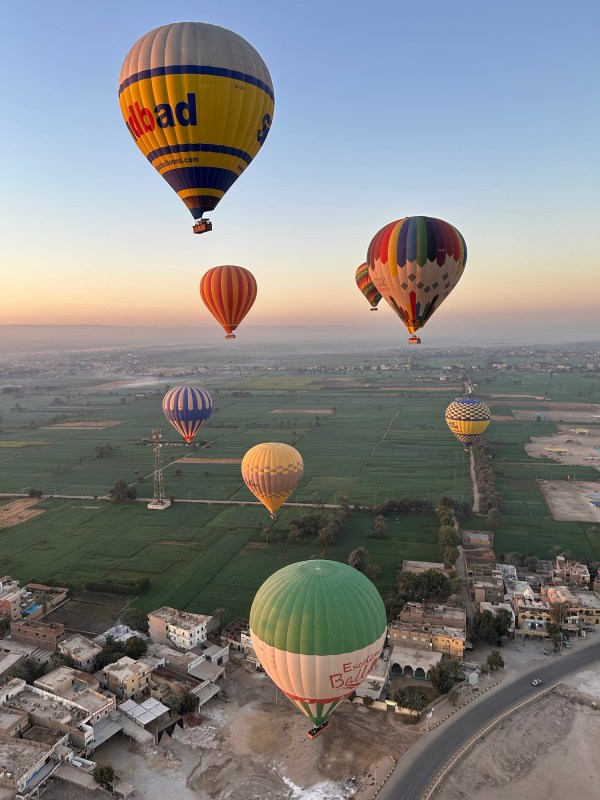
Our balloon rises quickly – and now that I’m not paniced – I take a look around. There are over 100 balloons flying – We are in the middle of the pack – but 2nd to go up. The balloons were laid out in such a way as to keep enough space between the balloons to avoid collisions. I’m guessing they also control ‘lift-off’ time to stagger the balloons further.

The ride up is actually quiet and the view is amazing. We are looking towards the hills that seperate Luxor from the Valley of the Kings and the Valley of the Queens and the pilot explains that we definitely don’t want to go over those hills – There’s no easy place to land. And we aren’t allowed to cross the Nile for exactly the same reason. It would be really hard to find a landing space for one of these huge balloons in Luxor City.

So we are hoping to drift North towards Cairo where there is a good place to land the balloons.

But right now – he’s going to spin the balloon and the basket so we can all get a Pano picture of the sunrise over Luxor. Insanely beautiful. I’m so happy.

We drift over towns on the west bank of the Nile – Victor loves the view of the roof tops – it’s HO scale! I’m just enjoying the breeze, the feeling of flying, and the thrill of being up so high.

My heart is definitely racing! This is so beautiful. Much better than the balloon ride in Turkey!

Folks in another basket ask our Pilot how much training he has – and after quiping that this is his first try – admits that to be a Pilot you must do 3 years of training and get something like 1000 hours of experience before you can take up a balloon on your own – let alone with guests.

He then starts explaining about landing – reminds us of the landing position – and then shows us where it is safest to bring the balloon down. Only then does he also explain that it’s almost impossible to hit a good spot – so we need to be prepared to stay in the landing position till his all clear.

Our 90 minute flight is almost over – and to say it has flown by is an understatement! Wonderful.

We start to decend – and while several of the balloons are already down in the right place, we decend a bit quicker than our Pilot planned – and we are going to be landing in a rougher area than he likes. He cautions us again about the landing position – and then asks us to assume it!

We are only 20 feet above the sand and rock – and the crew has driven around to be directly below us with the truck parked safely to the side. As we decend – the crew grabs the basket and tugs it into a flatter part of the landing area.

Then once again they put all their weight into holding us down. The balloon as a different idea and makes a quick dash for the sky – but loses the battle and falls gentle to the ground.

Now most of the crew stop hanging onto the basket and switch jobs. The silk of the balloon can not be torn – so they have somehow spread a large mat on the rocks and sand where we have landed and pull the lower part of the balloon onto that mat. There is still a bit of air in the upper part of the balloon so they team up to fold and twist the lower part of the balloon, safely protected by the mat, and pull it forward into a fold. Pull, twist, fold, Pull, twist, fold – repeat until the balloon has been emptied of all the air – and safely carried onto a truck.

Next it’s our turn. The crew circles around the basket helping folks out of their sections. We were the last section in – so we’re the last section out. And it’s not like getting out of bed, but it’s easier than getting up from the ground without using your hands! Victor waits until both Andrea and I are safely out of the basket and in the hands of the crew before climbing out himself.

Now we must board a flat bed truck to be taken back to our van. Remember we were last out … well – everyone else is already sitting in the truck bed – we have to squeeze in. This is made more interesting by the fact that the side of the flat bed has to be raised to hold us all in. Us and 29 of our closest friends cuddle up on the bed of the truck with some members of the crew. Other crew members sit on top of the truck Cab!

It’s about a 5 minute drive – 30 minute walk – to where the vans are waiting. We get off the truck bed, into to the Van – and all of us cheer! We’ve done it – and it was super fun.

My heart is racing the entire ride back to the hotel for a quick breakfast. Surprisingly there’s an Egyptian Gal with a Chef’s badge working the omlet station! I’m so surprised – it’s one of the few women I’ve seen working since we got to Egypt. We start to chat and I tell her that my daughter and my granddaughter are also chefs! She asks about what they do – and without mention the animal – I explain that Adrienne used to butcher animals and use the meat to make sausages and that Anais is a running a bar and the head Mix-ologist. She says – say hello to them from a Chef in Egypt!

So Hello Adrienne and Anais from Chef Yasmine!

Now we regroup for the moments this tour has been working towards – visiting the tombs of the Valley of the Kings and the tombs in the Valley of the Queens.

Hussein explains that there are 32 tombs in ‘good’ condition in the valley of the Kings, but only 5 are open to visits each day. They rotate which of the 5 will be open – but always include one of the ‘Super Stars’! And he thinks 2 of the 5 of the ones open today are amazing!

But first we are starting with the place that King (Queen) Hapshepsut had built to be mummified. Imagine – this was built for just 40 days of use! And every Pharoah had one. Despite the efforts of her nephew to remove her name from the lists of Pharoahs, this survived quite intact – and was an amazing place to visit.

The outside is more amazing than the inside – but still – pretty cool. On the ground floor on the left side of the building (a 3 story hehemoth with a huge entrance staircase) are some well preserved carvings celebrating the Expedition to Punt – still with some of the original 4000 year old coloring). This is one of the few military victories for Hatshepsut – doesn’t it surprise you that she believed in compromise over the sword? We check those out, climb the steps up to the actually Temple, and then Hussein explains that because so many tourists visit these temples – as of 6 years ago – the government banned all guides from entering.

It was determined that having the guides in with their tour groups delayed folks from quickly leaving the inner chambers – and I have to admit that most folks move a lot faster when someone isn’t trying to get them to see a particular carving.

Hussein outlines the ‘top’ things to watch for – including the stunning blue sky with stars in the Santuary. I recognize and gleefully photograph the image celebrating the fact that this Pharoah ruled both upper and lower Egypt. It’s clearly Horus and Set holding ropes that knot around the spine (for stability) to the lungs. I particularly love the fact that in this rendition the feet of the Gods are so vividly pushing down on the lungs to get more pressure on the knot.

There are frequent occurances of the Lives Life slogan.

Unlike the paintings on the bottom floor – the carvings in the Santurary are High Relief and very well done. Given that her nephew tried to erase her – it’s a miracle that her Mortuary Temple survived.

I meet an Egyptian family wearing of all things – Disney attire! They pose for a picture with me – what fun!

Next stop – the Valley of the Kings. First stop Tomb of Ramses IV – and as Hussein predicted – it’s extraordinary.

One of my concerns has always been that the Valley of the Kings – because of the massive amount of tourists that visit it – will disappoint. I’m pleased to report that I was wrong. The carvings are truly magnificant – from the Book of the Dead carved into the walls to help the Pharoah’s Ka find it’s way to heaven to the stars on the ceiling to full color (4000 years old people) images of his attendance in different colored robes, to the magnificant ceiling – still highly colored.

I can’t read the Hieroglics – but I can admire them.

After all of Hussein’s efforts – I do recognize the symbol for Ra giving Life to the Pharoah!

The way into the tomb is fairly straight – and easy – and again guides are not allowed in so the stream of folks moves fairly quickly. Yet again I run into another Egyptian Family – also touring the tombs with their 1 year old son. Did I get a picture – of course!

Hussian challenged us to find the image of the sky – a woman bending at her hips and shoulders to protect the land. Her legs are firmly planted on the land, her hips to shoulder are the sky, and from the shoulders her arms reach back down to the earth. It’s a very powerful way of seeing the world.

There are also full colored carving of the Pharoah taking the boat thru the night to reach heaven. Not surprisingly – the carved boat looks very much like the one found near King Korfu at the GEM.

Hussein also challenged us to keep our eyes out for snakes – a re-occuring theme in tombs of this period. There are good and bad snakes of course – the good ones protect the Pharoah, the bad ones provide challenges he must overcome to get to Heaven.

One last challenge – see if you can find the ‘good’ people and the ‘bad’ people. The ‘good’ people are shown walking upright to greet their God, the ‘bad’ people are shown upside down, and sometimes headless on their way to Egyptian hell.

Our next tomb is the one created for the sons of Rameses II. Given that he had close to 50 sons – there were lots of folks to celebrate – and the tomb is fairly large.

We pause for a photo of the plaque showing where the tomb of King Tut Ankh Amun was found – they charge extra to enter the tomb ($20 US) – and Hussein warns us that it is small, crowded and empty. There are not even any carvings because he died so young.

We also get to visit the Tomb of Rameses VI – originally intended for Rameses V but quickly repurposed for Rameses VI. Like the one for Rameses IV – it’s covered with paintings – but the carvings at the top level are much less impressive and have been damaged. You have to continue walking downwards to get to the ‘good stuff’.

I particularly liked the carving showing Rameses VI on his throne and suplicants coming to him up a staircase. They represent the different tribes he had conquored! Again its the richness of the blue and yellow colors that is most surprising. How can artifical colors, created by chemist 4000 years ago have lasted so long?

In this tomb I easily find the upside down folks heading for their punishment – They are actually carved in Low Relief right below their more fortunately fellows heading to heaven!

This tomb goes on and on – as it spirals downward – the colors are better preserved and the carvings become High Relief – clearly the artists started at the lowest level.

Hussein explains that when the 40 days required to mummify the body was finished – all work immediately stopped on that Pharoah’s tomb, the body was sealed inside and the artists moved on to the tomb of the next Pharoah.

My favorite image in this tomb – just for the use of color – shows the Pharoah on his chair holding blue and white colored staffs crossed, a red sash that is tied and flows down to the hem of his robe, and an offering of a Lotus Flower.

At the lowest levels – this tomb is insanely beautifully decorated – and at the very lowest level there is the final burial chamber – with it’s images of the sky as a woman bent over the earth to protect it.

The colors and carvings at this level are breathtaking.

Without Hussein’s guidence I can only guess at the meanings – but I easily find the snakes – both good and bad, and the details are just wonderful.

We then visit the tomb of Rameses III – I do love the crocodile details and take a close up image of the Pharoah (identified by the snake shown on his forehead ready to spit posion at his enemies offering smoking incense to a God. I am reminded yet again that High Relief makes a huge difference!

There is also a surprising image of a large block of stone sliding down a ramp. Is this a hint at building techniques?

Did I mention the other Egyptian family I met who had brought their 2 year old son to view the tombs. Friday is a day off for Egyptians – which explains why today I’m meeting Egyptians among the hoards of Foreign Tourists!

We get back on the bus – and Hussein has a treat for us – the Egyptian version of Lays Potato chips! Yum!

We move on the Valley of the Queens – where we are offered access to two tombs. One has been severly damaged by water coming in over the years from the Nile, but the 2nd one is my personal favorite.

Unlike most tombs which just celebrate a Pharoah and at best have interesting scenes of the conquests marching towards the Pharoah with their hands tied behind their backs – this one has a very loving story to tell.

The Prince buried here was the Pharoah’s favorite and his death was a shock. So the images on the walls of the tomb show the father first telling his Queen that he will return and the son is shown walking behind the grieving couple. The young prince is identified by his side hairlock and the Ostrich feather he proudly carries. In another scene his father introduces him to the Gods, and in the last scene – the father is seen leaving the tomb with his son among the Gods.

I’m emotional just writing about this story. It is told so clearly and so beautifully.

Like the best of the tombs in the Valley of the Kings – the carvings are high relief, the colors brilliant and the story told well.

Our last tomb is the least impressive – although it is much more famous – it’s the tomb of Titi. Unfortunately the damage by the water seeping in and out of the tomb has destroyed the colors and made the carving hard to see. Because they are so damaged, glass panels have been placed over them – making them hard to see and a challenge to photograph.

We board our bus and head back to the hotel for a mixed grill lunch and an afternoon of leisure. Victor and I grab a nap – then try to take a walk outside. We manage to go in the wrong direction – so we quickly run out of anywhere to walk.

We are approached by two different gentlemen – who say that they remember seeing us at breakfast in the hotel.

Fortunately – Hussein had mentioned that this had become the newest ‘come-on’ – so we know to ignore them. But isn’t that funny – twice – about 5 minutes apart.

We return to the hotel, eat dinner – and go to bed. Later tonight (like 1:30 AM) we have to wake up, pack our bags, and check-out. We fly to Cairo at about 4:30 AM and definitely can’t be late.

Signing off for a few hours of rest – The Soup Lady
Egypt and Jordan – Day 10 – Feb 12, 2026


Oh No! it’s another transfer day, although this one is by far the easiest. We just have to get off the ship and onto a bus for a short ride to our next hotel – the Steigenberger Nile Palace.

Of course it’s NEVER that simple in Egypt. The trick is that we can’t check in to the hotel under afternoon – and of course we have to check-out by 10:00 AM. But Odyessy doesn’t waste time. Hassein has planned a full agenda for us this morning.

So – suitcases outside by 7:30 – get breakfast and be ready in the lobby by 8:00.

I begining to think that Hassein has only two start times – insanely early and 8:00 AM!

Anyway – good travelers that we all are – we are ready at 8:00 to visit the Big Fish of all Temples in Egypt – Karnak. And it is huge. 60 acres in it’s entirety – and Hassein jokes that we shouldn’t worry – we are only visiting 59 of the acres.

Cute. Very Cute.

Even though it seems really early to me – Karnak is busy, busy, busy – and Hassein basically tells us – you haven’t seen anything yet. That and Follow Me are his ways of letting us know it’s time to move!

As we have come to expect from the bigger temples – there’s a ticket required – which Hassein hands us when we get to the automated ticket scanning booths. Inside the ‘Visitor Welcome Center’ there is a 3D structure of the original Temple – as best we can imagine it today. Hassein points out that what makes Karnak special is that every Pharoah from the Old, Middle and New Dynasties had a finger in the pie. Each created a part of the temple, or added a wall, or erected an Obelisk or two. And well meaning folks have tried to ‘save’ sections, sometimes helping out, sometimes with disasterous results.

The worst attempt was French – an well meaning gentleman was asked to just get rid of some of the salt build-up along one side of the Temple. The problem was that the Nile’s flood and drop cycle had left salt over time and the salt had created issues. His idea was to allow the Nile water’s to remove the salt – so he built channels to bring in the water and left it sit under the wall for 3 months.

The wall fell down.

What the fellow didn’t know was that the builders had put cedar wood pegs in the middle of the stone blocks to hold them in place. Adding humidity made the wood swell – and the stones were pushed apart. Just brilliant, right!

On the other hand – under the wall that came tumbling down were found the painted tiles from the temple of Akhenaten that I described in the last Blog. So in fact – in failure they gave Akhenaten eternal life!

Anyway – we spend a brief moment looking at the 3D model, and then it’s time to see the real thing. And it is HUGE. Sheesh. The main hall – famous for having the stone pushed down in the movie – Death on the Nile – is actually as mysterious and huge as the movie makes it seem. A dozen men couldn’t link arms and circle just one of the Columns and there are dozens.

The ‘shorter’ columns are topped with closed Lotus Flowers, and the larger columns in the center of main hall are carved as Open Lotus flowers. The roof was built to go up vertically on the inner set of closed Lotus Flower Columns and then over the open Lotus Flower Columns and then down vertically on the other side. In the Vertical spaces, are grids of windows – creating rays of light. The net effect is to have the rays of the Sun illuminating the Open Lotus Flowers!

So cool. Such a neat effect.

I get some lovely sun rise images over bits and pieces of the temple. There are some really striking parts to this temple – not least of which is the remainders of the ramp system that the builders and artists used to create a Wall. Basically they used mud bricks, built a ramp up to the final height, placing the blocks layer by layer as the ramp was being built.

Then the artists arrive and start carving the blocks from the top. As they finish, the ramp is destroyed and they can access the lower parts of the wall. To make sure the designs are carved in the right places – they used plumb lines to make straight vertical lines (ask your local painter) – and then other plumb lines to make horizontal lines. That makes a grid – and then the images are transfered into the grids.

I use exactly the same technique to copy a painting from a small sketch to a bigger piece of paper. Wow – who knew I was using a 5000 year old technique.

There are some lovely low Relief and high Relief images to admire – and of course the wonderful Obelisks of Hatshepsut. She married her Nephew, then made him marry her daughter, all to keep control of the throne and title of Pharoah in her hands. She ruled for 18 years – and when she died – her Nephew – who finally got to be Pharoah – tried to erase her name everywhere. Nice family – right.

Anyway – Hassein went to great effort to explain what we know and don’t know about the creation and placement of an Obelisk. Because they are needles pointing the way to Heaven for the souls – they are made of one huge piece of stone, carved out in the Quarry. He explains how they measured out the size, carved out parts including the pieces that would in the end make the Obelisk raised at one end and lower at the other. Then the carving would start. When that was finished, the rest of the stone that wasn’t Obelisk was removed and the obelisk put on a boat to take it to the Temple. It was moved into position, and then raised. There are images that have been found that detail carefully all the steps except the one key one – how did they raise the Obelisk into position? No one apparently knows!

We pose for a group photo in front of the Obelisk of Hatshepsut – Admire the magnificant carving of a young King Tut and then use our free time to wander (or go to the toilet!).

We then take the bus a very short distance to a place where they make and paint Papyrus. There’s an interesting demonstration of the technique – starting with the plant (a lot like bamboo), and showing how strips are laid in both horizontil and Vertical position to create after 5 to 10 days of drying – Papyrus. And based on what we’ve seen in the GEM – this stuff really lasts and lasts! It’s flexible and pliable, and with proper preparation – easy to paint. Lots of our fellow travelers happily do some shopping – but we’re trying to downsize – and honestly – nothing really grabs our attention.

Then it’s finally time for lunch – which Hassein tells us is his favorite meal of the trip. We are crossing the Nile by boat to eat at a framer’s home. I must admit I’m sceptical – but in fact – is really truly is his home. There’s a shady area in front of his door that they have put out tables and benches to seat the 21 of us – and a bread oven in the corner. The walls of the space are painted to remind the family of their 2 trips to Mecca – one by steamship, one by airplane.

14 people live in the house – it has 3 floors with maybe 12 rooms, and from what we can see – one sink, and one toilet. Sharing is caring.

The kitchen where the meal has been prepared is very very basic – but the meal is amazing. We start with a vegtable delicious soup (all veggies from their farm), followed by Chicken and Beef. The beef is so tender – it’s wonderful. Of course there’s Rice, Hummus and Tahini – and pita. No meal in Egypt is Pitaless!

They show us how to make a ‘pastry’ type of bread that they dip into Molasses for dessert (it’s yummy – and I’m a complete Klutz at rolling out the bread). The farmer – who speaks excellent English, although he appologizes first – answers all our questions, explains how big his family is – and also tells us that no one knows how old his mother actually is – because age doesn’t matter!

Then they take us inside the house so the Mother who is probably 1/2 my height – can show us how she spends every day grinding wheat using a grinder handed down to her from her mother. One of my fellow travelers tries it – and can make the grinder turn, but just barely. I wait till everyone else is outside to ask if I can try. I can’t even turn the top stone 1/2 way. And this tiny little lady can make it grind wheat.

Mona – if you read this – you know what I need to work on – sigh.

We then say our good-byes and get back on the boat to check-in finally at our hotel.

It’s the best one I might EVER have stayed at. Huge and beautiful. The rooms are stunning, tons of space, lots of lights and we have a giant balcony that overlooks the Nile. I sit on the Balcony working on my blog while Victor takes a nap.

In the late afternoon we are escorted to another Cotton House – where more of our group do more shopping. Victor buys a lovely Blue shirt of linen, and a cotton scarf he’s been hunting for. I chat with one of the very sweet sales girls.

When we get back to the hotel, we take a stroll around the swiming pool, various restarants and double lobby – at the lowest level we find a cute bar where some of our fellow travelers have gathered. We join them for drinks (delicous). I see one of the staff swinging a bucket of coals to get them to light up – and then put the coals into a tall, rather elborately decorated stand. Victor takes one looks and says – those are Hookahs – and lots of folks are smoking. Our waiter asks if we’d like to try one – but we all agree since we don’t smoke – it might not be a good idea to start with these!

When we get up to leave the waiter tells us that entertainment is starting – we should stay. But we all agree – we are done for the evening!

We settle for a simple dinner (I have a salad) at one of the hotel’s restaurants – and go back to bed. Naturally – tomorrow is another LONG day!

Signing off – The Soup Lady

Egypt and Jordan – Day 9 – Feb 11, 2026


Our assigned Visit time at the Edfu Temple is 5:45 AM – so clearly we are going to get an early start.

At least we don’t have to pack first. We just need to get up, get dressed, and get down to the lobby.

I’ll admit that I’m wondering why the rush. I never even heard of the Edfu Temple – and we don’t even have time to grab breakfast first.

Well – it turns out that there are several reasons for our very early start.

One – your group leader must pick a time to go to the temple – this is done to try to cut down on over-crowding. I will admit that it’s a great idea – but there are an awful lot of folks getting up really really early to check this place out.

Two – The Amwaj Livingstone needs to get on it’s way early to meet our designated time to get thru the locks at the first Cataract. The plan is for the boat to sail at 7:30 AM to make our assigned time at the locks, and we will actually get an easy morning and afternoon after we return from the Edfu Temple.

Three – this is a really really cool Temple. So suck it up lady – you are going.

Ok – now that I understand – I’m willing to go with the flow and get up and downstairs on time. 5:15 AM. You have to be kidding me.

It’s dark when we leave the ship – and yes – we’re not the first ship here either, we must cross thru 2 other ships on our way off. And Hassien has been warned that the ship might move. He’ll have to check when we get back.

There are scores of horses and buggys waiting to pick up guests from the different ‘floating hotels’ – but Odyessy has decided not to use the horse and carriages – we are told that they are worried about the way the horses are treated, so we board a bus to get to the Edfu Temple.

Along the way – Victor and I check out the horses – and we really don’t see signs of abuse. The horses actually look quite happy to be out at this early hour – and it is clear that they are well fed. I suspect the issues arise when a horse can no longer fulfil his carriage pulling job – but there’s no one to ask.

They do have sunshades for the horses – lots and lots of them are located near the temple. And most of the carriages have an alfalfa supply under the feet of the driver for ‘horse munching’ when it needs a fresh treat. I’m told that Alfalfa is a major crop here in Egypt, although I’m sure it’s not just for the horses in Edfu.

Surprisingly – despite the early hour – there are lots of folks at the temple, and Hassien tells us that we’re lucky it’s not very crowded. Right.

One advantage of our early start is that we get to watch the sun rise over the Temple of Edfu – a stunning sight. The colors of the sky here, well above the pollution further down stream are simply stunning.

Edfu is famous because it is very very large – and almost completely intact. It was saved because it got used by more than just the Egyptians. There’s evidence of it’s use by the Greeks and the Christians.

Unfortunately the Christians decided that some of the images were inappropriate – and ‘removed’ them by chiping away at the offending parts – generally the faces, arms and legs. Apparently looking at carved bodies distracted from serious worship. I think the priests might have been bored. But again – no one around to ask. Fortunately – the carved images were left intact in the Storerooms, so not surprisingly – Hassien hussles us in that direction.

His plan is simple – hit the highlights that will get seriously crowded first, then double back to see the larger parts of the temple when the crowds are less of an issue. And I can see his point. We get to take our time admiring the glorious carvings in the relatively tiny storerooms – and can still easily enjoy the large columned mid Temple and peacefully admire the huge front Courtyard. Good planning Hassien.

This is a temple built by Ramses II – and to make sure that no one repurposed it easily – He had his name carved in huge Hieroglyics – about 4 times the normal size and depth. This worked because his name is still visible all over the place!

Many of the carvings are in excellent condition (we are talking 4000 years) – and Hassien loves to point out the most interesting ones – like the one of the ‘sky’ bending over the world. She is portrayed with her feet on the ground, her torso bent to be the sky, and then her arms extending down back to the earth. We will see other examples of the sky lady – particularly in the Valley of the Kings! She is quite beautiful.

One of the prime locations is the central courtyard – huge with giagantic pillars on three sides creating a space for the worshipers to wait for the priests to bring out the golden statue of the God from the inner santurary. There is also a 18’ high statue of the Falcon God wearing the double crown of Egypt that is a focal point for folks to stand infront of and have a photo taken! Who can resist that option!

We are given about 20 minutes of free time to wander on our own – and I go back into the storeroom area – I love how the entrance is hidden to the far side of the santuary and then runs all the way behind it. So reminds of Catholic Churches I’ve been in where hidden behind the main altar is a series of smaller chapels.

I’m again impressed by the quality difference between the High Relief and the Low Relief carvings. Apparently Temples are carved, but Tombs are painted. Low Relief is more common and easier to create – High Relief is saved for the most ‘important’ images, and more commonly found in Lower Egypt. It’s the High Relief Carvings that look so alive to me, although even Low Relief ones carry more movement than the paintings, despite the coloring.

We re-group, and head back to our bus and our ship. As predicted – it has moved – and is now about 5 ships out from the shoreline. We count carefully – get on board – and as predicted – the ship sets sail for the locks. We definitely need to be there on time.

This gives us ample time to enjoy the scenery on the sides of the river (mostly green with the very occasional building), breakfast (yum), and then lunch (yum).

From my comfy seat on the Sundeck I can admire the scenery, chat with fellow Odyssey guests, meet some of the other folks traveling on our ship – and of course we compare notes on our different tours.

I’m very happy with Odyssey – Hassien has taken great care of us – and while the ships aren’t the newest on the river – I think they are quite lovely and the service is wonderful. I’m comfortable – what more can one ask?

I also contemplate the advantage of including the section on Lake Nasser. Because we started at Abu Simbel and then floated down to a series of oher smaller Nubian Temples – our visits seemed intimate and private. We rarely saw other folks, and got to spend as much time as we wanted in the temples. There were no glass panes to prevent us getting close to the carvings, few vendors trying to sell us random books/scarves/alabastor whatevers – and it felt like a private adventure.

Now that we are within spitting range of Luxor – for many tourists the end of the line – we are seeing the impact of so many people keen to have their chance to see the Temples. It’s a very very different feeling.

As we get close to Esna – we run into the predictable waiting line for our turn at the lock. So we join several other ships that have ‘parked’ by heading bow first into the shore of the Nile on the Eastern side – away from the town of Esna and upstream of the two sets of locks that provide passage over the first Cataract. Keeping the engine running, keeps the ship stationary – but we now become a target for vendors. They row out on boats and yell at folks on the sun deck to buy their wares.

Our group ignores them, but we have on board a large group of Japanese tourists who are completely intrigued.

The vendors hold up table cloths – shouting prices. If a buyer seems interested – the action intensifies. The men on the boats 40’ or more below us toss up table cloths in plastic bags – and the tourists put their money in the bag to toss it back! I think that generally there are two table cloths in each bag – the expectation being that one will be ‘bought’ and the other – with the money inside – will be tossed back to the vendor.

I must say – I’m not a fan of this kind of shopping – but the Japanese seem to love it – and a lot of table cloths end up being purchased!

Eventually – the ship’s ‘lock’ time comes – and we back off the shore. The vendors are disappointed to lose so many buyers – but thank goodness another ship arrives and they get distracted.

We head into the locks.

The first lock is really just a bottle neck. It’s the original lock, and it took an hour per ship. Now – it’s not in use – but because of the Catarat – every ship must be pulled thru manually before getting to the proper locks just a bit downstream. This makes us again a target for vendors – although they are not allowed too close to the lock itself. I did watch with great interest when one boat pulled infront of our ship. There was a man with his son inside, and the man put out his prayer rug, the son use the oars to orient the bow of the boat towards Mecca – and the man began to pray.

Hmm.

We are fairly quickly into the lake between the two locks (new and old). The new lock is actually a double lock – with room for 3 or 4 ‘floating hotels’ on each side. It takes about 20 minutes to close the doors hehind our ship, open the doors infront of the first ship in line – and allow the water to spill out – lowering the ships 8’ to the new level of the Nile. We then move out of the locks, and if there are ships going up stream, they motor in and the process is reversed.

So old timing – 1 per hour. New timing 6 per 20 minutes or 18 per hour. It’s probably still a bottle neck – but at least it’s not an insane bottleneck!

Next stop – Luxor.

First a word about the word Catarat. The white build up in eyes losing vision reminded the Egyptian Priets of the bubbling white water of the Nile when it hits the granite rocks in the Catarats. Hence the term – Catarats in the eyes! Hassien is just a fountain of information.

As soon as we tie up at Luxor – and the number of ‘floating hotels’ goes up drastically – we immediately re-group in the lobby – exit the ship – and head for a bus. We are going to be touring Luxor and then going to the Luxor Museum.

The program has planned for a total of 2 hours for both visits, but I think we go a bit slower. In any rate – there is plenty of time to both get a guided tour of the Luxor Temple, and to have private time to do a tiny bit of exploring on our own.

The Temple completely lives up to it’s hype. It’s amazing. Not nearly as huge as Karnak of course – it was built for a Queen not a King – but lovely. The carvings are glorious, the heights of the columns incredible, and the courtyards both inspiring and daunting. My ownly complaint – and it’s predictable – is the crowding. And I’m reminded again why I’m so glad we did Lake Nasser’s Nubian Temples first. I spend more time saying sorry and getting out of the way of other people than I do enjoying the beauty of the carvings.

The avenue of the Sphinxs is stunning – just the fact that the Egyptian government could commit and execute such a project, with a lot of help by foreign interests including USAid – is special. over a mile long, over 1000 platforms for Sphinxs – wow. Unfortunately they haven’t found most of the Sphinxs – but the planners carefully put the best ones into the best positions for Photos.

This avenue was used twice a year, when the statue of the God Orisis in the Karnak Temple went to visit his wife – Isis – in her temple at Luxor. There was a huge parade there – carrying the statue of the God. And then 10 days later – an equaly huge parade brought the God Orisis back to his own temple.

Next stop – the Luxor Museum. Hassien tells us that this is his favorite museum – to his mind better than the GEM – and I have to agree it is right up there.

His highlight are the two mummies on view, carefully displayed in very dark rooms and in glass ‘cases’ – to keep them intact. He is also intrigued by the pieces of painted tiles found under the collasping wall at the Temple of Karnak.

After the death of the Pharoah Aton – who tried to convert the Egyptians to mono-thesism – the next Pharoahs with the help of the priests who lost their jobs because of his actions tried to erase his memory. They buried these Tiles under the wall at Karnak. But when the wall was destroyed by accident in the mid 1800’s – the tiles were found and it was a gigantic jig-saw puzzle to put them back. The result is displayed along a huge long wall in the Luxor Museum. The result is – as so many things are here in Egypt – quite stunning.

But now it’s time to return to our ship – just walking distance from the Luxor Museum – dinner – and for Victor and I – Bed!

Tomorrow is another LONG day!

Signing off – the Soup Lady.

Egypt and Jordan – Day 8 – Feb 10, 2026


We wake to the bright sun of Aswan. During the night another ‘cruise ship’ has pulled up alongside us – so our lovely view is now directly into the window of someone else’s cabin.

We were warned that this would happen – and probably continue to happen as we move down the river. This is high Tourist Time, and high Tourist Region. Hassien tells us that there are 340 ‘cruise ships’ that naviagate the Nile River. Observation by me says – yup – and they all are the same height and width because there are bridges over the Nile that restrict both dimensions! So while the ships all look different on the outside – they aren’t really all that different.

All the ‘floating hotels’ as the Egyptian’s call them are 5 stories tall. In the basement (lowest level) for our ship – the Amwaj Livingstone – there is the restaurant, the kitchen, the ‘spa’, and I suspect – crew quarters!

Since the winidows of the restaurant are literally at water level – I can’t imagine that the crew quarters have much in the way of a view! But they do have a private staircase of sorts – it runs down the stern of the ship from the 5th deck. No one offered us a tour – so I couldn’t check it out – but I’m guessing from the lack of carpeting that this was the crew access.

The 2nd level – which lines up with the docks that run along the shore of the Nile – is the Lobby, a Lounge and towards the bow of the ship – Staterooms.

On the 3rd level – there are stateooms to both sides and two shops – one selling Jewery and the other selling Egyptian Clothing. Both are tiny – but have quite a bit of inventory!

On the 4th level – there are staterooms towards the stern of the ship, and ‘suites’ towards the bow. Our lovely stateroom is on this level – and I love it! Unless we pull up to other ships – we have a glorious view, and our bathroom looks extremely nautical with wooden floor, walls and ceiling. I’m one happy camper.

And on the 5th level – there is the wonderful sun deck and swiming pool. I love this level – it’s super comfortable – lots of tables in the shade, a bar should you suddenly need a drink, and a 2 large wooden boxes with Towels for the pool. These come in super handy when it gets cold on the upper deck! That wind off the Nile can be brisk.

That’s a lot of traffic on the Nile – and Hussien had in fact warned us. Not only are there 340 ‘floating hotels’ – there are Felucca’s (single sail boats that take tourists on traditional ‘rides’), small muti-passenger motor boats that cruise up and down this area of the river, and of course fishing boats. To suggest that this is a crowded river is to state the obvious!

Todd decides to get off the ship to visit a pharmacy that he and Ed spotted last night – the rest of us are comfortably hanging around on the Sundeck waiting for our planned 11:00 departure for a trip back up the Nile when suddenly I realize our ship is moving. Christie says – Leslie – don’t be silly – its the ship next to us that moving. Oh – Ok – but wait – that Granite Island is now a whole lot closer to us – I’m sure our ship is moving.

At that moment Ed says – OH NO – Todd got off to go to a Pharmacy! And races down the staircase!

He returns a few minutes later to announce – it’s ok. The ship is jockeying for a new position – and I let Todd know. Sure enough – our ship pulls out into the river, several other ships go either North or South while we make a 360 degree turn around the island! Disaster averted. We eventually tie up back to a different set of ships – and everyone breathes a sigh of relief.

Back to the real plans for the day – Orginally today was a day off until the boat sailed for Komobo at 2:00 – but Hussien suggsts a ride up river (heading back to the Low Dam) to visit a Nubian Village. Apparently there is a Crocodile there. Victor get’s excited – and basically everyone signs on to the adventure.

So after breakfast (I know I mentioned this before – but the eggs are delicous) and the excited of the moving ship, we re-group and head out. This time our transport is one of the cute motor boats that are brightly covered and kareen up and down the river. Our boat is divided in two – with padded benches on both side and both parts of the boat. You can board on the bow – or from the side, depending on how much ‘dock’ space you can grab.

For this trip – the captain can only grab a small bit of dock – so we climb in by stepping off the dock onto the bow. Once loaded the captain blows his horn (Ok – everyone loves to honk – ships, boats, cars, trains! I’ve never been anywhere so noisy!). We pull out and head up stream.

Near Aswan, the Nile splits into several channels – the main one which the large ‘floating hotels’ use, and smaller streams that wind their way down stream (heading North to Cairo- just remember) . Our boat (with a draft of at most a foot) takes one of the side streams and the captain winds his way past fishing boats, birds basking in the sun or fishing, a beach devoted to Camel rides (lots of riders, lots of Camels!), and finally thru a bit of a cascade – the famed granite rock formations that make navigation on the Nile so tricky.

I love this journey. We are effectively at water level – so it feels – well – more like being in the times of the Pharaohs. I relax and enjoy the views of the water rushing by, the birds flying overhead, and the reeds brushing along the sides of the boat. Charming.

We arrive at the village – which unlike Aswan or Cairo or even Luxor – is brightly colored. The Nubians certainly know how to paint their houses! Our destination is a home/restaurant that – as per Hussien – is a typical Nubian dweling. Off the large main area that is divided into areas by low benches and tables that I suspect double up as sleeping quarters are ‘rooms’ that contain bedrooms, a bathroom, and storage. One very large family (with a very large crocodile) live here – offering refreshement if folks want – but mostly – it’s their home!

Interesting.

We re-board our boat, take the main channel back down – and get back on board just in time to enjoy lunch while the Amwaj Livingstone prepares to head down river. We are visiting the Komombo Temple before sailing on the Edfu – our destination for tonight.

The temple is dedicated to two different Gods – the Crocodile God and to Horus – the Falcon headed God who is the son of Isis and Osiris. Since it is dedicated to both, it has two entrances!

Most interesting thing we see is how the temples were held together. Each of the building stones was placed next to the next stone, and a Triangle was cut in each stone – with the tops meeting where the stones would join. Then the triangles were ‘carved out’ – and a piece of Cedar Wood carved to exactly fit in the space – holding the stones together. Here at Komombo – it’s obvious! Too bad the team trying to restore Karnak Templie in the 1900’s didn’t know about the Cedar inserts because they flooded a huge wall section of the Karnak Temple to try and remove salt deposits – only to find out that they managed to ruin the Cedar pieces and brought the wall tumbling down!

Sigh – those who don’t know history are bound to repeat it.

The Komombo Temple is filled with glorious carvings, many in High Relief – and the result is to add an incredible 3D effect to the carvings – the see thru dresses seem to float around the legs of the God and their servents – and the lifelike fingers and toes are clenched and torsioned. You can feel the strength of the foot and leg muscles. It really has to be seen to be believed.

Fingers grasp the Ankh – the strength of the God clearly visible. Insane. Pictures do not do this justice. I’m so glad I got to see it with my own eyes.

The sun is setting while we are in the temple admiring the carvings, which only makes the Temple seem even more exotic and inspiring.

One of the key reasons we came to Komombo was to see the famous surgical instrument Panel. Remember that most of this Temple dates from the 2nd Century BC – 2500 year ago – so seeing a carved panel showing Foceps for delivering babies, containers for various medicines, scales for weighing drugs, Scapels and Measuring spoons seems insane.

Hassien tells us that there was a huge difference in how science was treated by the Egyptians (3000 – 5000 years ago) and the Greeks (just 2000 years ago). The Egyptians treated science as the domain of the priests, and the priests to remain mysterious, hid the sciene behind magic. So only the priests knew what they were doing wasn’t ‘magic’ – it was chemistry and medicine. Meanwhile the Greeks took a completely different perspective – they wanted to explain science to everyone – to take away the Magic. So the Greeks are considered the Fathers of Science – not the Egyptians.

Komombo wasn’t just a temple – it was also a hospital. Which goes a long way towards explaining why the ‘surgical tool’ panel is here. There are brilliantly drawn and carved examples of women awaiting child birth, including one of a woman rather dramatically giving birth!

In another section there is even a purification pool for the prists – fed by running water from the Nile and there is a huge well that was connected to the Nile by a long tunnel in order to use the theory of Communicating Vessels. This is 2500 years ago – not in the 1800’s people. Yes Blaise Pascal explained why it works – but the Egyptians were using this method 2500 years ago to predict when the Nile would go into Flood! Wikapedia just mentions the Romans. Guess whoever updated Wikapedia has never visited Komombo!

Since it is now dark – Hassien uses his flashlight to highlight other carvings of interest – then it is time to return to the Amwaj Livingstone and head on downstream – North remember!

But wait – we haven’t seen the Crocodile Museum yet. It turns out that since Komombo was partly dedicated to the Crocodile, there was a Crocodile burial ground at the Temple. And since these Crocodiles represented the God – they were mummified. And now they lie on display in the Crocodile Museum. Can’t miss that!

Finally – it’s time to return to the ship. Our ship is no longer tied up to the shoreline – there are now 4 ships between us and the Amwaj Livingstone! Hassien warns us to count carefully – no trying to jump ship!

Everyone accounted for – We set sail at 6:30 PM for Edfu – where we are spending the night. But where exactly we sleep doesn’t worry us – it’s a floating hotel and we are having an Egyptian Buffet Dinner tonight. All the staff dresses in traditional Egyptian robes – and all the dishes (it’s still served buffet style) need explanation. I try everything – some I like – some I’m not such a fan – but I do really appreciate the effort they have put in to make this meal special.

And there’s a treat waiting for us in our room – they have made our clean towels into to huge swans and put them head to head in the shape of a heart. Sigh. That’s sweet.

After dinner – I’m heading to bed – there’s another busy busy day ahead of us tomorrow.

Signing off – The Soup Lady

Egypt and Jordan – Day 7 – Feb 9, 2026


When your daily summary starts with – Luggage outside the cabins at 7:30 AM – you know it’s a travel day!

Today the plan is simple – put luggage out – visit a temple – go back to the ship to grab luggage – visit the High Dam – take a bus to the other side of the High Dam – get on a new ship – eat lunch (whew – right!), then ride in a felucca, cocktail party and dinner.

Sure – simple. Ok – moral – not so simple, but so much fun!

Let’s start with the luggage outside the cabin. That means getting up, eating breakfast (Eggs in Egypt are amazingly delicous. How come our eggs have so little flavor and these taste dipped in Sunshine?), and then packing.

But no – Victor insists we pack before breakfast. Sigh. Good news – I never unpacked, so I’m tossing stuff in quickly and I’m ready to go. Victor rolls the luggage outside our door – I discover something that I forgot – but the luggage is already gone. Those porter are FAST!

Ok – everything packed – down stairs to breakfast (I have long since decided that the elevator on the ship is cursed and dangerous – so I’m walking up and down the staircase. You do meet more people that way for sure.)

Yummy eggs, bit of toast, 2 cups of coffee and we are off.

The ship is tied up above the Aswan High Dam – so all that is visible is the top 6 feet of the dam. Hassien explains that the High Dam was built with Russian help. They suggested instead of building a ‘proper’ dam, they would just explode mountains of rock on either side of the Nile and create a triangle of rock – 1/2 mile wide at the bottom and only about 200 feet wide at the top. On the high water side – Lake Nasser, on the low water side, just 240 feet lower would be the lake with no name. And further downsteam (North if you need to know) is the Low Dam – built in 1902 by the British. And to generate electricity from the High Dam – they put large tunnels below the Dam with the turbines. And to keep the Nile Crocodiles from the ‘high side’ going into the tunnels and becoming Crocodile Jam – they add huge nets.

The High Dam and Low Dam combined produce 10% of Egypt’s electricity. But geography is against them – the drop of only 240 feet isn’t enough to generate a lot of water motion – which is why I suspect that the amount of hydroelectric power produced is relatively low. But that’s just a guess.

Anyway – we are tied up with another ship between us and the shore, but that doesn’t matter right now because we are going to be using the skiff to get the the Kalabsha Temple.

I’m getting a lot better at going down the movable steps to the skiff – but I’m still very happy to be able to grab hands and arms of the crew as I move myself carefully down to the skiff.

A very short boat ride later and we’re pulling up to the landing area for the Kalabsha Temple. I will simply never get enough of these incredible Nubian monuments. Like the rest – it has been moved up to avoid being submerged by the rising waters of Lake Nasser.

I sneak a picture of the gun on the hip of our ‘security’ officier. He’s been very nice to me – and he’s quite young and cute – but he does take his job somewhat seriously. I think he’s been traveling with us on the ship because he always appears when we get ready to board the skiff.

Hassien explains that the government is trying to protect tourists after an unfortuante incident several years ago at Luxor – but I’m reminded of our trip to the Artic and the guys with guns who were ‘protecting’ us from Polar bears.

Moving on – First stop is the Temple of Beit El Wally. It’s also done for Ramses II (that guy was amazing – he had 4 kids when he was first crowned King at age 25, and over his life had over 100 kids – 52 Girls, 49 Boys. I guess he did it because he could.

Again we admire the magnificant carvings – and like the others – it too was used by the Christians as a church – and like the others – some of the carvings have been ‘scratched’ out. The faces of the Female Gods and the ‘wallets’ as Hassien like to call them of the male carvings are the most notable ‘erasures’.

The image of Ramses II offering food to Horus – the son of Isis is remarkable for both it’s detail and it’s coloring.

Yet again I’m amazed by Hassien’s ability to read the Hieroglyphs – I think he thinks if he keeps repeating the relationship between the symbols and the words – we’ll start to remember them. But the only symbol and word relations I remember are the triangle for Give, and the Anka for Life. Given the number of times that folks do something for the Gods in return for Life – well – it’s not surprising I’ve learned those two!

Hassien uses his flashlight to draw our attention to specific carvings. Remembering that this is a Nubian Temple, it’s not a surprise to see Nubian figures – identified by the features – kneeling and offering thanks to Ramses II. They are also protrayed losing a rather brutal battle.

The battle scene starts with a woman cooking under a tree when a young boy (no clothes – that’s how we know) comes running towards her. As we move along the carving – we see more and more Nubians running away until finally there are carvings of Nubians being injured (falling down) or dying (carved upside down). Eventually there is the chariot of Ramses II followed by two smaller chariots of his sons who were included in this foray.

In the end, the Nubians are shown bringing Elephant tusks, an Ostrich, and Food to Ramses II as tribute. He accepts the offerings of course.

In a scene on another wall of the temple, Ramses II is shown killing the leader of the Hittites – identified by his uniquely non- Nubian features.

In the Santuary which is more protected from the elements, some of the color has survived for 4000 years (ok – that’s amazing), and Ramses II is shown ‘smiting’ his enemies.

There is also a Doric Column – proof positive that Doric Columns were NOT invented by the Greeks – nope – these columns have been carbon dated back 4000 years.

In another colored painting – Ramses II is shown with two containers of wine – offering them in thanks to one of the God’s for his victories.

I am left feeling so so glad that these Temples were saved from the waters of Lake Nasser. And I again am reminded how fortunate I am to include these temple visits in our tour. I’ve always wondered how close one could get to the temple paintings – and I know the answer for the Nubian Tembels. Within touching distance.

This particular location, very close to the Aswan High Dam was choosen to house not only the Beit El Wally Temple – but several other’s as well.

But the most striking visual is the ‘open air museum’. Here they have gathered blocks that they couldn’t quite place. And about 10 of these contain drawings from 6000 BC – that’s 8000 years ago! Yes – they used carbon dating to figure that out. The blocks are huge – 6’ high, 6’ wide. There’s an elephant that can clearly be seen, and a herd of deer, I’m not making this up – these images are obvious – and 8000 years old.

On a smaller block there is either a hunter or a herdsman that can clearly be seen along with his charges. One of which appears to be an Ostrich. Remeber that this is Nubia – very very close to the Sudan – so we’re taking Africa wildlife. Wow.

Remember that the temples here were not all orginally in the same physical location, so the fact that they are from different periods showing different parts of the story shouldn’t be a surprise.

In one of the other temples there is even a Greek inscrption – memoralizing another battle. This temple has a lot of graffiti – interesting to see that ‘Killroy was here’ didn’t orginate in the WW’s.

We head back to the skiff, board and return to our ship. Identify our luggage to be taken by the Porters to our next mode of transport – a Bus.

A few minutes later – we’re at the High Dam Memorial and overlook. Rather disappointing after the glories of the Kalabsha Temple complex.

We avoid the vendors, reboard the bus and head down the relatively short ride to the city of Aswan and our next Ship – the Livingstone.

Our stop here is short – just drop luggage and join Hussien for our trip to the Philae Temple by a bit larger covered skiff.

Unlike the Nubian Temples – which were often gathered together from a variety of places to be carefully placed on a high and dry spot, the Philae Temple was originally located not far from the Low Dam on a nearby island. But the Nile floods frequently swamped it – and the decision was made to move it. Because this Temple is below the High Dam – it gets a LOT more visitors than the Temples above (South) of the High Dam.

It’s worth visiting – but it’s exposed position means more erasures have happened, and there is less color to be seen even in the inner santuaries. But it’s huge, beautiful, and impressive.

My favorite few minues had nothing to do with the temple. I need to take a rest, so I sit down in the shade. Behind me there is a man unrolling a huge carpet, and then putting out the famous in Montreal – Orange Cones. Soon afterwards a man comes to do the call to prayer – totally mystical in this very old, historical, and exposed location. Soon he is joined by 12 other men who perform the noon prayer. I relax and enjoy the mystery and joy of this unexpected event.

We reboard our skiff and head back to Livingstone. I’m done it – but I do manage to eat lunch before both of us crash and burn.

Victor and I take a quick nap before it’s time to head out for our Felucca ride. This s the traditional sail boat on the Nile, but in comparison to the mystical nature of our visit to Philae and the glory of the Kalabsha Temple – a bit of a let down.

We are not blessed with wind – it happens – and it’s more of a tow by smaller boat – but who cares – it’s great to be on the water.

At 5:00 there’s a quick trip planned to a ‘Egyptian Cotton’ house – and I join Nancy, Muriel, Christy and Andrea on the trip. We are escorted by Hussien to a van – and introduced to the owner of the shop – he’s to take us to the shop and bring us back to the ship.

The advantage of the shop is that there’s no pressure – no vendors shoving and trying to bargain with themselves to get you to buy their wares. And the goods are lovely. But it’s Egyptian Cotton which requires ironing. So I just feel the materials (lovely) and sit and watch the other’s shop. Christy buys 7 Egyptian dresses – she’s thrilled and everyone else makes the shop owner happy. I’m the only hold-out. But as we leave he hands each of us a pillow cover – so I will have a reminder of Egypt when I get home.

On the ride home – which is after dark and the lights of the city are on, and the folks that live here (over 1.5 million) are doing their shopping. It’s a busy busy place. There are horse drawn carriages, folks on scooters, families walking and shopping – and for the first time I see Egypt as more than a tourist destination.

We get back to our ship, and join a cocktail party in the lounge – I have this awesome Mocktail with Mango Juice topped by Lime Juice (very refreshing). Then dinner during which I mention how lively the city seemed now – and how I hope someone (maybe Ed and Todd?) will venture out to enjoy – and then Victor and I go back to our room. Victor is soon asleep – I work on my blog (has to be written sometime) – and then to bed.

Tomorrow will be another busy day.

Signing off – The Soup Lady

Egypt and Jordan – Day 6, Feb 8, 2026


We overnight at Wasi El Seboua, and start our day very early.

Breakfast at 5:45-6:45, then at 6;50 we board the skiff to visit the Valley of the Horns – a collection of 3 wonderful Nubian temples that have been saved from Lake Nasser.

The first temple is the largest of the two – and has an entrance protected by a row of Sphinx – body of a Lion, Face of either a King or a God. The idea is that you are being protected by the King or God – and he has the strength to protect you!

Like all the other temples in the Nubian area – it was rescued from the rapidly approaching waters of Lake Nasser. And I’m so glad they saved it.

Hassien shows us the smaller statue of a woman (labeled sister/bride) hidden behind the large statue of Ramses II. I think to myself – how cool is it to have a guide that can READ hieroglyphs.

The drawings inside are in excellent condition – given that they are 4000 years old – dating from Ramses II.

The first part of the temple has no roof but they have protected it from the birds by wire fencing – and the drawings are not colored – but they are brilliantly detailed. I’m particularly impressed by the drawing of a boat carrying the God/King. It looks so like the one in the GEM museum. Amazing.

One wall carving that Hassien highlights for us shows someone offering the king burning inscense on the end of a long pipe. Looks very similar to pipes I remember from the 60’s!

Leaving the temple – and going back into the sunlight is a stunning exerience. The sky is so clear, the scenery so dramatic. Wow.

I think the most impressive part for me were the Sphinx. Several are completely intact – and Ramses II is clearly the face – including the double crown of Egypt.

It is a rather long walk from the first temple to the 2nd – and up a rather high hill – but they provide transport in the form of a cart pulled by a motorscooter. As two of the more senior in the group – both of us are offered a seat – I gladly take advantage and take the ride. I’m glad I did too – it’s not ‘hot’ but it is getting warmer, and the walk is significant. And of course – there’s no shade.

The 2nd temple – the Temple of Dakka – is much smaller – a simple one room chapel that was started in the 3rd century BC and worked on during the reigns of Ptolemy IV, VII and the Roman Emperors. IE: it took 400 years to build! Think of that for a moment. At least they get the prize for determination.

There is quite a bit of ancient graffiti – and when the chapel became a church, some of the Egyptian art was ‘removed’ (aka chiseled out) as inapporiate. We have seen this before – and will see it again. I get it – but it is a shame when the faces of god’s are destroyed because they are deemed ‘bad’.

It is this temple that shows the marks of the Roman’s sharpening their swords on the outter walls. Inside there are wonderful carvings – including one that shows a young King receiving food from a god. You know that it’s a young King because he has no beard, only a side lock of hair. And he’s sucking his thumb. Hassien comments that the artists in Nubia weren’t very good at conveying the idea of a young person – so it’s a adult face – but with childish features. Cool, eh?

He would have been nude – but the ‘wallet’ as Hassien puts it has been chiseled away – deemed inappropriate for a church wall!

This editing has been repeated in other places as well.

There is a tiny inner chamber that has the best of the carvings – most intact and most beautiful. The fun of this chamber is that there is room for 2 at the most so we must wait our turn to enter!

Again – the change for inside to outside is stunning. I wonder if that was part of the original intention?

The third and smallest of the temples – the Temple of al-Maharraqa is noted for the spiral staircase that ran up to the roof for special ceremonies. It is clearly only a Roman Temple – which makes it much younger, dating from somewhere between 30 BC and 14 AD. Still – that’s 2000 years!

We walk back down to the ‘landing’ place, reboard the skiff – and head back to our ship.

As a treat – they offer us a visit to the helm – and I’m surprised to find the controls very basic. There’s a depth meter, Radar, a compass, the switches for the lights in all parts of the ship – and two joy sticks for controlling the rudders. Ed comments that avoiding complexity makes a lot of sense when you don’t have easy access to mechanics and I’m going to agree with him. Keep it simple – and keep in running.

Apparently there are only 2 ships currently running in Lake Nasser our of an original 5 that we saw parked at the dock in Aswan. Luckily – we were on the newer of the two – and glad to be there!

After our tour of the helm, Hassien entertains us with a very interesting talk on the history of Egypt – going all the way to the present – and highlighting that in 5000 years – they have only had 7 months of a truly elected government. Strong Dictators – from Kings to Military Generals is the norm – and it works for the population.

Then lunch (yum), a brief break while I nap, then tea on the Pool deck and an Egyptian Dinner Party. I will observe that this is my favorite meal – They definitely can do Egyptian!

After our boat docks in Aswan – we have a party in the 5th floor lounge – drums and a singer with 4 dancers.

Then its bedtime. Tomorrow is another long day. We are checking out of one ship and into another on the Northern side of the Aswan High Dam. It’s not a long trip – but we have temples to see before we can pack, move luggage, and change ships!

Signing off to go to bed.

The Soup Lady.

.

Egypt and Jordan – Day 3 – Feb 5, 2026


It’s another day in Cairo, and today we start our Odyssey Tour by meeting our guide and fellow travelers in the lobby of the Kempinski.

But first – breakfast. It’s just as overwhelming as it was yesterday – but this time I bravely ask the chefs to prepare me an Egyptian Version. They gleefully agree and are handing me plates with samples of all the ‘special’ things that they feel Egypt has to offer.

I do love their version of scambled eggs I will admit – add nuts to anything and you pretty much have me sold, but Ful Medames has me frankly unimpressed. Part of the issue – I said not spicy – and I’ll bet it is always served spicy. But it’s a very unappealing grey color. I kinda pretend to eat it, and then push it aside.

Now we go down to the lobby area and meet our guide – Hussain, and our 19 fellow travelers. They are mostly in the 60 to 79 age range = or as Victor refers to us – the White Haired Crowd. But they seem very nice. Hussain – our guide and fearless leader for the next 2 weeks is a Nubian Gentleman with a degree in Egyptology, and has actually worked 2 seasons as a archologist. He’s experienced, well spoken, extremely informatie – and a general delight.

This is going to be great.

We start with the standard ‘rules’. No polictics – there was a fist fight several months ago – they don’t want repeats. Don’t talk or even recognize the vendors. If you ignore them, they will ignore you. Be polite, be on time (he’s not waiting if you aren’t there), All delivered in a droll manner and with a smile. I like him!

We then board our 44 passenger bus. Given that we’re just 19 (21 if you include Hussian and our security guard), that makes for plenty of space.

As before – we are heading out to the GEM.

I ask Hussain about the frequent condos that have entire floors vacant – without even windows.

Hussain says that naturally there are lots of reasons – but bottom line – it’s money. If you want to put up a building – you need a permit. Permits are only good for one year.. So developers hop to it. and get the structure of the bilding up and running . They stop just sort of finishing the building! No foors, No ceilings, No windows, and tell the buyer – your job to finish. They have fulfilled the requirements of the Permit – their job is done.

And there are lots and lots of building like this –

As one of our fellow travellers quipped – well that explains the lack of ‘homelessness’.

After what feels like a much faster trip – avoid rush hour in Cairo folks – it’s not worth the travel time – we again arrive at the GEM.

And this time Hussain takes care of everything for us. We are given ‘Whispers’ – remote listening devices that allow us to hear what Hussim has to say – even if he Whispers. Since we must set them to a specific channel – I’m going to guess a version of an old fashioned walkie-talkie. Our channel for the entire trip will be #5!

What is astonding is the differences between what Hussain (remember – he’s a University trained Egyptogist and has experience doing digs) shows us and what we saw yesterday reveals the incredible depth of displays in this volumous space.

Again we start with a quick look at some of the materials before King Tut – focusing on reading the hieroglyphics. Hussain tells us that we define Civilization as an Organized society with a discernable leadership, a written language, and records. By this standard – as soon as the Egyptians had formalized hieroglyphics, they were civilized – and that happened almost 5000 years ago.

He shows us how to do a beginner’s read of hieroglyphics, then takes us to see some of the most interesting examples of why the Egyptians were considered Civilized so long before other communities. In the museum’s collection are examples of early writings that have now been ‘translated’ – and because the Egyptains loved to write on stone – are still readable. He also shows us perserved early versions of the Book of the Dead – the insanely complicated instructions that had to go with a corpse to the afterlife.

Unlike our first guide – Hussain is interested in convincing us of the depth and weath of Egypt. He also is concerned with some of the more conteversal aspects of the current regime. But more on that later.

We tour the museum slowly – but very differently today. So worth that extra day! I spot places that I didn’t ‘see’ yesterday and would like to spend more time at today because Hussain has promised us time to wander. The docents have done a wonderful job of identifing in both English and Arabic all the display cases – sometimes repeating a brief explanation 4 times (once on each side), but sometimes changing it up.

After our 2 hour guided tour – which includes a much more detailed description of what might have gone wrong with King Tut who died very young – and was buried with 365 Canes (clearly he had trouble walking) and a very detailed discussion of the relationship between the 4 gods – Osiris, Isis, Set and the 4th sister – Nephithys – it’s free time.

Victor finds a comfy place to sit – I go back to sections that were skipped on both tours. There are 3 (maybe more – I found 3) underground sections. One dedicated to the Valley of the Kings, one to what has been uncovered in the ‘artist’ colony that existed not far from the Valley of the Kings and housed all the folks and their families who had dedicated themselves to workiing on the tombs, and one focused on what has been done underwater near the former site of Alexandria.

The last was my favorite. They had video footage of the divers ‘discovering’ various items – mostly statue pieces and coins – and then the items were displayed for us to see. As a scuba diver who’s done some underwater ‘forging’ – this was super interesting.

They also had photos taken during the opening of King Tut’s tomb, a section devoted to explaining what happens during the 12 hours of night – including images of the various gates a soul must navigate on their way to the afterlife.

It’s a huge huge museum, and like all really big museums, there is lots to uncover. I barely make it on time back to our meeting place!

We all go for lunch at Zooba – and this time are served a feast of Egyptian flavors and foods. Beware the Egyptian appetizers – it’s easy to eat your fill of beets, sausages, and humus – not leaving room for the main courses of grilled chicken (I do LOVE their grilled chicken), fava bean and cheese vegetarian dishes, and of course deserts. Today it was a truly delicious rice pudding.

Hussain now takes us over to see the full sized ship that carried King Korfu to the great Pyramid and was then unassembled and stored near by for his use in the afterlife. I’m am again impressed. Not only with the ship which is remarkable intact after 4000 years – but the incredible design of the building built to house it.

Hussain also points out some Paprus that is growing at the museum. I didn’t actually realize it was a plant much like bamboo! Cool.

We have definitely walked our feet off today – but we still need to get back to the hotel.

Because buses are higher than cars, on the return trip we drive very close to the appartment buildings we’ve been passing. Hussain explains that these appartment buildings were painted by the government when it was realized that the road visitors must travel from the ‘fancy hotel district near the Nile’ and the museum would pass this way.

We also see ‘farms’ on the roofs of several of the buildings. Once you know to look for them – they were highly visible from our elevated positon. We say several chicken farms of course – but also sheep herds, and goat herds. I’m consumed with wondering how they take them down the elevators!

Back at the hotel we get a brief period to relax – then we meet for a welcome ‘drink’ (I’m drinking only soda water – this place is dry!) – and then we go over to one of the popular islands in the Nile for dinner. Again the appetizers (Mezze) are delicious. This time we have the Egyptian version of Samosas, Fried Beef buns, and course Pita. The main course – Grilled Chicken! I’m a happy camper.

Back to the hotel and bed. We must have our luggage outside by 1:30 AM – and we must be in the lobby by 2:00 AM sharp as we are flying tomorrow to Ashwan!

Signing off to get packing – and trying to grab some sleep – The Soup Lady

Egypt and Jordan – Day 2 – Feb 4, 2026


It’s a new day – and I’m straving! Clearly the airport and airplane food wasn’t sufficient – and I’m thinking Breakfast!

So Victor and I get up – and get going. First stop – Breakfast at the Kempinski Nile – and What a breakfast it is!

I’m totally blown away. And it’s not like I haven’t enjoyed some pretty impressive breakfasts in my life – but this one – wow. And it was included in our reservation. Color me very very happy.

Naturally – my first stop is coffee – but you are not allowed to get your own – oh no – there are two coffee waiters and it is their job to get my coffee.

Ok – Latte would be perfect – and they smile, nod, and disappear, returning quickly with a small but completely perfect Latte. Yum.

Meanwhile, I’m investing the breakfast options. There are several different service areas. First I see the fruit juices – fresh squeezed Mango, Guava, Orange and a fourth choice that I can’t remember.

2nd section – the fruit station – some fruits I recognize, like grapefruit and oranges, others I think look familiar – like dates, and a lot of fruits that I’ve honestly never seen before. I try something white – and I’m no wiser. On this section there are also a lot of round fruits – green, white, pink, red – but my bravery only goes so far. I’ll skip them for now. Also on the fruit station are the meats and cheeses. So many options.

3rd section – the Honey Comb and raw honey selection! Wow – My camera is out immediately. That’s the largest Honey Comb I’ve ever seen!

4th section – the Bread choices. I’d say I recognize maybe 4 or 5 of the options – the rest are mysteries. Not quite pastries, but they look to be sweet. I’m sure at least 3 different options were in the donut family, but the ones that appeal to me the most are decorated with sesame seeds – both white and black. They are in different shapes – round and cresent variations, and I gleefully grab a round one with black seeds. Then I turn around and realize there’s another station behind me with cereals like oatmeal (delicious) and Fool (fava beans I’m told – but not green – more of a grey). There are toppings for the hot cereals – standards like nuts, but other options I really don’t recognize.

And there’s an omlet station! Now that looks familiar – and delicious.

Since it’s my first breakfast here – and I’m not sure how my stomach is going to react to gastronomical challenges – I opt to go safe. We are here for 3 nights – I’ll be braver tomorrow!

After my delicious breakfast, we take a hired car to the GEM. I’d bought us tour tickets for 10:00, and based on last nights travel adventure – I’m leaving lots of time to get to the Museum. Ahmad is quite friendly – the car is a mini-van – even though it’s just the two of us.

The plan is that the car is ours for the day – and we trade phone numbers. I’m to message Ahmad when we’re ready to head back to the hotel.

After info exchange – we head to the GEM. This time it’s both daylight, and not rush hour – although the traffic is still quite insane. We can see more and more appartment buildings – and I point out to Victor how many appear to have deserted floors. Not only do the floor appear vacant – they often have no windows, and the ones we can see inside have no finishing inside either. We spend the ride trying to guess what causes this – I suggest that maybe when you move out you take the windows with you, Victor thinks that maybe something has happened and the owners have never moved in at all. I decide to definitely ask when we meet our guide tomorrow.

From one of the many multi-lane highways in Cairo, Ahmad rounds a corner – and there is the GEM. It’s over 500,000 ft of exibit space making it one of the largest museums in the world. The entire thing is done on a massive scale – in keeping with the massive size of the objects on display.

I’d pre-bought tickets – and despite my language concerns – folks generally speak English – and everyone is super helpful. It’s the massive size that is the most daunting.

We find how to get earphone sets for our tour – and join our guide. She’s obviously highly experienced, and after a bried info proceeds to guide us thru the top exhibit in a 2 hour tour. About 1 hour of the tour is devoted to King Tut – all 5000+ of the object discovered in his tomb are on display. And the rest of the tour is spent pointing out the highlights of the exhibits related to other Kings.

The grandeur simply can not be described in words. Nor can words describe the crowding. Our guide estimates that there are more than 5000 visitors today – a relatively standard week-day load. I’m betting that 1/2 of them were in the King Tut Galleries. Good thing are are 6 of them, right?

The center part of the musuem is an open air atrium that runs the full height of the building. To reach the main exhibit areas – all located on the top level, on the left side of the Atrium – you can opt to take an upward moving sidewalk, or climb stairs. Or guide takes the walkway – and talks to us about what she’s seeing as we move slowly up past the Egyptain timeline. Everything is on a simply gigantic scale. Even the moving sidewalk is split into 5 parts!

King Tut is clearly the highlight of our first tour – and our guide makes sure that we play attention to what she thinks are the highlights of that collection. So yes we get time with the all gold funeral mask, she points out dagger with the iron blade – created hundreds of years before iron was created, and most importantly – talks about the 8 layers of Sarcophgus.

I hadn’t appreciated the sheer size of the outer 4 Wooden Boxes that were nested, one inside the next. They are quite literally room sized – and decorated with gold that has been engraved with glorious Designs – including of course – Eyes of Horus.

But even more stunning are the inner coffins (he had 4). From Gold covered carved wood to solid gold – they are beautiful. And in absolutely perfect condition.

It’s the condition of the items – all 4000 years old – that of course makes them most remarkable.

After the tour – Victor and I decide to try the Multi-Reality show on the creation of the pyramids – from simple dug graves, to the humble ‘bread’ momunent – thru the step Pyramid to the Great Pyramid that is visible from the ‘Pyramid Viewing Gallery’. It’s cute – but not a must see.

The real must see is the Boat of King Korfu. Discovered fairly recently, it was used to transport the body of the King to Giza, then disassempbled and carefully placed into a boat shaped pit dug to one side of the Great Pyramid. After the discovery, the boat was treated like a jig-saw puzzle and re-assembled.

It is massive – over 150 feet long – and intact. Over 4000 years old – Organic – and beautifully preserved.

We grab lunch at Zooba – an upscale Egyptian Fast Food Restaurant in the GEM and very highly rated. Yum.

Then we contact Ahmed to let him know we’re ready to head out. As we leave – we realize they are closing the GEM for some dignatary – and said VIP is arriving right now! Yikes. I ask who is coming – and find out that it is the wife of the Turkish President who has come to chat the Egypitan Leader.

We quickly regroup with Ahmad and head out – we are lucky and manage to escape the parking area secuirty detail right before the VIP shows up. Whew.

The trip back to the hotel is much easier than the trip to the GEM. Victor and I are totally wiped out – we’ve done a lot of walking and a lot of traveling in the last 2 days – and we need some down time.

The roof of the Kempinski is the perfect hideout. There’s a heated swimming pool, nice tables, a bar and food service team, and a magnificant view over the Nile. We relax, chat, blog, and wind-down. Tomorrow is another long day.

Signing off over-looking tourist boats on the Nile – the Soup Lady

Nov 8 – Last chance for Tigers – and I go shopping!


Again it’s Yoga, quick breakfast, and we’re off. Today we’re going to hit the West side of the Kaziranga Park. It’s not ‘known’ for seeing the tigers – but the crowding has just beaten us down!

It’s a bit of a longer drive – so we start a bit earlier – and still get to the park at opening bell. Good news – it’s so early the Ranger’s aren’t even ready!

So at least we’re going to be doing this at the earliest possible time, and while it’s unlikely we’ll see Tigers, we’re betting that at least the bird and other animal population will put on a good photographic effort.

Good news and Bad news – we were right on both accounts.

No Tigers (that’s the bad news) – a video of an Amazing Rhino Mate-ing session (the male lost this round) – and lots of close-up encounters with birds and Rhinos, Wild Pigs and Buffalo – and lots of Photo stops. It’s a far easier to focus on the pictures you are taking when there are no other jeeps buzzing past you – or worse sitting behind you looking disappointed.

It’s fun, it’s beautiful – and yes – I’m disappointed that we managed not to see any Tigers.

We did stop at a look-out tower that offered three interesting things:

  1. A toilet. No it didn’t flush, and no there was no place to sit, and yes I provided my own toilet paper – but it had a door that closed and locked (double success) and all my squat work-outs with Mona have strengthened my legs so – well – I could do what needed to be to be done.
  2. A sign showing all the Flood Levels over the years – as measured at this particular tower. Wow – these guys get seriously flooded. Big years (like over my head!) were 1988, 2017, 2019, 2024, and 1998. That means the water not only went over its banks – but it went over the footings of the tower, and reached over 5’ up the posts supporting the first floor. And that happened just this summer for the 5th time since 2014 when the tower was built. My photo is on the blog if you go to http://www.MontrealMadame.com
  3. Another sign gave the Animal Census result as of 2022

Animal Census Results:

  1. Greater One Horned Rhinoceros: 2613
  2. Royal Bengal Tiger: 104
  3. Asiatic Wild Buffalo: 2565
  4. Asiatic Elephants: 1200+ (2024)
  5. Eastern Swamp Deer: 1129
  6. Important Bird #’s: 553 Species including 25 Globally Important Species

Photo’s taken and bathroom break finished, we are leaving the park when Abi suddenly says to our driver – turn right then back up NOW! He’s speaking Hindi – but it’s impossible not to miss his meaning.

The driver is surprised – but after some reinforcement – does what Abi says. We end up on the left side of the road – back to the park, front to the entrance – looking toward the Park. Perfect lighting!

There’s a Male Rhino on one side of the road, a Female Rhino on the other side – who is going ‘Huff, Huff, Huff’. And about 8 Jeeps parked on the sides – just waiting.

We get our cameras ready- and I actually decide to try to use my iphone to film this. Abi says – they are either going to fight or mate – just watch.

So we watch.

After a few minutes of pawing the ground – the Male (on my left – other side of the road) – starts moving up and across and then down the other side. Not munching speed – but a lot lot fast. I think that’s a Rhino fast walk.

He goes nose to nose to the clearly in Heat Female – and they exchange Huffs getting louder and louder. Then she charges! OMG – she’s going to butt him!

He spins around (I didn’t know Rhinos could do that) – and starts running – these may the large animals – but they are FAST!

The Female is in hot pursuit – and they both hit the pond just below us with a gigantic splash. Our driver – who is rather new at this – gets scared and puts his foot on the gas – we scream STOP!!! We’re Filming!!!!

The Rhinos complete the dash across the pond – then the Male finally gets clear – or the Female thinks she’s made her point… They calmly – like nothing happened – get back into their original positions – the Male on one side of the road – the female on the other – and they calmly put their noses down and start munching.

Excitement over team – you all can go now.

Whew!

Since time is almost up (we must be out of the park by noon) we head to the exit, stop for a bit of T-shirt shopping, and then head for Lunch.

After that excitement – you’d think lunch could only be a let down – but you’d be WRONG!

Abi knew a gal who is running a cooperative looming group for women of the area. She had spinning wheel, 3 full size looms – a full manual, a more Automated (there are strings to pull the shuttles, you don’t pass it by hand, and a Jacquard Loom. She explains that there are a team of women who come and spend time making cloth for Saris and finished placemats for sale. In addition, she’s been working on getting women committed to getting an education, and involved in a lot of other community projects. I’m impressed.

They bring us into their ‘back space’ – aka restaurant – and serve us a lovely vegetarian lunch. We start the meal with prayers, and end the meal with prayers. It’s all very calm and wonderful.

Yes – I bought some cloth… How could I not, right? But since I had no money (long silly credit card story) – Abi covers my debt. I’ll pay him back later. Meanwhile my big suitcase is suddenly a lot heavier…

We leave, wander back to our lovely HomeStay – and take a bit of a rest before an early dinner. Tonight our host has invited (for the first time ever) a group of 10 Tea People dancers who will be performing for us.

The host and I walk the space where the dancers will be performing – and to no ones surprise, I make some suggestions about the lighting. He has bought lanterns to put in around the dancing space – but I suggest that instead we line-up the lanterns in front and then block the light going into the eyes of the audience. He listens to my suggestions – and to my completely surprise – has his team make the changes.

Now we can actually see the performers faces! And the change has brought the audience much closer! You can thank me later…

The music is wonderful – drums and singing by the male dancers – while the women do their dancing in circles and in lines in front of the guys. Can anyone say – mating ritual?

They invite Andrea and I into the circle – and she says – come on – let’s go. Never one to miss a chance to party – I join the group. With any luck at all the videos will never get off of Helmut’s cell phone! I just hope they don’t go viral.

Then it’s time to thank the dancers for their efforts – comment on the beauty of their dancing – and head upstairs to bed.

No surprise – but tomorrow is another early day. We have an 8 hour drive ahead of us.

Signing off – The Soup Lady

Close encounters at Manas National Park


I just can’t resist sharing this photo.

Andrea is sitting in back of me – and the Elephant decided to reach over her head to give the top of Helmut’s head – sitting right next to me – a bit of a sniff.

Enjoy the image.. imaging the moment!

The Soup Lady!